
Cyanotype: the historical blue photographic printing process
Cyanotype is a contact photographic printing technique that yields characteristic Prussian-blue images. Invented in the 19th century, it has scientific, technical and artistic applications.
Cyanotype is a light-sensitive photographic process that creates images in a distinctive deep blue. The name combines "cyano-" (Greek for blue) with "type" (from printing). It is a contact printing method: the negative or object must sit directly on the sensitized surface and be exposed to ultraviolet light to form a permanent image.
Image gallery
10 Images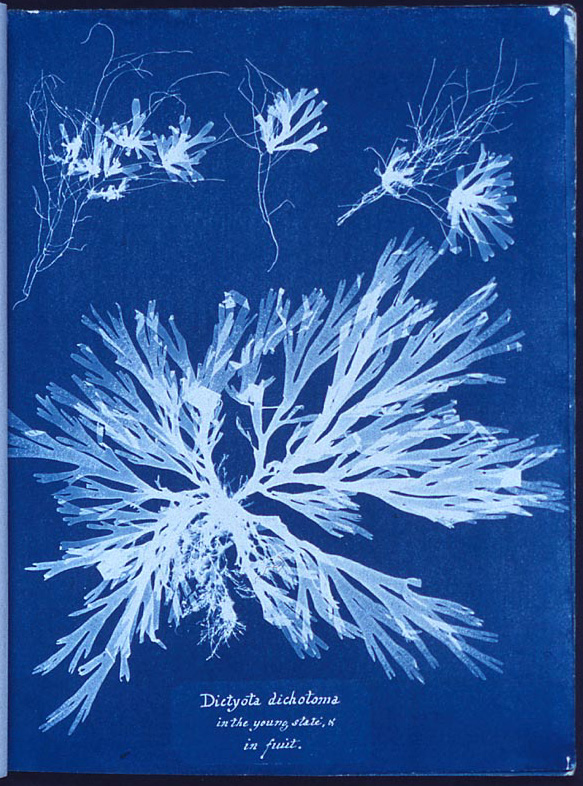


How it works and materials
The chemistry relies on two principal reagents, ammonium iron(III) citrate and potassium ferricyanide. When these solutions are mixed and coated onto paper, fabric or other porous supports, the coating becomes light-sensitive. Ultraviolet exposure reduces iron(III) to iron(II), which then reacts to produce an insoluble iron–cyan compound known as Prussian blue. The image develops and intensifies during washing in water; no conventional fixer is required.
Typical process steps
- Prepare or purchase a sensitizer and coat the chosen support in subdued light.
- Dry the coated support in the dark, then place a negative or objects directly on it.
- Expose to sunlight or a UV lamp until the image appears faintly.
- Rinse thoroughly in water to stop the reaction and remove unreacted chemicals; the blue color darkens as it oxidizes.
History and notable figures
The process was discovered in 1842 by the British scientist Sir John Herschel, who described its chemistry and potential uses; he is often cited in accounts of early photographic methods (Herschel). Shortly thereafter, botanist Anna Atkins adopted cyanotype to create detailed photograms of algae and plants, producing some of the first illustrated scientific books made with photographic images.
Applications and legacy
Engineers and architects widely used cyanotypes for producing working copies of technical drawings in the 19th and early 20th centuries; these copies became known colloquially as blueprints (term origins and usage). Because cyanotypes are inexpensive, stable when properly washed, and straightforward to make, they experienced a revival among contemporary artists and educators who value tactile, analogue photographic techniques.
Distinguishing features and cautions
Cyanotype prints are contact prints and therefore match the size of the negative or object. The process tolerates many papers and textiles and can be altered by toning or chemical post-treatments to shift hue. While the core chemicals are not highly volatile, standard laboratory precautions apply: avoid ingestion, prevent acidification that can release hazardous cyanide species, and dispose of waste responsibly.
For practical demonstrations, community darkrooms and workshops often provide safe, tested recipes and demonstrations suitable for beginners and experienced practitioners alike.
Questions and answers
Q: What is cyanotype?
A: Cyanotype is a photographic printing process that produces blue prints.
Q: Who discovered the cyanotype process?
A: John Herschel discovered the cyanotype process in 1842.
Q: What were engineers using the cyanotype process for in the 20th century?
A: Engineers used the cyanotype process to produce copies of drawings, referred to as blueprints.
Q: What are the two chemicals used in the cyanotype process?
A: The two chemicals used in the cyanotype process are ammonium iron(III) citrate and potassium ferricyanide.
Q: Why was the cyanotype process popular among engineers?
A: The cyanotype process was popular among engineers because it was a simple and low-cost process to produce copies of drawings.
Q: When was the cyanotype process discovered?
A: The cyanotype process was discovered in 1842.
Q: What color do cyanotype prints produce?
A: Cyanotype prints produce blue prints.
Related articles
Author
AlegsaOnline.com Cyanotype: the historical blue photographic printing process Leandro Alegsa
URL: https://en.alegsaonline.com/art/24840