
Aardwolf (Proteles cristata): the termite-eating hyena
Small nocturnal African carnivore in the hyena family that feeds mainly on termites. Notable for its long sticky tongue, burrowing habits, strong scent-marking and generally solitary or pair-based social structure.
Overview
The aardwolf (Proteles cristata) is a small, insectivorous mammal in the family Hyaenidae. Its common name derives from Afrikaans and Dutch terms meaning "earth wolf" and reflects its ground-oriented, often secretive behaviour; alternative names include the maanhaar jackal and civet hyena, the latter referring to pungent anal-gland secretions used in scent-marking. It is native to regions of East Africa and southern Africa and occupies an ecological niche distinct from the larger, bone-crushing hyenas of the same family. The aardwolf is a member of the order Carnivora but has specialized away from hunting large vertebrate prey.
Image gallery
10 Images
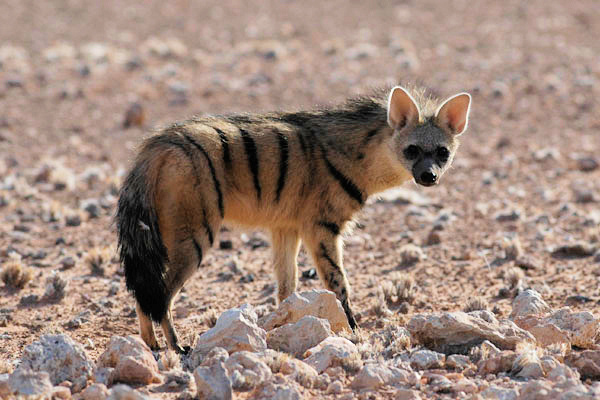


Physical characteristics and adaptations
Aardwolves are generally slender, with a coarse, yellowish coat streaked with dark vertical stripes and a noticeable mane along the back that can be erected when the animal is alarmed or displaying. They have relatively weak jaws and reduced, pointed cheek teeth adapted for an insectivorous diet rather than the powerful crushing dentition seen in other hyaenids. Aardwolves rely heavily on olfaction to locate food and use a long, sticky tongue and rapid licking movements to harvest termites without breaking open large numbers of mounds. Their anal glands and interdigital scent glands produce strong-smelling secretions that are used extensively in communication.
Habitat and distribution
The species inhabits open, dry habitats such as scrublands, grassland and lightly wooded areas where suitable termite prey is abundant. Its range extends across parts of eastern and southern Africa; within these regions it selects areas with high concentrations of the termite species it prefers. During the day the aardwolf rests in underground dens and burrows, often occupying or reusing burrow systems made by other animals. These shelters provide protection from heat, predators and disturbance, and are central places for rearing young.
Diet and foraging behaviour
Unlike most other hyaenids, the aardwolf feeds almost entirely on insects, especially certain species of termites. Foraging is predominantly nocturnal: the animal moves slowly and methodically across its territory, licking up termites with its tongue rather than excavating large numbers of nests. Individual aardwolves can consume very large numbers of termites in a single night (popular summaries often cite figures in the hundreds of thousands), a rate supported by rapid tongue action, specialized dentition and digestive adaptations for processing small, chitinous prey. They may take other invertebrates opportunistically but are not regular predators of vertebrate prey.
Social organisation, reproduction and communication
Aardwolves are largely nocturnal and are usually solitary or occur as monogamous pairs; pairs may share and defend a common territory and a network of dens. Reproduction is seasonal in many parts of the range, and both sexes use scent-marking—via anal gland secretions and urine—to advertise territory boundaries and reproductive condition. The mane and vocal displays can be used in threat displays or to deter intruders. Females give birth in a den, where pups are protected and suckled until they are old enough to accompany adults on foraging trips; juveniles remain dependent for several weeks to months before achieving full independence.
Taxonomy and relationships
Taxonomically the aardwolf is classified within Hyaenidae but stands apart from the larger scavenging or bone-crushing hyenas because of its insectivorous adaptations and different skull and dental structure. It is often treated as the sole living species in the genus Proteles and is the only true insectivore among extant hyaenids, illustrating the diversity of feeding strategies within the family. Comparative studies and regional species accounts provide context for its evolutionary and ecological distinctiveness (species profiles).
Conservation and interactions with people
Across much of its range the aardwolf is not considered among the most threatened African carnivores and can be locally common where habitat and termite prey are intact; conservation assessments generally treat it as relatively secure compared with many other species. Nevertheless, localized declines occur where natural habitat is converted, where termite populations are reduced through pesticide use or land management, or where individuals are persecuted because they are mistakenly regarded as pests. Conservation measures emphasise habitat protection, maintaining prey populations and reducing unnecessary killing near agricultural areas. Human-wildlife conflict over aardwolves is generally low because they do not normally attack livestock.
- Scientific name: Proteles cristata; family Hyaenidae.
- Primary diet: specialized termite-feeder rather than a predator of large mammals.
- Behaviour: nocturnal, burrow-using, strongly scent-marking and often solitary or in pairs.
Further background and regional information can be found in language and cultural notes (Afrikaans name origins, Dutch etymology), general mammal guides (mammal studies), ecological summaries of insectivory and territorial behaviour, and habitat or range accounts (scrublands and grasslands, East and southern Africa). For practical notes on burrow ecology and den use see resources on subterranean shelters (burrows) and for comparisons with other carnivores consult works on the order Carnivora. Human conflicts and conservation priorities are discussed in regional reports addressing threats such as habitat loss and prey availability (human-wildlife conflict, prey dynamics), while functional studies cover feeding mechanics and tongue adaptations (tongue function).
Questions and answers
Q: What is an aardwolf?
A: An aardwolf is a small, insectivorous mammal native to East Africa and Southern Africa.
Q: What does the name "aardwolf" mean?
A: The name "aardwolf" means "earth wolf" in the Afrikaans / Dutch language.
Q: What is another name for the aardwolf?
A: The aardwolf is also called "maanhaar jackal" in Afrikaans or civet hyena based on the secretions (civet) from their anal glands.
Q: What does the aardwolf eat?
A: The aardwolf eats insects, mainly termites.
Q: How many termites can an aardwolf eat in a single night?
A: One aardwolf can eat about 250,000 termites during a single night by using its long, sticky tongue to capture them.
Q: Where does the aardwolf live?
A: The aardwolf lives in the scrublands of eastern and southern Africa – these are open lands covered with stunted trees and shrubs.
Q: What is the behavior of the aardwolf?
A: The aardwolf is nocturnal, resting in burrows during the day and coming out at night to eat. Anal gland scent-marking plays an important role in mating-season in both sexes as it is the primarily communication method.
Related articles
Author
AlegsaOnline.com Aardwolf (Proteles cristata): the termite-eating hyena Leandro Alegsa
URL: https://en.alegsaonline.com/art/248