
Cudjoe Key: Lower Florida Keys community and site of military aerostat operations
Cudjoe Key is a small Lower Florida Keys community in Monroe County, known for its island setting and a longtime military aerostat site used for radar and law‑enforcement surveillance.
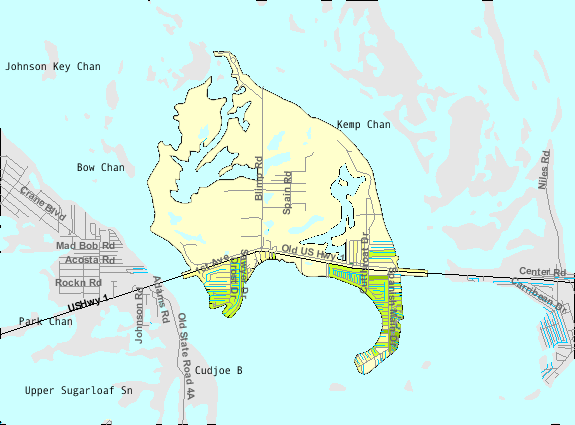
Cudjoe Key is a census community located in Monroe County, Florida. The community occupies an island of the same name in the lower Florida Keys. According to the 2000 census, the census-designated place had a population of 1,695. The area is officially classified as a census-designated place.
Image gallery
2 Images
Early name
Before it acquired its present name, the island was known as Littleton Island.
Military facility and aerostat operations
In 1959 the United States Army established what became known as Cudjoe Key Air Force Station to assist tracking of missiles passing through the Eglin Gulf Test Range. The following year responsibility for the site was transferred to the Air Force. Later the station operated as a detached installation of Homestead Joint Air Reserve Base.
The installation operates a white radar aerostat, a tethered balloon that local residents often call "Fat Albert." That aerostat has been employed in counter-drug surveillance and other law-enforcement support missions for agencies such as the Drug Enforcement Administration. Pilots are cautioned about the aerostat on aeronautical charts; the restricted area includes the notice, "Caution: Unmarked balloon on cable to 14,000 [feet]." On April 20, 2007 a small aircraft, a Cessna 182, collided with the tether for the aerostat after its left wing struck the cable, resulting in a crash.
Name and possible origins
One explanation for the name links it to the native Joewood tree (Jacquinia keyensis), a plant sometimes called cudjoewood. An alternative origin proposed by writer John Viele of Summerland Key suggests the name derives from the West African personal name Cudjoe; Viele contends that a fugitive or free Black person bearing that name may have lived on the island prior to Gerdes' survey of 1849. The term West African appears in discussions of this theory.
Questions and answers
Q: What is Cudjoe Key?
A: Cudjoe Key is a census-designated place in Monroe County, Florida. It is on an island of the same name in the lower Florida Keys.
Q: When was Cudjoe Key Air Force Station activated?
A: The United States Army activated Cudjoe Key Air Force Station in 1959.
Q: What purpose does "Fat Albert" serve?
A: "Fat Albert" is a white radar aerostat that is used for drug interdiction missions by the Drug Enforcement Administration.
Q: What happened to "Fat Albert" on April 20, 2007?
A: On April 20, 2007 a Cessna 182 crashed after its left wing struck the tether anchoring "Fat Albert".
Q: How is "Fat Albert" marked on air navigation charts?
A: On air navigation charts, "Fat Albert" is marked inside a restricted area with the warning, "Caution: Unmarked balloon on cable to 14,000 [feet]."
Q: Where did the name “Cudjoe” come from?
A: It is possibly named after the Joewood tree (Jacquinia keyensis), a native species also known as cudjoewood. However writer John Viele of Summerland Key believes that Cudjoe was the name of a fugitive slave or free negro who lived on the island at some point before Gerdes' survey in 1849.
Related articles
Author
AlegsaOnline.com Cudjoe Key: Lower Florida Keys community and site of military aerostat operations Leandro Alegsa
URL: https://en.alegsaonline.com/art/24547
Sources
- factfinder.census.gov : "American FactFinder"
- geonames.usgs.gov : "US Board on Geographic Names"
- radomes.org : "History of Cudjoe Key AFS, FL"
- books.google.com : Air Force Bases
- keys.fiu.edu : keys.fiu.edu/gazetteer/00000216.htm
- census.gov : "US Gazetteer files: 2000 and 1990"