
Cthulhu: fictional cosmic entity created by H. P. Lovecraft
Cthulhu is a fictional cosmic entity introduced by H. P. Lovecraft. It appears in Weird Fiction as a vast, otherworldly being associated with the submerged city R'lyeh and a cult of human worshippers.
Overview
Cthulhu is a fictional being invented by writer H. P. Lovecraft and first introduced in his short story "The Call of Cthulhu." Described as one of the Great Old Ones, Cthulhu is presented as an immensely powerful, nonhuman intelligence that predates humanity. Within Lovecraft's stories and later pastiches by other writers, Cthulhu functions less as a moral agent and more as an indifferent cosmic presence whose existence undermines human assumptions about the universe.
Image gallery
4 Images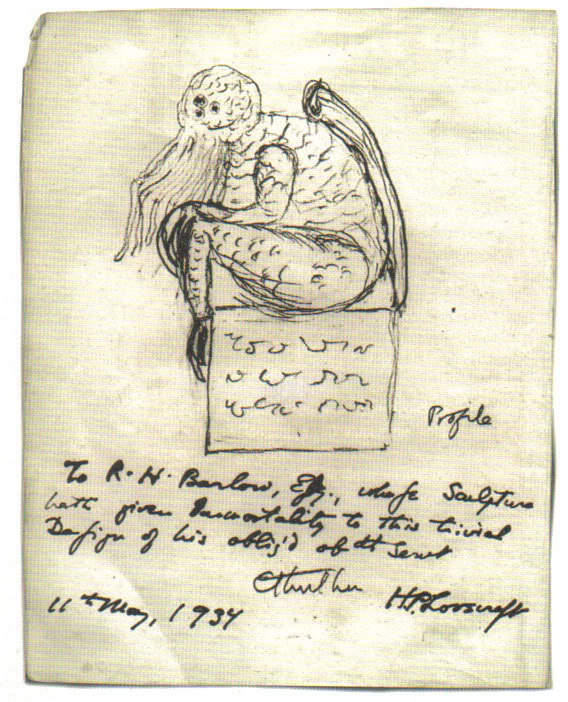



Appearance and characteristics
Accounts of Cthulhu emphasize an alien, composite morphology. It is commonly portrayed as enormous and vaguely anthropoid, with a head resembling an octopus or squid, multiple facial appendages, a mass of tentacles, a scaly or rubbery body, great wings or fins, and humanlike claws or hands. Witnesses in the fiction often experience profound terror and mental disturbance on seeing it. The creature is sometimes treated as agender or beyond human categories of sex and gender rather than strictly male or female.
- Form: cephalopod-like head, clawed limbs, wings or fins.
- Scale: immense compared with humans; often city-spanning in depiction.
- Mental effects: drives mortals to madness or profound dread.
- Alignment: amoral and indifferent rather than explicitly evil.
Origins and literary history
H. P. Lovecraft created Cthulhu in the early 20th century as part of a broader cycle of tales that later critics and fans grouped as the Cthulhu Mythos. The best-known narrative featuring the creature is "The Call of Cthulhu," in which the being is said to lie dormant beneath the sea in the sunken city of R'lyeh. Lovecraft's work was collaborative in spirit: he encouraged other writers to expand on his concepts, and subsequent authors, game designers, filmmakers, and visual artists have elaborated the Cthulhu figure and its associated lore.
For more on the author and his work see H. P. Lovecraft. For introductions to the idea of a fictional deity in modern literature see studies of invented gods.
Role in the mythos and cultic worship
Within the fictional mythos, Cthulhu belongs to a category of ancient, powerful entities who arrived on Earth in a prehistory now almost wholly obliterated from human memory. These beings are sometimes called the Great Old Ones or Old Ones and are depicted as sleeping, imprisoned, or banished, awaiting a time when cosmic conditions will allow their return. A recurring element is the presence of small, secretive human cults and degenerate sects that revere Cthulhu, practice rituals to hasten its awakening, or preserve forbidden knowledge about its nature.
References to mind-influencing powers and cultic devotion feature in summaries of the mythos; see discussions of psychological horror and cosmicism in speculative fiction here.
Notable appearances and adaptations
The central story is "The Call of Cthulhu," which locates the sunken city of R'lyeh somewhere in the southern Pacific Ocean and describes the creature's dreamlike imprisonment there. Later adaptations and homages have placed Cthulhu in novels, role-playing games, films, music, comics, and art. The creature has also become a cultural shorthand for incomprehensible, ancient cosmic horror and has been referenced or parodied in diverse media. For works that expand on Lovecraft’s universe see fictional expansions and catalogs of adaptations at compilations of mythos fiction.
Interpretations and cultural impact
Scholars and critics interpret Cthulhu and related stories variously: as expressions of cosmic pessimism, as metaphors for humankind's insignificance, as explorations of forbidden knowledge, or as aesthetic exercises in the depiction of the uncanny. The figure’s image—a tentacled, sleeping god—has become iconic in popular culture. It functions both as a source of genuine horror in some works and as a kitsch or satirical emblem in others. Fans and commentators often debate the creature's nature: whether it is extraterrestrial, extradimensional, or symbolic of natural forces indifferent to human concerns.
For resources on mythos scholarship and cultural reception, see critical studies, annotated editions and collections at bibliographic resources, and compilations of multimedia adaptations here. Discussions of gendered language and portrayal of nonhuman entities are gathered at related critiques.
Distinctions and notable facts
Cthulhu is fictional and part of an invented mythos, yet its influence on horror and speculative fiction is disproportionate to the single story in which it first appears. The concept of an ancient, sleeping cosmic being who affects human minds has been reused and reinterpreted across genres. The sunken city of R'lyeh and the phrase "when the stars are right" have become recurring motifs signaling a threatened return of incomprehensible powers.
Because of its broad cultural penetration, Cthulhu is used today in both serious critique and playful pastiche, and it serves as a convenient emblem for the genre of cosmic horror more generally.
Questions and answers
Q: Who is Cthulhu?
A: Cthulhu is a fictional deity created by the horror writer H. P. Lovecraft.
Q: What does Cthulhu look like?
A: Cthulhu has the alien appearance of a large green dragon with the head of an octopus and human-like hands.
Q: What is the origin of Cthulhu?
A: Cthulhu is a powerful monster from another planet, and it has been around since the time of the dinosaurs.
Q: Why do some people worship Cthulhu?
A: There are said to be many people who worship Cthulhu as their deity because of their powers over the mind.
Q: What is the goal of Cthulhu and the other Great Old Ones?
A: The Great Old Ones, including Cthulhu, want to rise up and destroy the human race so they can rule the planet.
Q: Where is Cthulhu currently located?
A: According to Lovecraft's story "The Call of Cthulhu," Cthulhu currently lies in a dreamlike state in the underwater sunken city of R'lyeh (rill-ee-yeh), located in the southern Pacific Ocean.
Q: What happens to humans who see the Great Old Ones?
A: It is said that any human who so much as gazes upon one of the Great Old Ones will go insane because their appearance is so unlike anything of this world.
Related articles
Author
AlegsaOnline.com Cthulhu: fictional cosmic entity created by H. P. Lovecraft Leandro Alegsa
URL: https://en.alegsaonline.com/art/24494