
Cross-country race (cross-country running)
A running competition held over natural and mixed terrain. Covers course types, typical distances by age/level, team scoring, tactics, equipment, history and common event formats.
A cross-country race is a form of running competition conducted across natural and mixed surfaces rather than on a track. Courses commonly include grass, dirt, gravel, forest trails, fields and short paved sections; these varied surfaces are often described as varied terrain. Cross-country tests endurance, strength, footwork and the ability to adapt to changing footing and weather. Competitions range from short, fast loops to long, hilly courses that reward tactical skill as much as raw speed.
Image gallery
10 Images

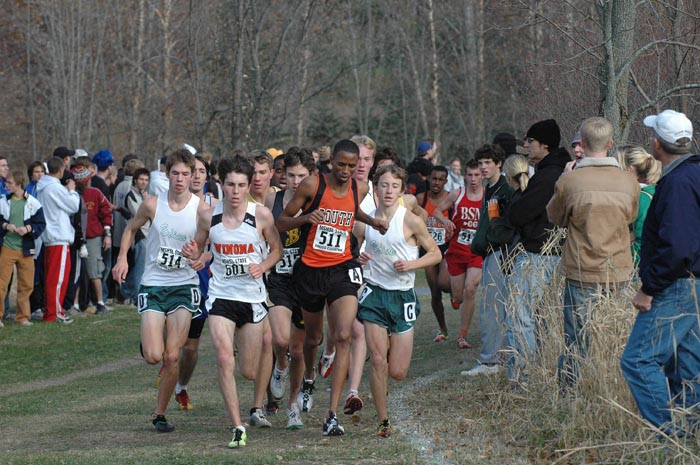


Typical distances and levels
Event distances and formats differ by age, sex and organizing body. Different levels of competition use standard lengths so athletes compete on comparable courses. Common examples include:
- Middle school races often cover approximately 2 miles (3.2 km).
- High school competitions frequently use a 5 km distance, though regional variations exist.
- Collegiate programmes stage races that may be 6–10 km for women and 8–10 km for men in many countries; formats depend on the governing body and season.
- Outside scholastic athletics, amateur clubs and organised events host a wide range of distances, while professional championships and international fixtures often use standard championship formats.
Course characteristics and environmental effects
Courses are usually loops or point-to-point routes that include natural obstacles such as hills, stream crossings and muddy sections. Organisers mark routes to keep runners on course and assess difficulty by length, cumulative elevation change and footing quality. Race-day conditions—especially weather—can dramatically change how a course runs: soft or frozen ground, wind and precipitation affect traction, pacing and equipment choices, so finishing times should be interpreted in context.
Competition structure and scoring
Many meets combine individual and team competitions. Team scoring typically assigns points equal to finishing positions (first place = one point, second = two points, etc.). A team’s score is the sum of a preset number of its top finishers; the team with the lowest score wins. Event officials provide standard rules for scoring, tie-breaking and the number of scoring runners. Local meets and championships may adopt slight variations but follow the same basic principle.
Tactics and racecraft
Successful cross-country running blends individual pacing and team strategy. Runners may form packs to control tempo, use surges on hills to break opponents, or adopt conservative starts to conserve energy for a strong finish. Team tactics sometimes involve protecting scoring positions and using sentry runners to displace rival scorers. Course reconnaissance and adapting to conditions are integral to pre-race planning.
Equipment, training and safety
Gear tends to be minimal: lightweight spikes or trail shoes chosen for traction, and clothing suited to the temperature and precipitation. Training emphasises aerobic endurance, hill repeats, strength work and runs on terrain similar to race conditions. Safety considerations include proper course marking, medical support at larger events, and awareness of hypothermia or heat-related illness in extreme conditions. Organisers also consider fairness and accessibility by setting clear rules on footwear and course assistance.
History, culture and major events
Cross-country has roots in informal running games and 19th-century school activities such as "hare and hounds" that evolved into organised competition. It remains a popular developmental discipline for distance runners at youth, collegiate and club levels. Major international and national championships, while varying in format, preserve the sport’s emphasis on adaptability and community participation. Local clubs, school teams and recreational events keep cross-country widely accessible as a low-cost way to race in natural settings.
For further details on rules, event calendars and training resources, readers can consult governing bodies and community clubs that publish guidance and calendars for races at all levels.
More about running competitions · Terrain considerations · Competition levels · Middle school events · Two-mile races · Metric equivalents · High school cross-country · Collegiate formats · Amateur clubs · Professional events · Scoring systems · Meet organisation · Weather and conditions
Questions and answers
Q: What is a cross-country race?
A: It is a running race that takes place on different types of terrain.
Q: What are the different levels of competition in cross-country racing?
A: The different levels of competition include middle school 2 mi (3.2 km), high school 5 km (3.1 mi), collegiate men 8 km (5.0 mi) and 10 km (6.2 mi), women 5 km (3.1 mi) and 6 km (3.7 mi), amateur, and professional.
Q: How is the scoring done in cross-country races?
A: The scoring gives one point to the winner, two points to the person who finished second, and so on. The team with the lowest score wins.
Q: How is the score calculated in an invitational or meet?
A: In an invitational or meet, the teams of runners count up the points of their top five finishers. This is their score.
Q: What happens if there is a tie in the score?
A: If there is a tie, the team with the fastest sixth man wins.
Q: What factors can affect the times in cross-country races?
A: Times in races depend on the terrain, weather, and the other runners.
Q: Can two athletes from different parts of the world who run the same time be at the same ability level?
A: No, because the terrain, weather, and the other runners can affect the times in races, athletes from different parts of the world who run the same time might not be at the same ability level.
Related articles
Author
AlegsaOnline.com Cross-country race (cross-country running) Leandro Alegsa
URL: https://en.alegsaonline.com/art/24318