
Critérium du Dauphiné Libéré: French week-long professional cycling stage race
A prominent eight-stage professional road cycling race in the Dauphiné region of France, held in early June as a key preparation event for the Tour de France.
Overview
The Critérium du Dauphiné Libéré is a professional multi-stage road cycling race held annually in the Dauphiné area of southeastern France. Traditionally run in the first half of June, it is a week-long event that typically consists of eight stages combining flat, hilly and high-mountain terrain. The race is closely watched by riders, teams and commentators as a final major test ahead of the Tour de France: it offers a chance for general classification contenders and climbing specialists to measure form against rivals on many of the same types of climbs used in July's Grand Tour. For the race type and basic format see criterium (race).
Image gallery
3 Images

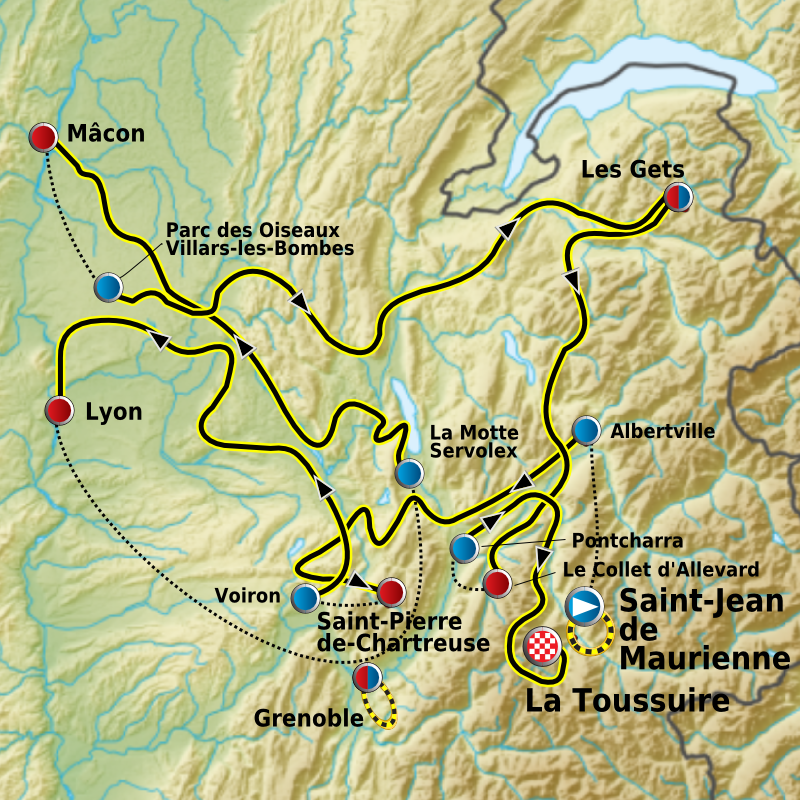
Characteristics and route
The Dauphiné region's varied topography shapes the race: stages often move through Alpine foothills and high mountain passes, with individual time trials and rolling stages mixed in. Organizers select a route that frequently includes iconic ascents that also feature in the Tour de France, such as Mont Ventoux and other notable cols. The combination of summit finishes, mountaintop time trials and transitional stages makes the race a comprehensive examination of a rider's climbing, endurance and time-trialling abilities.
- Typical length: approximately eight stages over a week.
- Terrain: flat approaches, hilly middle stages, and high Alpine climbs.
- Common features: summit finishes, long climbs, and at times an individual time trial.
History and organization
First organized in the years after World War II, the event was launched to promote regional sport and tourism and was closely associated with the regional newspaper that gave the race its name. The inaugural edition took place in 1947, with Polish rider Eduard Klablinski recorded as the first winner. Over the decades the race has evolved in length and profile but retained its status as an important stage race on the professional calendar. It has been run by regional organizers and media partners, and its timing makes it a natural precursor to the Tour de France.
Role and significance
Alongside the Tour de Suisse, the Dauphiné is regarded as one of the principal lead-up races for the Tour de France. Teams use it to finalize tactics, test climbing legs, and confirm equipment choices under race conditions. Because the course often includes high mountains, riders who excel in this event tend to be strong climbers and general classification hopefuls. It has served both as a proving ground for rising talents and as a tune-up for established Grand Tour contenders.
Notable winners and editions
Several riders who later achieved great success in Grand Tours have won the Dauphiné. Multiple-time winners include riders who dominated the event across different eras; among the names associated with three overall wins are Luis Ocaña and Bernard Hinault, reflecting the race's attraction to top stage racers. Specific memorable editions include a rapid ascent of Mont Ventoux by Iban Mayo in 2004 and Iñigo Landaluze's overall victory in 2005, both of which remain part of the race's recent history.
Distinctions and notable facts
The Dauphiné's mountainous profile means it is often won by climbing specialists and stage-race leaders. Historically, riders who have had sustained success in Grand Tours have also performed well here, reinforcing the event's reputation as a benchmark for Tour de France readiness. As with any long-running race, the event's route and organization have changed over time, but the underlying purpose—an elite multi-day contest through the Dauphiné's demanding terrain—remains the same.
For more on the event's context within professional road cycling see a general description of a road race, the geographical setting of the Dauphiné region, and the relationship to the Tour de France. Additional historical details and archives are available through specialized cycling resources and regional sports records.
Questions and answers
Q: What is the Critérium du Dauphiné Libéré?
A: The Critérium du Dauphiné Libéré is an annual cycling road race that takes place over eight stages in the Dauphiné region in France during the first half of June.
Q: Who organizes the Critérium du Dauphiné Libéré?
A: The Le Dauphiné Libéré newspaper organizes the Critérium du Dauphiné Libéré.
Q: Why is the Critérium du Dauphiné Libéré an important race?
A: The Critérium du Dauphiné Libéré is an important race because it is one of the lead-up races to the Tour de France in July.
Q: What kind of terrain does the Critérium du Dauphiné Libéré cover?
A: The Critérium du Dauphiné Libéré covers mountainous areas in the Dauphiné region of France.
Q: Who are the winners of the Critérium du Dauphiné Libéré usually?
A: The winners of the Critérium du Dauphiné Libéré are often climbing specialists because of the mountainous terrain.
Q: What are some famous climbs that appear in the Critérium du Dauphiné Libéré?
A: The Mont Ventoux, the Col du Galibier, and Col de la Chartreuse are some famous climbs that appear often in the Critérium du Dauphiné Libéré.
Q: Who are some notable winners of the Critérium du Dauphiné Libéré?
A: Nello Lauredi, Luis Ocaña, Charly Mottet, and Bernard Hinault share the record of the most wins, with three each. Iban Mayo won in 2004, and Iñigo Landaluze won in 2005.
Related articles
Author
AlegsaOnline.com Critérium du Dauphiné Libéré: French week-long professional cycling stage race Leandro Alegsa
URL: https://en.alegsaonline.com/art/24229