
Cricket (insect)
Crickets (family Gryllidae) are nocturnal orthopterans known for their chirping songs, long antennae, and jumping hind legs; they play key roles in ecosystems and are distinct from grasshoppers and katydids.
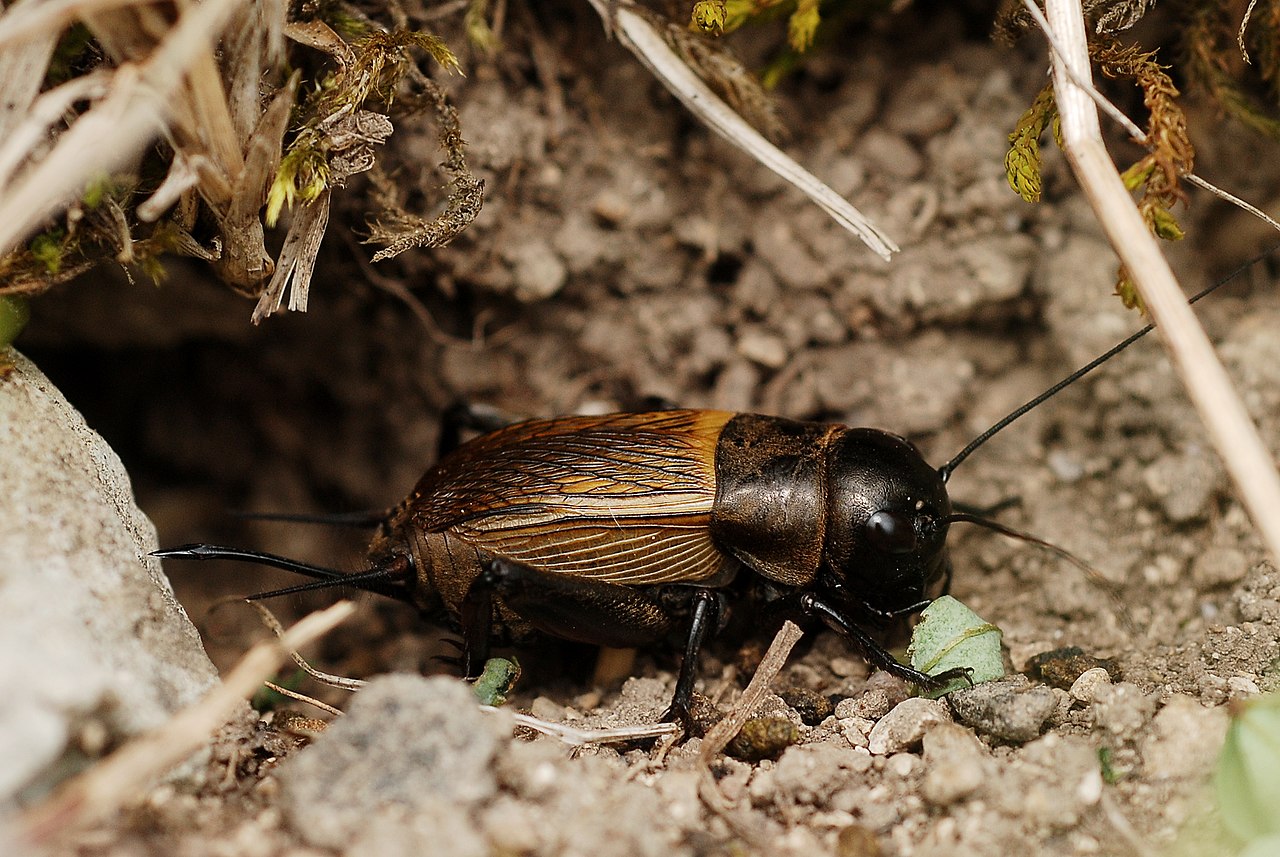
Crickets are members of the family Gryllidae, a group of insects commonly called true crickets. They are more closely related to katydids than to grasshoppers, though all belong to the order Orthoptera. Crickets typically have a somewhat flattened body, powerful hind legs for jumping, and very long antennae. Worldwide there are about 900 species, occupying habitats from grasslands and forests to caves, human dwellings and agricultural areas.
Image gallery
6 Images


Characteristics
Most crickets are nocturnal and are best known for the males' chirping, produced by rubbing specialized parts of the forewings together in a process called stridulation. They have tympanal organs for hearing (often on the front legs) and varied wing shapes: some species fly, others are wingless. Coloration ranges from pale browns to black, and many species show sexual dimorphism, with females often bearing an ovipositor for laying eggs.
Biology and behavior
- Diet: omnivorous—feeding on plants, fungi, small invertebrates and decaying matter.
- Life cycle: egg → multiple nymphal stages → adult, with incomplete metamorphosis.
- Communication: songs serve to attract mates and mark territory; chirp rate often increases with temperature (Dolbear's observation).
History, distribution and diversity
Crickets have a long evolutionary history within Orthoptera and are distributed across most temperate and tropical regions. Different lineages adapted to diverse niches: tree-dwelling species, ground burrowers and species specialized for life in caves. Common names such as field cricket or house cricket refer to ecology rather than strict taxonomy.
Uses, ecology and cultural significance
Ecologically, crickets act as decomposers and as prey for birds, reptiles and mammals, linking plant material and detritus to higher trophic levels. Humans use crickets as pet food, in scientific study of behavior and bioacoustics, and in some cultures as food. They appear in literature, folklore and music as symbols of night, luck or domestic life.
Distinctions and notable facts
Although often confused with grasshoppers, crickets usually have longer antennae and differ in ear placement and wing structure. Compared with katydids, crickets tend to be more ground-oriented and have different song patterns. For further reading on classification and species lists, see resources indexed under Gryllidae and regional faunas (antenna morphology, species catalogues).
Questions and answers
Q: How many species of crickets are there?
A: There are about 900 species of crickets.
Q: What family do crickets belong to?
A: Crickets belong to the family Gryllidae.
Q: What are crickets related to?
A: Crickets are related to grasshoppers and katydids or bush crickets (family Tettigoniidae).
Q: What kind of body structure do crickets have?
A: Crickets have somewhat flattened bodies and long antennae.
Q: Are crickets nocturnal?
A: Yes, crickets tend to be nocturnal.
Q: What are crickets often confused with?
A: Crickets are often confused with grasshoppers because they have a similar body structure including jumping hind legs.
Q: How are crickets different from katydids or bush crickets?
A: Crickets are more closely related to katydids or bush crickets (family Tettigoniidae) than to grasshoppers, but they belong to a different family (Gryllidae).
Related articles
Author
AlegsaOnline.com Cricket (insect) Leandro Alegsa
URL: https://en.alegsaonline.com/art/24175
Sources
- bbc.co.uk : bbc.co.uk
- pnas.org : pnas.org/content/early/2012/02/02/1118372109