
Coventry Cathedral (St Michael's): history, architecture and legacy
St Michael's Cathedral in Coventry is the Anglican seat known for its ruined medieval predecessor, a modern 20th‑century replacement, and a global reconciliation ministry symbolized by the Cross of Nails.
Coventry Cathedral, commonly called St Michael's, is the Anglican cathedral serving the city of Coventry in the English West Midlands. The site and institution combine medieval history, dramatic wartime destruction and a striking example of 20th‑century church architecture. The cathedral is the seat of the Bishop of Coventry and remains an active centre for worship, civic events and international reconciliation.
Image gallery
10 Images


Three cathedrals on one site
The city of Coventry is unusual in having three successive cathedral buildings associated with its name. The earliest, St Mary’s, was a medieval monastic foundation of which only fragmentary ruins survive. The second, a large 14th‑century Gothic church dedicated to St Michael, became the city’s cathedral and stood until the Second World War. On the night of 14 November 1940 much of central Coventry, including the medieval St Michael’s, was destroyed in a heavy aerial bombardment by the German Luftwaffe; the shell of the ruined cathedral was deliberately retained as a war memorial.
Modern replacement and design
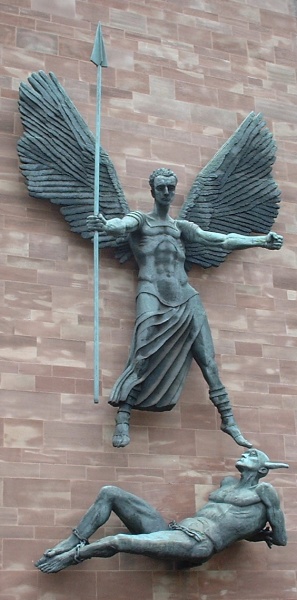
Adjacent to the ruined nave stands the third St Michael’s, a new cathedral built in the mid‑20th century to replace the bombed building. Designed as a modernist composition, the replacement juxtaposes the preserved ruins with a contemporary worship space, giving a visible dialogue between loss and renewal. The new cathedral is noted for its bold use of materials, large-scale modern artworks and stained glass, and for integrating memorial and liturgical functions in a single complex. It was completed and brought into use in the early 1960s.
Among the cathedral’s notable interior features is a major tapestry and other commissioned works intended to express themes of reconciliation and hope. The ruined west end, left as a roofless memorial, contains inscriptions and commemorations to those who died in the bombing and serves as a continuing reminder of the cost of war.
Beyond its architectural significance, Coventry Cathedral is internationally known for the Cross of Nails. Nails salvaged from the ruins were forged into a simple cross, which became the symbol of a reconciliation movement that spreads links with churches and communities around the world. The cathedral’s outreach and peacebuilding work continues through partnerships, pilgrimages and events that emphasise reconciliation, restorative justice and remembrance.
Today the cathedral functions as a diocesan centre, a place of regular worship, and a venue for civic services, concerts and cultural programmes. Visitors come both to see the contrast of old and new and to participate in the cathedral’s programmes of reflection and public engagement. For more detailed information, history and visitor guidance see these resources:
- Official cathedral page
- Diocesan information
- City of Coventry tourism
- West Midlands regional guide
- England heritage overview
- Monastic history resources
- Accounts of the 1940 bombing
- Luftwaffe historical context
- World War II chronology
- Cross of Nails and reconciliation
- 20th century architecture studies
- Bishopric and governance
Questions and answers
Q: What is Coventry Cathedral?
A: Coventry Cathedral, also known as St. Michael's Cathedral, is an Anglican cathedral in Coventry, West Midlands, England.
Q: How many cathedrals does Coventry have?
A: Coventry has three cathedrals.
Q: What happened to the second cathedral?
A: The second cathedral, St. Michael's, was largely destroyed by a bombing raid in the Second World War.
Q: When was the cathedral bombed and by whom?
A: The cathedral was bombed on 14 November 1940 by the German Luftwaffe.
Q: What happened to the nails found in the ruins of the bombed cathedral?
A: The nails found in the ruins were formed into a cross and consecrated in the Kaiser Wilhelm Gedächtniskirche in Berlin.
Q: What is the third cathedral?
A: The third cathedral is the new St. Michael's Cathedral, built to replace the bombed cathedral.
Q: Who is the current Bishop of Coventry?
A: The current Bishop of Coventry is The Right Reverend Dr. Christopher Cocksworth. He is the 9th Bishop of Coventry.
Related articles
Author
AlegsaOnline.com Coventry Cathedral (St Michael's): history, architecture and legacy Leandro Alegsa
URL: https://en.alegsaonline.com/art/23688