
Count of Soissons (French noble title)
Historic French noble title borne by a cadet branch of the Bourbon family; holders were princes du sang with a distinctive court rank, an important Paris residence and an uncommon episode of female inheritance.
The title Count of Soissons (French: comte de Soissons) belonged to a high-ranking line of the French nobility during the monarchy. It designated both a territorial lordship and a hereditary dignitary associated with a cadet branch of the Bourbon dynasty. Holders combined landed interests, court standing as princes du sang (princes of the blood), and the social privileges that accompanied membership in the royal extended family.
Image gallery
4 Images
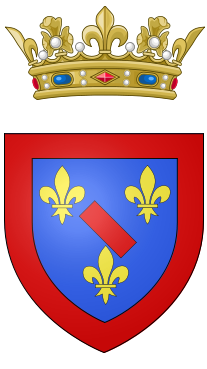


Origins and family connections
The Soissons title was established within the broader Bourbon kin-group and passed among members of that house. One early and influential holder was Charles de Bourbon, who founded the Soissons line; his close family ties connected the title to other prominent branches of the Bourbons. For example, a brother of Charles later became the first Prince of Conti — François de Bourbon — illustrating how multiple princely appanages circulated among the same extended family. The Soissons counts were therefore part of the network of princely houses that formed the higher strata of the French court.
Residence and patrimony
Like many great nobles, counts of Soissons maintained an urban residence in Paris known as the Hôtel de Soissons, a notable hôtel particulier of its time that served as a social and administrative base in the capital. The title also carried territorial associations with the region of Soissons and with estates and income typical of an early modern comital domain. The combination of rural lordship and an urban hôtel reflected the dual demands on aristocratic families: local authority and a permanent presence at court. Further information about the Paris residence is available through contemporary architectural and social studies of noble hôtels Hôtel de Soissons.
Rank, style and court practice
Counts of Soissons enjoyed the elevated status of princes du sang, which placed them within the circle of relatives qualified to take precedence at court and to claim certain honors reserved for the royal family. They were entitled in writing to the style "Serene Highness," though that form was most often used in formal documents rather than everyday speech. In court address the male holder was called "Monsieur le Comte" and his wife "Madame la Comtesse." Their rank gave them access to ceremonial roles, opportunities for patronage, and frequent participation in military and administrative offices typical of leading nobles.
Inheritance, notable characteristics and exceptions
Most French hereditary titles followed male-preference succession or the Salic principles that governed royal succession. The Soissons title is notable because, at one point in its history, it passed to a woman — an outcome that was exceptional under prevailing norms and therefore attracted attention. This episode highlights the variability of noble inheritance patterns, which could be affected by marital alliances, lack of male heirs, legal arrangements and royal dispensations.
- Typical forms of address: "Monsieur le Comte" (holder) and "Madame la Comtesse" (wife).
- Princely status: regarded as princes du sang with associated precedence and ceremonial rights.
- Urban seat: the famed Hôtel de Soissons served as an important Parisian residence and a locus of influence (Hôtel de Soissons).
- Family links: connected to other Bourbon appanages such as the Conti line; see François de Bourbon for a related figure.
Over time, like many noble titles, the comte de Soissons reflected changing patterns of power: its bearers engaged in military command, court service and landed administration, while marriages and inheritances tied the line into the broader political fabric of France. Today the title survives in historical records, heraldry and the urban memory of Parisian hôtels, and it provides a clear example of how princely rank, patrimony and royal kinship intersected in the ancien régime.
Questions and answers
Q: Who was the Count of Soissons?
A: The Count of Soissons was a member of the French court during the time of monarchy.
Q: What rank did the Count of Soissons hold?
A: The Count of Soissons held the rank of Prince of the blood, and as a result, was entitled to the style of Serene Highness, but this was used in writing only.
Q: What was the Hôtel de Soissons in Paris?
A: The Hôtel de Soissons was once a famous property owned by the Counts of Soissons in Paris.
Q: Was the inheritance of the title Count of Soissons unique?
A: Yes, the inheritance of the title Count of Soissons was unique in the sense that it was later inherited by a woman, which was actually forbidden in France at the time.
Q: Who was the founder of the Soissons line?
A: Charles de Bourbon, Count of Soissons was the founder of the Soissons line.
Q: How were the Counts of Soissons addressed at court?
A: The Counts of Soissons were addressed as "Monsieur le Comte" and their wives as "Madame la Comtesse" at court.
Q: Who were the members of the house of the Count of Soissons?
A: The members of the house of the Count of Soissons are not specified in the given text.
Related articles
Author
AlegsaOnline.com Count of Soissons (French noble title) Leandro Alegsa
URL: https://en.alegsaonline.com/art/23468