
Corwin Amendment (1861)
A proposed U.S. constitutional amendment passed by Congress in March 1861 to bar federal interference with state 'domestic institutions'—an effort to reassure slaveholding states that failed to prevent the Civil War.
Overview
The Corwin Amendment was a proposed modification to the United States Constitution that Congress approved on March 2, 1861 and submitted to the state legislatures for ratification. It was introduced in the House by Representative Thomas Corwin and in the Senate by Senator William H. Seward as part of a last-ditch political effort to avert further secession and civil conflict. Supporters described the proposal as a constitutional assurance protecting state "domestic institutions," while opponents viewed it as a federal endorsement of slavery. For the original proposal and related materials see primary text and the record of Congressional action.
Image gallery
2 Images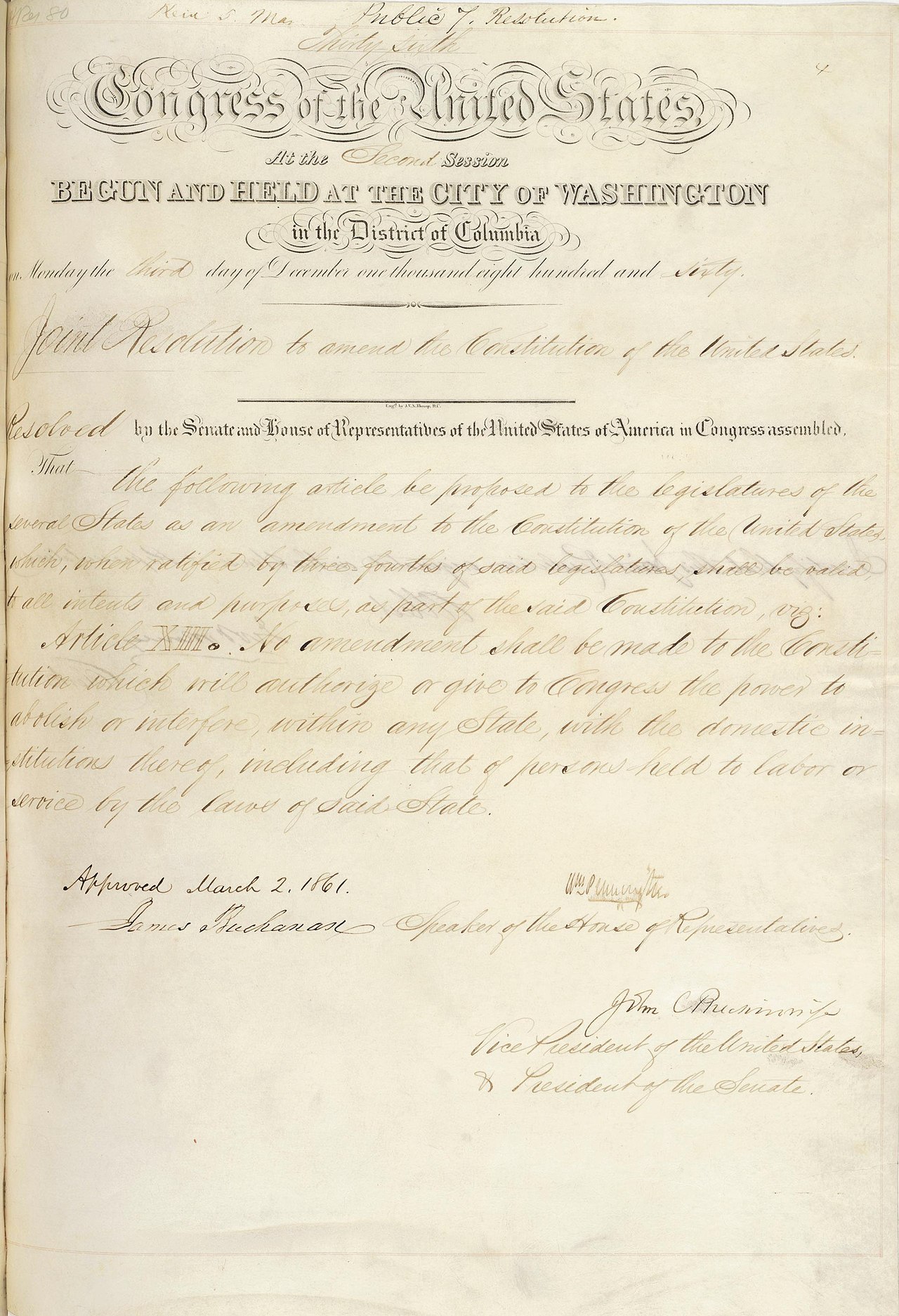
Text and intended effect
The amendment’s core idea was to prevent Congress from passing or enabling an amendment that would authorize federal power to abolish or otherwise interfere with a state's domestic institutions. In the political language of 1861 this phrase was understood to include slavery in slaveholding states. Advocates argued the change would offer a constitutional guarantee against future federal encroachment, while critics countered that it would constitutionally entrench an institution many in the North were trying to eliminate. Contemporary drafts and commentaries are summarized in draft archives and period analyses.
Historical context and passage
The Corwin Amendment emerged during a period of intense sectional tension. After Abraham Lincoln’s election in November 1860 several Southern states declared secession. In the months that followed, national leaders considered various measures—political compromises, proposed constitutional changes, and legislative proposals—aimed at reconciling differences and persuading border and undecided states to remain in the Union. The amendment passed both houses of Congress at the close of the Buchanan administration and immediately before Lincoln took office; it was one of these conciliatory measures intended to reassure Southern opinion. Records of its introduction and sponsors are available in the congressional and senatorial archives: Senate proceedings, sponsor statements, and state reactions.
Ratification status and later developments
The Corwin Amendment did not receive enough state ratifications to become part of the Constitution. A number of states considered or acted on the proposal, but the onset of the Civil War in April 1861 altered political priorities and made further ratification politically unlikely. Because Congress did not attach a deadline to the submission, the amendment technically remains pending before the state legislatures. In practical terms, subsequent events—most notably the Thirteenth Amendment (ratified in 1865), which abolished slavery—superseded the Corwin Amendment’s intended protections and rendered its original purpose moot. For the ratification history and timeline, consult ratification records, Civil War chronology, and the text and effect of the Thirteenth Amendment.
Significance and legacy
Today the Corwin Amendment is chiefly of historical and scholarly interest. It exemplifies the constitutional and political maneuvers attempted to manage sectional conflict on the eve of the Civil War and highlights how amendment proposals were used as tools of negotiation. Legal historians and constitutional scholars sometimes discuss the amendment in counterfactual terms—asking how the nation’s legal landscape might have differed had different compromises prevailed—but it has no operative legal effect. Useful collections of documents and modern commentary can be found in archival material, contemporary press accounts, and scholarly studies.
Key points
- Passed by Congress on March 2, 1861 and submitted for state ratification; it was introduced in the House by Thomas Corwin and in the Senate by William Seward. See Congressional action.
- Its purpose was to prohibit federal amendment or interference with state "domestic institutions," a phrase then commonly applied to slavery. For contemporary explanations see period commentary.
- The proposal was never adopted by the requisite number of states; it remains technically pending but was made effectively irrelevant by the outcome of the Civil War and later constitutional amendments.
Questions and answers
Q: What is the Corwin Amendment?
A: The Corwin Amendment is a proposed amendment to the United States Constitution that was passed by Congress on March 2, 1861 and sent to the state legislatures for ratification.
Q: Who introduced it in the Senate?
A: Senator William H. Seward of New York introduced the amendment in the Senate.
Q: Who introduced it in the House of Representatives?
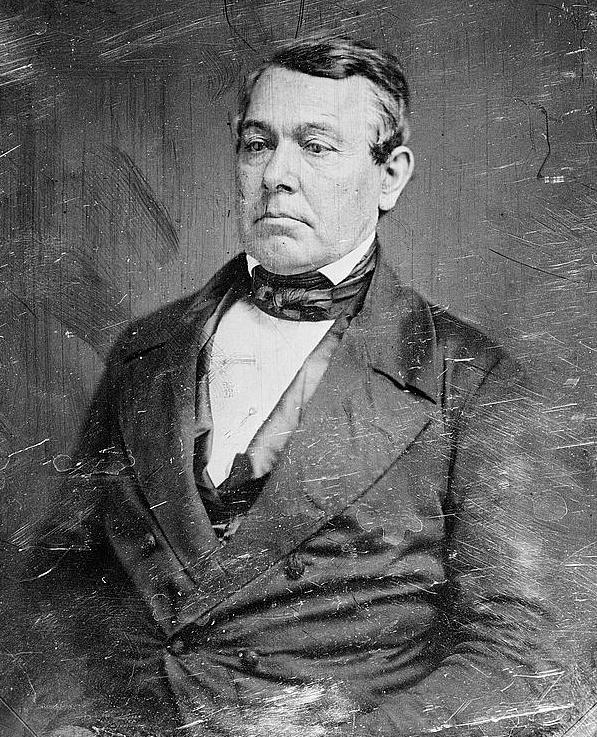
A: Representative Thomas Corwin of Ohio introduced it in the House of Representatives.
Q: What was its purpose?
A: Its purpose was to attract seceding states back into the Union and to convince border slave states to stay.
Q: How would it be ratified?
A: It would be ratified by state legislatures if approved by them.
Q: What would it protect if ratified?
A: If ratified, it would shield "domestic institutions" of each state (which included slavery at that time) from constitutional amendment process and from interference by Congress.
Q: Is this amendment still pending before any states today?
A: Yes, technically this amendment is still pending before any states today.
Related articles
Author
AlegsaOnline.com Corwin Amendment (1861) Leandro Alegsa
URL: https://en.alegsaonline.com/art/23280
Sources
- ghostamendment.com : "Ghost Amendment: The Thirteenth Amendment That Never Was"
- house.gov : "Constitutional Amendments Not Ratified"
- mgaleg.maryland.gov : "Rescission of Maryland's Ratification of the Corwin Amendment to the United States Constitution"
- progress.org : "Slavery: Just a "Detail"?"
- law.umkc.edu : "What in the Constitution Cannot be Amended?"
- iconnectblog.com : "The Unamendable Corwin Amendment"