
Corpus cavernosum penis
Paired erectile bodies of the penis composed of vascular spaces and smooth muscle; responsible for most blood storage during erection and clinically important in erectile function and disease.
The corpus cavernosum penis is one of two parallel masses of erectile tissue that run along the length of the penis. These paired structures are specialized, sponge-like vascular bodies that fill with blood to produce rigidity. The more distal and single midline structure that contains the urethra is the corpus spongiosum; together these tissues form the functional erectile organ.
Image gallery
8 Images
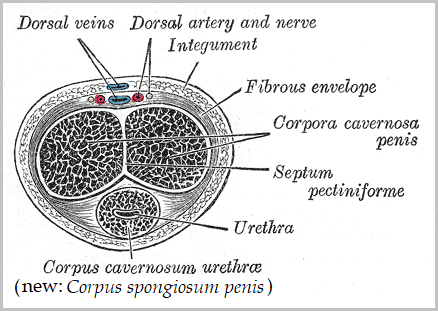


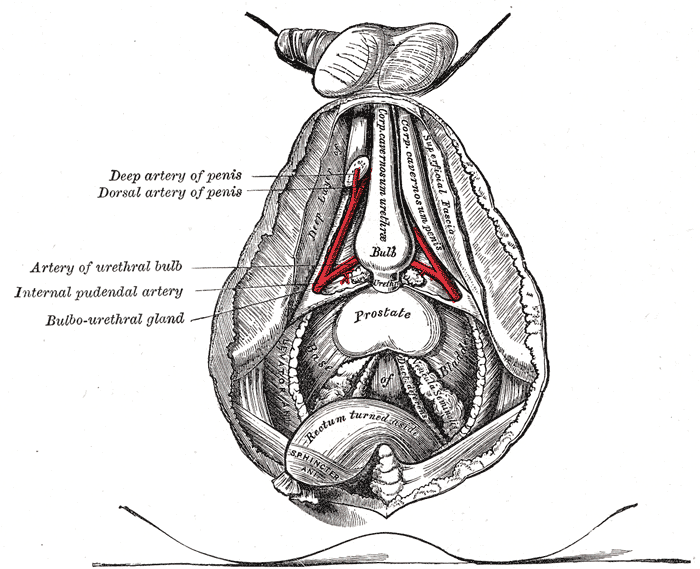


Structure and histology
Each corpus cavernosum is formed from a network of blood-filled spaces (sinusoids) lined by endothelium and supported by trabeculae of connective tissue and smooth muscle. They are enveloped by a dense fibrous layer called the tunica albuginea, which helps trap blood and create rigidity. The paired proximal attachments, called crura, attach to the pelvic bones and anchor the penis.
Function and physiology
During sexual arousal the cavernosal arteries dilate and blood fills the sinusoids. Expansion of the corpora compresses venous outflow against the tunica albuginea, a veno-occlusive mechanism that sustains an erection. Neural signals and local mediators such as nitric oxide regulate smooth muscle relaxation and blood flow.
Development, name and distinctions
The name derives from Latin meaning "cave-like body." In embryonic development the corpora arise from mesenchymal tissue and differentiate with the penile shaft. They differ from the corpus spongiosum, which remains more compliant to protect the urethra during erection.
Clinical relevance
- Peyronie’s disease: fibrous scarring of the tunica albuginea can produce curvature.
- Priapism: prolonged erection due to impaired venous drainage risks tissue damage.
- Erectile dysfunction: vascular, neural, or tissue changes in the corpora can reduce erectile quality; treatments target blood flow or use implants.
- Trauma and surgery: injuries or corrective procedures may involve the corpora and their coverings.
For general anatomy references see penile anatomy. For descriptions of the tissue texture use the term sponge-like. For hemodynamic emphasis see articles on blood flow and on the physiology of erection. This overview focuses on broadly accepted features without exhaustive procedural detail.
Questions and answers
Q: What is the corpus cavernosum penis?
A: The corpus cavernosum penis is one of two sponge-like sections of tissue in the male penis.
Q: What is the function of the corpus cavernosum penis?
A: It contains most of the blood during an erection.
Q: What does the term "corpus cavernosum penis" mean?
A: It means "cave-like body".
Q: Is the corpus cavernosum penis present in females?
A: No, it is only present in males.
Q: Which part of the male penis contains most of the blood during an erection?
A: The corpus cavernosum penis contains most of the blood during an erection.
Q: Are there any medical conditions related to the corpus cavernosum penis?
A: Yes, conditions such as priapism (prolonged and painful erection) can affect this part of the penis.
Q: How are erections initiated?
A: Erections are initiated by stimulation of the nerves and blood flow to the corpus cavernosum penis.
Related articles
Author
AlegsaOnline.com Corpus cavernosum penis Leandro Alegsa
URL: https://en.alegsaonline.com/art/23221