
Cornell University: History, structure, campuses, and distinguishing features
Comprehensive overview of Cornell University: founding and mission, campuses and colleges, academic structure, research and outreach, student life and athletics, and notable distinctions.
Overview
Cornell University is a private research university located in Ithaca, New York, United States. Chartered in 1865, it combines an eclectic academic mission with public responsibilities as one of the nation’s private land-grant institutions (land-grant). From its founding statement—an aspiration to offer instruction in any study—the university has sought breadth across both the humanities and the applied sciences, supporting a wide range of scholarly, professional and practical programs.
Image gallery
10 Images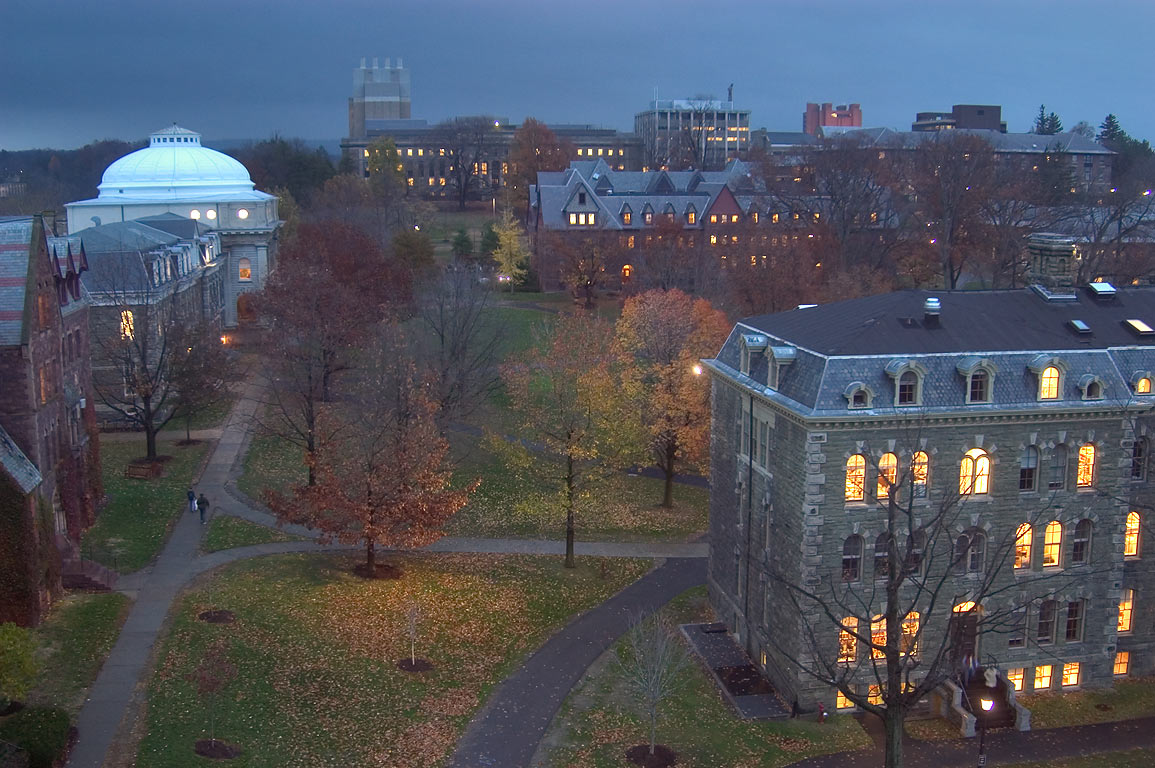


History and founding principles
Cornell was co-founded by Ezra Cornell and Andrew Dickson White, who together secured legislative approval to establish a college that would be open and nonsectarian. The founders emphasized practical as well as classical education, explicitly aiming to teach subjects from the classics to the sciences. Coeducation and a secular approach were distinctive for the era: the university admitted students irrespective of gender, religion or race, a stance reflected in its early policies and ongoing commitments to access and diversity (co-educational).
Campuses, colleges, and organizational structure
The main campus in Ithaca hosts multiple colleges and schools. Cornell's governance divides responsibilities among separate undergraduate colleges and graduate divisions; each unit defines its own admissions standards and curricula. Common designations include several undergraduate colleges (undergraduate) and graduate or professional divisions (graduate). In addition to Ithaca, Cornell operates medical and professional campuses in New York City and an international medical campus in Education City, Qatar, while three statutory colleges receive state support as part of its land-grant mission.
Academics, research, and public engagement
Cornell offers a wide array of programs across arts, sciences, engineering, agriculture and professional fields. It also runs an extensive cooperative extension and outreach system that serves communities across New York State, translating research into practical benefits in agriculture, health, and economic development. The university counts notable academic achievements among its affiliates, including recipients of major scholarly prizes and fellowships, and emphasizes interdisciplinary research that spans theoretical inquiry and applied solutions.
Student life, athletics, and community
Student life at Cornell blends residential communities, student organizations, and cultural activities with research and internships. Athletics teams are known as the Big Red, competing in 36 varsity sports and participating in the Ivy League conference (Ivy League). The institution supports a rich campus culture with public lectures, arts programming, and outreach projects that connect students to regional and global issues.
Notable distinctions and legacy
Cornell's alumni and faculty include leaders across government, industry, scholarship and the arts. The university often highlights its record of fellowship recipients and laureates; among its community are Rhodes and Marshall scholars as well as Nobel laureates. For those exploring more detailed histories, official pages and archival sources provide further documentation of Cornell’s founding ideals, growth, and contemporary initiatives (scholarship records).
- Location: Ithaca, New York
- Legal status: Private university with public land-grant responsibilities (land-grant)
- Academic breadth: From the classics to the sciences
- Campuses: Main campus plus sites in New York City and Qatar
- Student and alumni honors: Includes fellowship and scholarship awardees (honors)
- Athletics: Big Red, competing in the Ivy League
- Admissions units: Distinct undergraduate colleges and graduate divisions
- Access and equity: Founded on nonsectarian, co-educational principles
This summary provides a structured introduction to Cornell University’s origin, organization, and public role while pointing to its geographic, academic and historic touchstones for further exploration.
Questions and answers
Q: What is Cornell University?
A: Cornell University is a private land-grant university located in Ithaca, New York, United States. It was founded in 1865 by Ezra Cornell and Andrew Dickson White and receives annual funding from the State of New York for certain educational missions.
Q: What is the motto of Cornell University?
A: The motto of Cornell University is an 1865 quotation from Ezra Cornell which states "I would found an institution where any person can find instruction in any study."
Q: Is admission to Cornell offered irrespective of gender, religion or race?
A: Yes, admission to Cornell is offered irrespective of gender, religion or race.
Q: How many undergraduate colleges does the university have?
A: The university has seven undergraduate colleges.
Q: Does the university have any satellite campuses?
A: Yes, the university administers two satellite medical campuses - one in New York City and one in Education City, Qatar.
Q: How many alumni are affiliated with the university?
A: There are more than 255,000 living alumni affiliated with the university.
Q: What are the athletics teams at Cornell called?
A: The athletics teams at Cornell are called the Big Red and they have 36 varsity teams that compete against other teams in the Ivy League.
Related articles
Author
AlegsaOnline.com Cornell University: History, structure, campuses, and distinguishing features Leandro Alegsa
URL: https://en.alegsaonline.com/art/23141
Sources
- news.cornell.edu : "Cornell University Facts: Motto"
- cornellsun.com : "Endowment Climbs 19.3 Percent to $5.28 Billion"
- dpb.cornell.edu : "Enrollments by College"
- cornell.edu : "2009–10 Factbook"
- cornellsun.com : "Wild Cornell Mascot Wreaks Havoc"
- oag.state.ny.us : "Agreements between state agencies and Cornell University to procure academic services from the statutory or contract colleges administered by Cornell should be regarded as contracts between a state party and a non-state party"
- news.cornell.edu : "Cornell Nobel laureates"
- ezra.cornell.edu : "Uncle Ezra"
- admissions.cornell.edu : "Undergraduate Admissions"
- usnews.com : "Chinese Schools Are Top Feeders for U.S. Doctorates"
- nsf.gov : "Universities Report $55 Billion in Science and Engineering R&D Spending for FY 2009; Redesigned Survey to Launch in 2010"
- nsf.gov : "R&D Expenditures"
- cornell.edu : "Facts about Cornell - Marks of Distinction"
- news.cornell.edu : "Cornell's role in missions to Mars: 1962–2003"
- sciam.com : "Science and Technology at Scientific American.com: Father of Spirit and Opportunity"