
Cordelia (moon of Uranus)
Cordelia is the innermost known moon of Uranus, a small, irregular satellite discovered in Voyager 2 images in 1986, named for a character in Shakespeare's King Lear and associated with Uranus's rings.
Overview
Uranus's moon Cordelia is the planet's innermost known natural satellite. It carries the numerical designation Uranus VI and was first identified as S/1986 U 7 in images returned by the Voyager 2 spacecraft on 20 January 1986. The object was later re-observed with the aid of the Hubble Space Telescope in the late 1990s, confirming its orbit and many basic properties.
Image gallery
6 Images



Physical characteristics
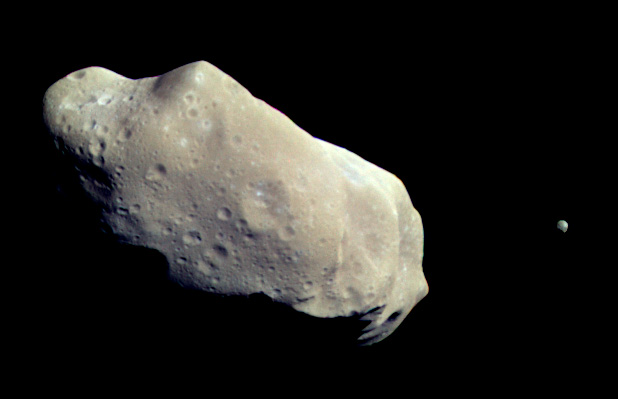
Cordelia is a small, irregularly shaped body with a dark, low-reflectivity surface typical of many inner satellites. High-resolution data are limited, but published estimates place its diameter on the order of a few tens of kilometres (roughly 40 km across), indicating that it is much smaller than the major planetary moons. Its irregular shape implies that self-gravity is too weak to pull it into a spherical form, and it is expected to be tidally locked so that one face always points toward Uranus.
Orbit and relation to the rings
Cordelia orbits very close to Uranus and lies near the planet's ring system. Along with the nearby moon Ophelia, Cordelia is commonly considered a shepherd moon for the planet's epsilon ring: the gravitational influence of these inner satellites helps confine narrow ring particles and maintain sharp edges. Because of its proximity to the planet, Cordelia completes an orbit in a short interval compared with the outer satellites and is subject to strong tidal forces and orbital perturbations from the rings and nearby moons.
Name and cultural origin
The name Cordelia comes from a character in works of literature: the youngest daughter in William Shakespeare's tragedy King Lear. The naming follows the convention of giving Uranian satellites names drawn from characters in Shakespeare and Alexander Pope, a practice established in the 19th and 20th centuries for moons of this planet.
Observations and scientific importance
Scientific knowledge of Cordelia is based primarily on the Voyager 2 flyby imagery and subsequent telescope observations. Because it is small and faint, details about its surface composition, internal structure and exact shape remain uncertain. Its role in ring dynamics as a potential shepherd moon makes it a subject of interest for studies of ring–satellite interactions and the long-term stability of narrow rings. Improved ground- and space-based observations could refine estimates of its size, albedo and orbital behavior.
- Designation: S/1986 U 7, Uranus VI
- Discovery: Voyager 2 (20 January 1986); later seen by Hubble
- Name origin: character Cordelia in works by William Shakespeare, notably King Lear
- Size class: a few tens of kilometres across, larger than some very small moons such as Deimos but far smaller than major satellites
Questions and answers
Q: What is Cordelia?
A: Cordelia is a moon that orbits Uranus.
Q: When was Cordelia discovered?
A: Cordelia was discovered on January 20, 1986 from the images taken by Voyager 2.
Q: Has Cordelia been seen since its discovery?
A: Yes, Cordelia was observed again in 1997 by the Hubble Space Telescope.
Q: How did Cordelia get its name?
A: Cordelia was named after the youngest daughter of Lear in William Shakespeare's King Lear.
Q: What is Uranus VI?
A: Uranus VI is another designation for Cordelia.
Q: How wide is Cordelia?
A: Cordelia is 148 kilometres (92 mi) wide.
Q: What moon is Cordelia the same size as?
A: Cordelia is the same size as Mars' smallest moon called Deimos.
Related articles
Author
AlegsaOnline.com Cordelia (moon of Uranus) Leandro Alegsa
URL: https://en.alegsaonline.com/art/23051