
Cooum River — short urban river of Chennai, India
The Cooum River is a small but historically significant river that flows through Chennai to the Bay of Bengal. It is notable for urban pollution, tidal influence, flood roles, and ongoing restoration efforts.
Overview
The Cooum River (also spelled Koovam) is a short coastal river in the southern Indian state of Tamil Nadu. Measuring about 72 km overall, it drains into the Bay of Bengal and passes through the city of Chennai, where roughly 32 km of its course lie inside the urban area. Together with the parallel Adyar River to the south, the Cooum plays an important role in dividing the city's neighborhoods and in urban drainage.
Image gallery
10 Images



Course and physical characteristics
The river rises in a place locally known as Cooum or Koovam in Tiruvallur district and flows southeast toward the coast, entering the sea within the Chennai metropolitan area. Its lower reaches are influenced by tides, and the mouth can form a sand bar that restricts outflow seasonally. Urban stretches of the channel are narrow and heavily engineered in places; upstream sections pass through rural and agricultural landscapes.
Causes and consequences of pollution
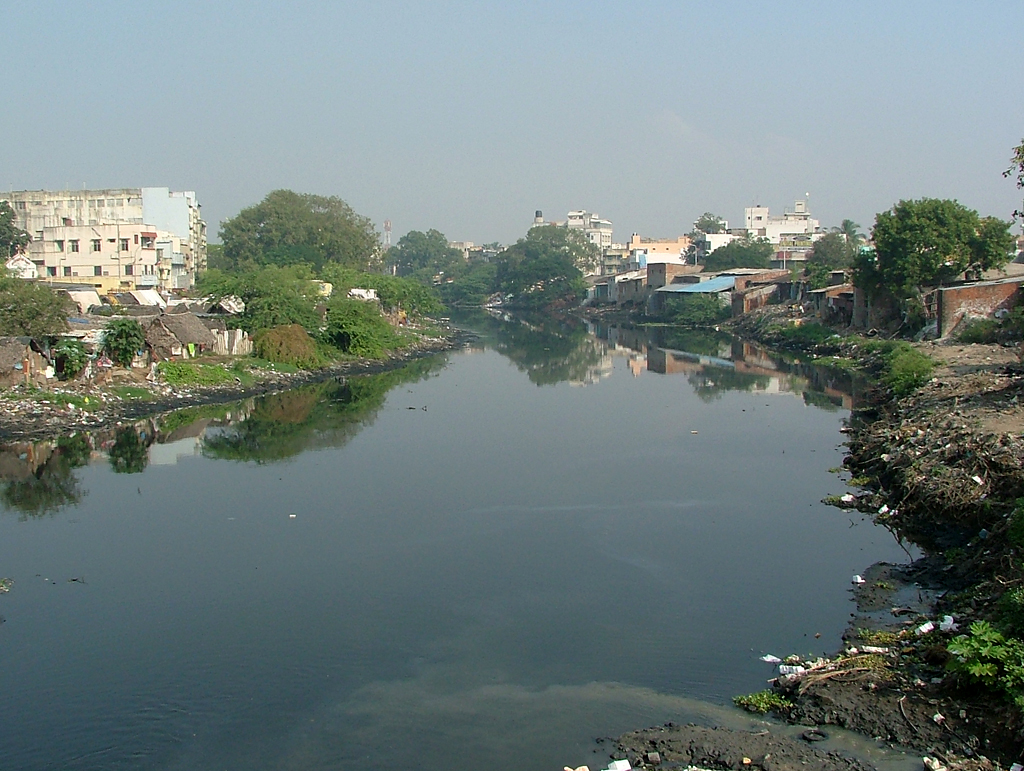
The Cooum is widely recognised for its degraded water quality in the urban reach. Multiple interacting factors have reduced its base flow and ecological function: extensive extraction of surface water for agriculture upstream, indiscriminate pumping of groundwater, encroachment along banks, accumulation of sediments and sand-bar formation at the mouth, and the discharge of untreated sewage and industrial effluents. These pressures have led to foul odours, loss of aquatic life, reduced recreational and aesthetic value, and heightened public-health concerns in adjacent neighborhoods.
Human uses, urban role and impacts
Historically the river and its floodplain supported local agriculture and small-scale livelihoods. Within Chennai the Cooum functions as a stormwater conduit and affects flood risk when blocked or silted. Its banks have been sites of informal settlement, small businesses and transport links; at the same time, encroachment and solid-waste dumping have exacerbated channel constriction and pollution.
Restoration efforts and management challenges
For several decades authorities, municipal agencies and civil-society groups have pursued measures to restore the river's health. Typical actions include desilting and channel clearance, efforts to intercept and treat sewage before it reaches the river, bank-protection and afforestation, and community clean-up drives. Implementation is constrained by competing land uses, complex inter-agency responsibilities, the need for reliable sewage infrastructure, and the hydrological reality of reduced freshwater inflow during dry seasons. Several programmes remain ongoing, combining technical, legal and community-based approaches.
Notable distinctions and further context
Although short in length compared with major Indian rivers, the Cooum's significance comes from its urban setting: it directly affects the lives of Chennai residents and serves as a visible indicator of the city's water-management challenges. The river interacts with adjacent waterways and districts — for example, it runs parallel to the Adyar River, originates in Tiruvallur district and flows through areas adjoining Chennai district — and therefore restoration requires coordinated metropolitan planning. Continued attention to sanitation, watershed management and community engagement is central to any long-term recovery of the Cooum's ecological and social values.
- Main causes of degradation: untreated sewage, industrial discharges, encroachment, reduced base flow.
- Common restoration steps: sewage interception, desilting, bank stabilization, public awareness campaigns.
- Why it matters: urban health, flood control, biodiversity and local livelihoods.
Questions and answers
Q: What is the length of the Cooum River?
A: The Cooum River is about 72 km in length.
Q: How much of the river is situated in the urban area?
A: The Cooum River flows 32 km in the urban part and the rest in rural part.
Q: What does the Cooum River separate in Chennai?
A: The Cooum River trifurcates the city and separates Northern Chennai from Central Chennai.
Q: Where is the source of the Cooum River located?
A: The source of the Cooum River is in a place by the same name 'Cooum' or 'Koovam' in Tiruvallur district adjoining Chennai district.
Q: Why is the Cooum River highly polluted in the urban area?
A: The Cooum River is highly polluted in the urban area (Chennai) due to the discharge of untreated sewage and industrial effluents, encroachment along the banks, and intensive use of surface water upstream for agriculture.
Q: What is the effect of indiscriminate pumping of groundwater on the Cooum River?
A: Indiscriminate pumping of groundwater leads to reduced base flow in the Cooum River.
Q: What are some of the problems faced by the Cooum River?
A: The Cooum River faces problems such as the formation of a sandbar at the mouth of the river, discharge of untreated sewage and industrial effluents, encroachment along the banks, and reduced base flow due to the intensive use of surface water upstream for agriculture.
Related articles
Author
AlegsaOnline.com Cooum River — short urban river of Chennai, India Leandro Alegsa
URL: https://en.alegsaonline.com/art/22922
Sources
- epaper.timesofindia.com : "A River for All Seasons"