
Conveyor belt
A continuous-loop carrying surface used to move materials or people; key in mining, manufacturing, airports and logistics for efficient bulk and unit handling.
A conveyor belt is a continuous moving loop of material that carries objects from one location to another. It serves as a simple, versatile form of mechanical transport for bulk materials and individual items, and in some installations for people. A typical modern installation consists of a flexible belt supported and guided by rollers and driven by a powered pulley. Conveyor systems speed up handling, reduce manual labour and form the backbone of many industrial and commercial processes. Goods or people can be moved on belts shaped and finished to the task.

Image gallery
8 Images


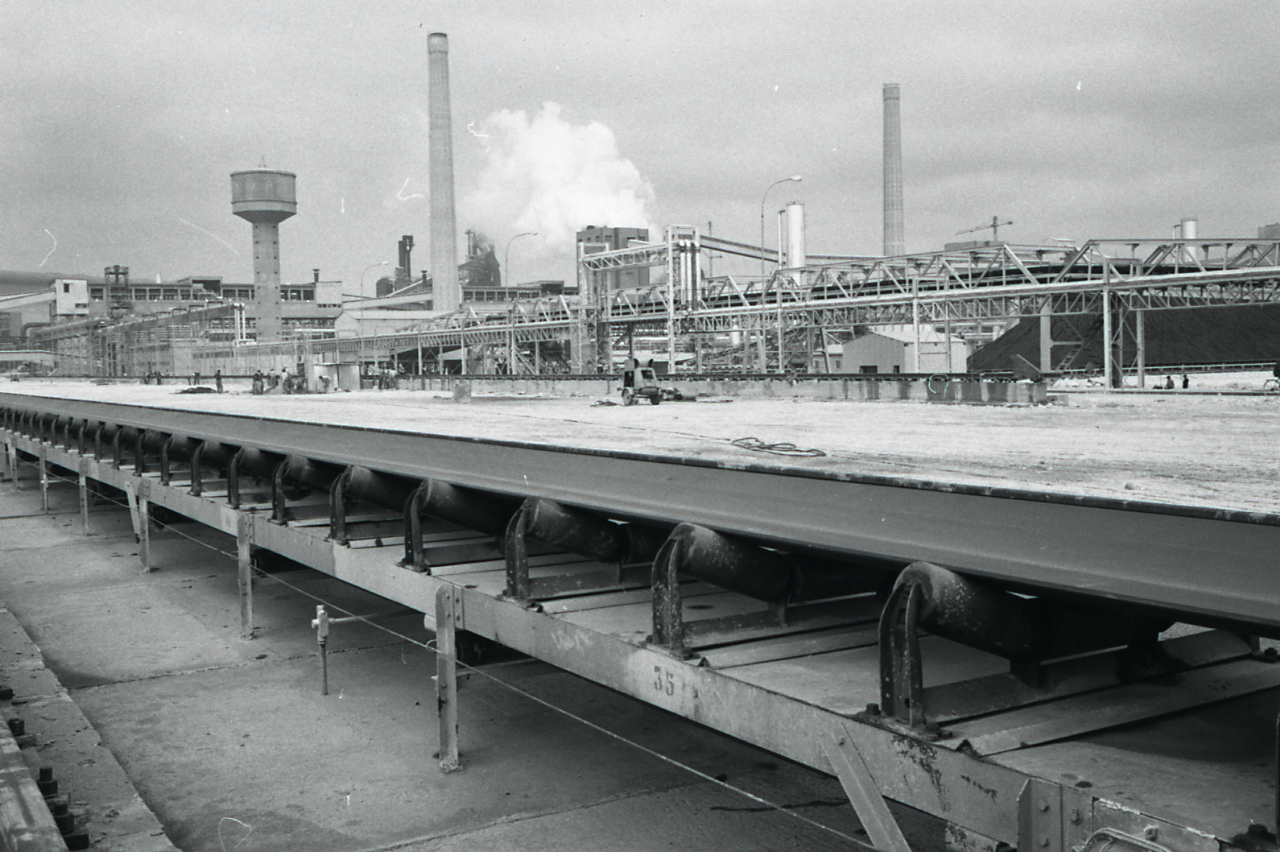


Key components
A belt conveyor is made from several main parts that work together to carry loads steadily and reliably:
- Belt: the continuous carrying surface, often rubber, PVC, fabric or modular plastic, sometimes reinforced with steel cords for long spans.
- Drive pulley and motor: provide the traction that moves the belt.
- Idlers and rollers: support and guide the belt along the route.
- Tensioning and take-up equipment: keep the belt at correct tension to prevent slipping and tracking problems.
- Frames and supports: the structure that holds the components and resists load forces.

History and development
The conveyor belt evolved during the Industrial Revolution when factories and mines needed more efficient material handling. Early systems used leather or canvas belts and simple pulley drives; later improvements introduced vulcanized rubber, synthetic materials and reinforced cores that allowed heavier loads, longer runs and higher speeds. Technological advances in motors, sensors and controls have turned conveyors into automated lines in modern manufacturing and logistics.

Uses and common types
Conveyors appear throughout industry and public infrastructure. Common applications include bulk handling of minerals and aggregates, for example moving sand in processing plants and coal at mines and power stations. Other uses are assembly lines, parcel and airport baggage handling, food processing and moving walkways for people. Variants include flat belt conveyors, troughed belts for loose bulk, modular plastic belts, and roller or chain conveyors for unit loads.

Practical considerations and safety
Selection depends on load type, distance, throughput, incline and environment (outdoor, abrasive, hot or hygienic settings). Maintenance tasks—belt alignment, wear inspection, cleaning and lubrication of bearings—are essential for reliability. Safety features such as emergency stops, guards, belt pullback or anti-entanglement devices and regular training reduce injury risks where conveyors interact with workers.
As a fundamental element of material handling, the conveyor belt remains a cost-effective, scalable solution for moving goods and people across many industries and public spaces.
Questions and answers
Q: What is a conveyor belt?
A: A conveyor belt is a mechanism which is able to transport goods or people over a distance. It consists of a band, which is held by a number of wheels, and can be used for transporting bulk goods such as sand or coal.
Q: What are some common uses for conveyor belts?
A: Conveyor belts are commonly used to transport bulk goods such as sand or coal, and can also be used to transport luggage at airports.
Q: How does the conveyor belt work?
A: The belt travels in one direction on one side, while travelling back the same distance on the other side. This allows it to continuously move items along its length.
Q: What materials are used to make conveyor belts?
A: Conveyor belts are typically made from durable materials such as rubber, plastic, leather or fabric.
Q: Are there different types of conveyor belts?
A: Yes, there are different types of conveyor belts depending on their purpose and application. For example, some may have cleats that help keep objects in place while they travel along the belt's length.
Q: Where can you find examples of conveyors being used?
A: Conveyors can be found in many places including factories, warehouses and airports where they're often used to transport bulk goods like sand or coal and luggage respectively. They can also be found in mines where they're often used for transporting coal.
Q: Is it easy to maintain a conveyor belt system?
A: Yes, most modern systems require minimal maintenance due to their robust design and construction from durable materials such as rubber or plastic.
Related articles
Author
AlegsaOnline.com Conveyor belt Leandro Alegsa
URL: https://en.alegsaonline.com/art/22846