
Alemannic German (Alemannisch): dialects of Upper German
Alemannic German is a group of Upper German dialects spoken across parts of central Europe and a few diaspora communities. This article describes its varieties, history, distribution, and sociolinguistic status.
Overview
Alemannic German (Alemannisch) designates a cluster of related dialects within the Upper German branch of the West Germanic languages. Spoken by roughly ten million people, Alemannic varieties range from everyday regional speech to distinct local traditions of poetry, theatre and song. In Switzerland these dialects are commonly referred to as Swiss German; in the French region of Alsace the vernacular is often called Alsatian.
Image gallery
1 Image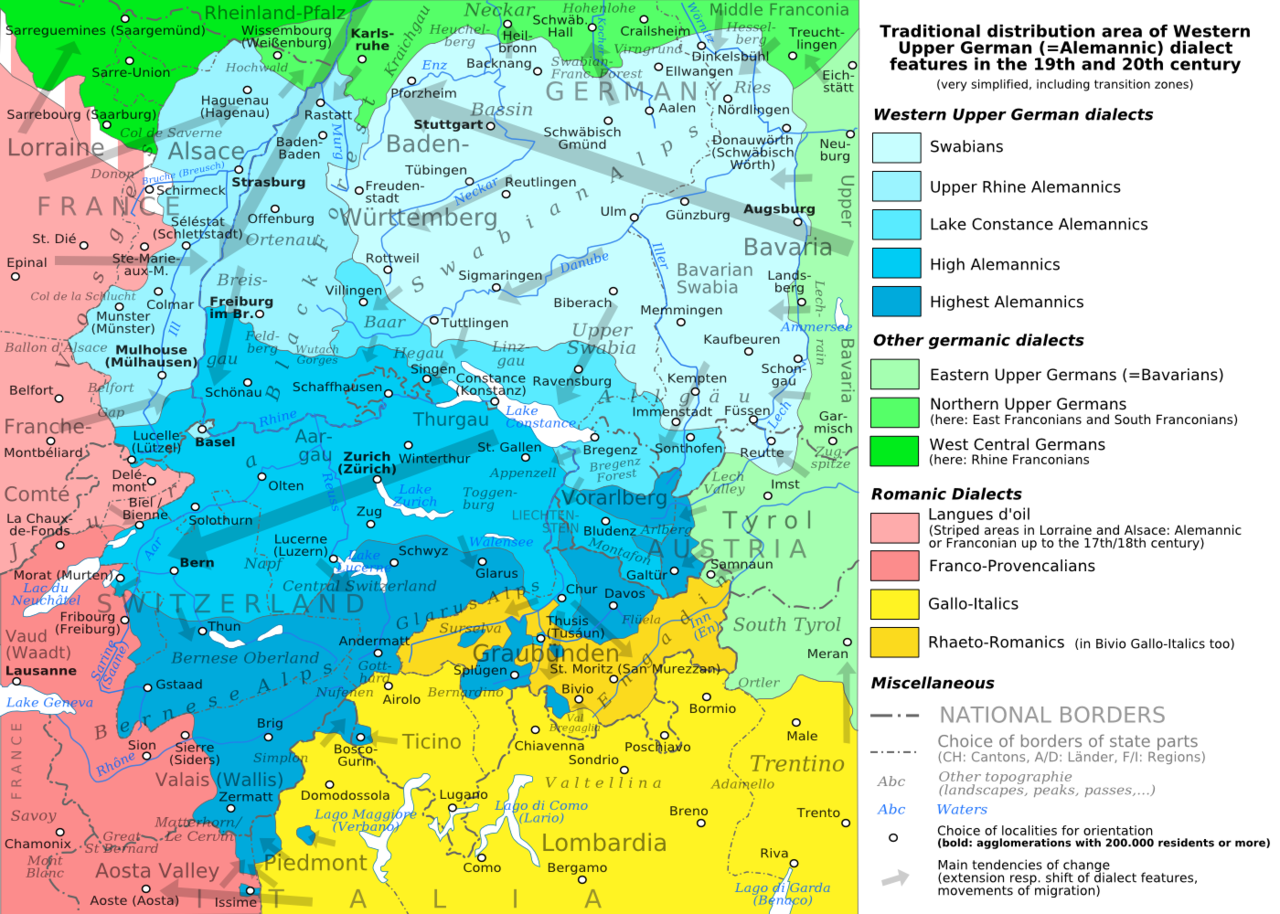
Key characteristics
Alemannic dialects share a set of phonological and grammatical features that set them apart from Standard German and other German dialect groups. Common traits include particular vowel qualities and consonant realizations, regional pronoun forms and reduced or altered case distinctions. Mutual intelligibility with Standard German varies: some Alemannic speech forms remain largely comprehensible to outsiders, while others — especially the most conservative mountain varieties — can be difficult for speakers of Standard German to follow.
Major dialect groups
- Swabian – spoken in parts of southern Germany, with its own local lexicon and sound patterns.
- Low Alemannic – includes urban and Rhine-valley dialects such as those of Alsace (often called Alsatian).
- High Alemannic – found across much of Switzerland and some neighboring areas; it forms the backbone of what many call Swiss German.
- Highest Alemannic – conservative mountain dialects of the Alpine region, present in parts of Switzerland and small Walser communities in northern Italy.
- Walser varieties – dispersed Alemannic varieties preserved in isolated Alpine settlements in Italy and neighboring countries.
History and name
The designation "Alemannic" derives from the Alemanni, a confederation of Germanic tribes documented from late antiquity. Over centuries their speech diverged regionally under the influence of geography, political boundaries and contact with neighboring languages. Many features of today's dialects reflect long-term local continuity rather than a single uniform standard.
Geographic distribution and diaspora
Alemannic is concentrated in a contiguous area that crosses modern national borders: parts of Germany, Switzerland, France (Alsace), western Austria, the microstate of Liechtenstein, and Alpine pockets in Italy. Small overseas communities also preserve Alemannic speech: a village in Romania (Zădăreni), certain Old-Order Amish groups in the United States (notably in Adams County and Allen County), and the German-rooted settlement of Colonia Tovar in Venezuela.
Writing, status and modern use
Unlike national standards, Alemannic dialects lack a single, widely accepted orthography. Speakers typically use the standard national written language (for example Standard German in Germany and Austria, or Swiss Standard German in Switzerland) for formal writing. Nevertheless, Alemannic is commonly used in spoken communication, local media, folk literature, comedy and music. In Switzerland, dialects enjoy strong prestige and everyday visibility; in other regions, some Alemannic forms face pressure from national standard languages and language shift, while localized preservation efforts and cultural organizations promote continued use.
Importance and distinctions
Alemannic dialects are important for linguistic study because they exemplify regional branching within Germanic languages and show how dialect continua cross modern borders. Distinctions among Alemannic varieties are often as great as those between some recognized languages, which explains the diversity of local identities and the variety of names used by speakers. For readers seeking more regional detail or resources, consult local linguistic surveys and cultural organizations tied to the areas above or follow regional media and literature in the relevant dialects.
Further links and resources: dialect overview, southern Germany, Switzerland, France (Alsace), Austria, Liechtenstein, Italy (Walser), Alsatian, Zădăreni, Adams County, Allen County, United States, Colonia Tovar.
Questions and answers
Q: What is Alemannic German?
A: Alemannic German is a group of dialects of the Upper German branch of the Germanic language family.
Q: How many people speak Alemannic German?
A: It is spoken by about ten million people in southern Germany, Switzerland, France, Austria, Liechtenstein, and Italy.
Q: What is Alemannic German called in Switzerland?
A: In Switzerland, it is sometimes called Swiss German.
Q: What is Alemannic German called in Alsace?
A: In Alsace, the language is usually called Alsatian.
Q: Where is Alemannic German spoken outside of its area?
A: Alemannic German is spoken in the village Zădăreni in Romania, Old-order Amish in Adams County and Allen County in the United States, and Colonia Tovar in Venezuela.
Q: What are the Bernese dialects of Alemannic German?
A: The Bernese dialects are stable and spoken by about 5% of all Amish (15,000 people) in the United States.
Q: Is there a fixed orthography for Alemannic German?
A: No, unlike other languages, Alemannic German is only a spoken language; there is no fixed orthography for the language.
Related articles
Author
AlegsaOnline.com Alemannic German (Alemannisch): dialects of Upper German Leandro Alegsa
URL: https://en.alegsaonline.com/art/2279
Sources
- ethnologue.com : Colonia Tovar
- ethnologue.com : Swiss German and Alsatian
- ethnologue.com : Swabian
- ethnologue.com : Walser
- glottolog.org : "Alemannic"
- wikidata.org : wikidata.org/wiki/Q131339
- catalogue.bnf.fr : cb11930857n
- data.bnf.fr : (data)
- d-nb.info : 4112483-2