
Contract bridge: rules, structure, history, and competitive play
Contract bridge is a four-player trick-taking card game played in partnerships. This article explains its phases, roles, scoring methods, history, common conventions, strategy, and competitive scene.
Overview
Contract bridge, commonly called bridge, is a four-player trick-taking card game played by two partnerships. Each player sits opposite their partner. The standard game uses a 52‑card deck: each deal distributes 13 cards to every player. The objective is to win tricks according to a contract established in a preceding auction; success or failure in fulfilling that contract determines the score.
Image gallery
9 Images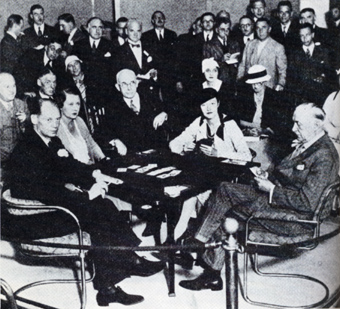



Structure and phases of a deal
Each deal of bridge proceeds through four distinct phases:
- Dealing: the deck is shuffled and each player receives 13 cards.
- The auction (bidding): players in turn make bids or pass to agree on a contract specifying a level (number of tricks above six) and a denomination (one of the four suits or no trumps).
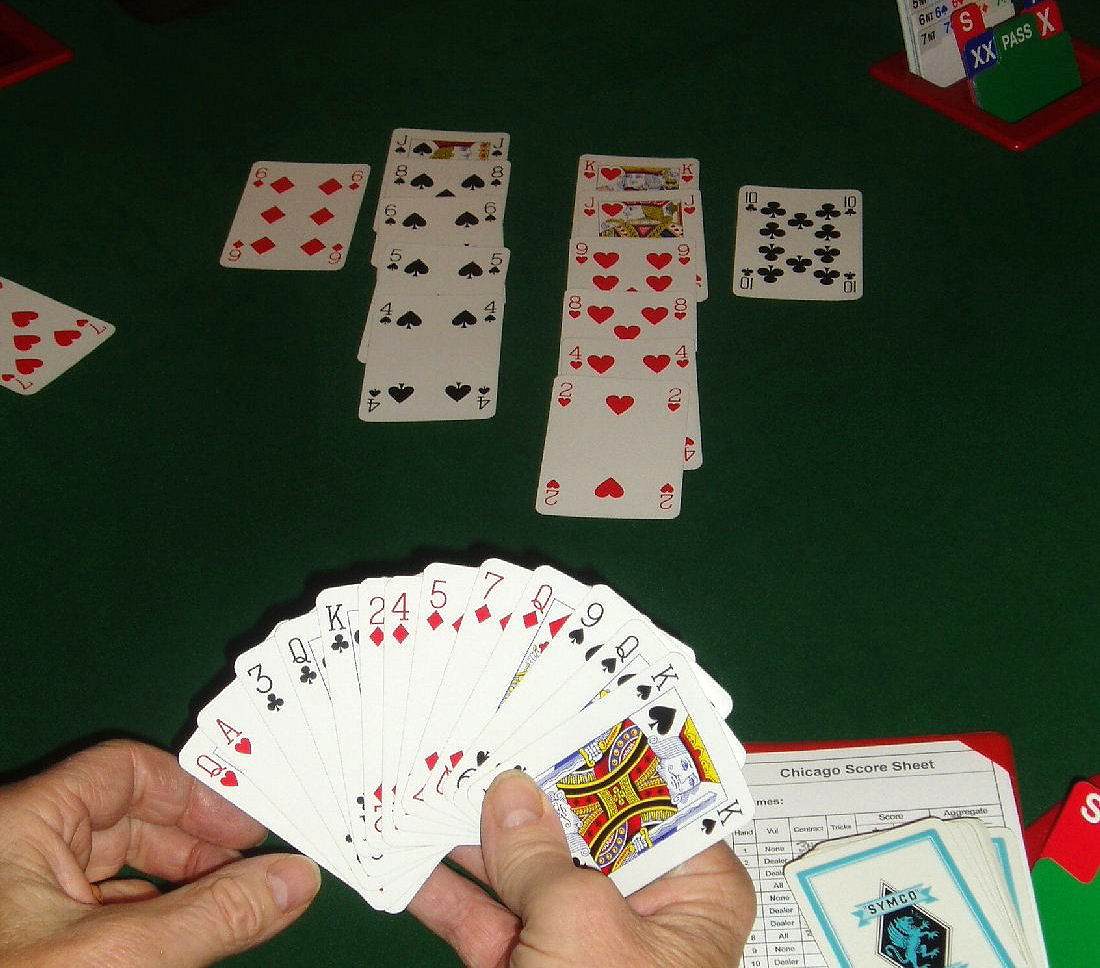
- Play: the player to the left of the declarer leads and twelve more tricks are played; one partnership tries to take the agreed number of tricks.
- Scoring: results are scored according to the form of play—rubber, duplicate, matchpoint or international team scoring—rewarding successful contracts and penalizing failures.
Roles and terminology
Key roles and terms include declarer (the player who must make the contract), dummy (the declarer's partner, whose hand is laid face up after the opening lead), and defenders (the two opponents who work together to defeat the contract). Common actions during play include leading, following suit, trumping (ruffing), and discarding. Conventions and agreements made by partners guide the auction and defensive signaling.
History and development
Bridge evolved from earlier trick-taking games such as whist and auction bridge during the late 19th and early 20th centuries. The modern contract bridge form emerged in the 1920s and 1930s and was refined by influential figures who popularized bidding systems and point-count methods. Over time many bidding systems and conventions were developed to improve partnership communication.
Competitive play, organizations and scoring
Bridge is played socially and at organized events in clubs and tournaments worldwide. Duplicate bridge, where the same deals are compared across multiple tables, minimizes the luck of the deal and is the dominant tournament format. Scoring methods include matchpoints, International Match Points (IMPs), and rubber scoring, each emphasizing different strategic priorities. The World Bridge Federation (WBF) is the international governing body that organizes world championships and publishes standardized laws for tournament play.
Strategy, conventions and learning
Bridge rewards memory, reasoning, partnership agreement and communication. Declarer play techniques include counting suits and opponents' hands, developing long suits, and executing finesses. Defenders use signals and leads to convey information. Bidding systems range from natural to highly artificial; well-known conventions include Stayman and Blackwood. New players often learn via clubs, lessons, books, and online platforms, while advanced players study probability, inference and detailed convention sequences.
Importance and notable facts
Bridge is both a social pastime and a serious mind sport. It has long-running club scenes, national organizations, and a calendar of international events. Because duplicate scoring reduces variance, competitive bridge emphasizes skillful bidding, careful declarer play and coordinated defense. The game is widely used as a test of logical thinking, teamwork and memory, and it remains one of the world’s most enduring card games.
Questions and answers
Q: What is contract bridge?
A: Contract bridge, or just bridge, is a trick-taking card game played by two pairs of players.
Q: Where can people play bridge?
A: People can play bridge in clubs, tournaments, online and with friends at home.
Q: How big should the table be for face-to-face games?
A: For face-to-face games, a convenient table size is from 32 to 40 inches (80 to 100 centimeters) square.
Q: Why is the table usually covered by green baize cloth?
A: The green baize cloth is used to stop cards skittering (sliding) across the table.
Q: Who governs international competitive bridge?
A: The World Bridge Federation governs international competitive bridge.
Q: How many phases are there in each deal of the game? A: Each deal goes through four phases - dealing the cards, the auction (also referred to as bidding), playing the cards, and scoring the results.
Related articles
Author
AlegsaOnline.com Contract bridge: rules, structure, history, and competitive play Leandro Alegsa
URL: https://en.alegsaonline.com/art/22789
Sources
- kardwell.com : kardwell.com
- usatoday.com : USA Today: Billionaires bank on bridge to trump poker