
Constant Permeke: Flemish Expressionist Painter and Sculptor
Overview of the life, work, and legacy of Constant Permeke (1886–1952), a central figure in Flemish expressionism noted for powerful marine and peasant imagery and later experiments in sculpture.
Overview
Constant Permeke (31 July 1886 – 4 January 1952) was a Belgian painter and sculptor widely regarded as a leading voice in Flemish expressionism. His work is best known for monumental, often somber representations of working people—fishermen, peasants and coastal laborers—rendered with a rugged sense of form and an earth-toned palette. Permeke's paintings and later sculptural pieces emphasize mass, simplified contours and an emotional intensity that reflects both his environment and the upheavals of his time.
Image gallery
10 Images


Life and career
Permeke was born in Antwerp and moved with his family to Ostend as a child, a city whose maritime life would leave a lasting impression on him. He attended school in Bruges in the early 1900s and served briefly in the Belgian army after being drafted in 1906. Following military service, he associated with artists such as Gustave De Smet and spent periods living quietly in artist communities. In 1912 he married Maria Delaere and settled in Ostend, where the sea and shoreline figures became recurring subjects.
When World War I began, Permeke fought in the defense of Antwerp and was wounded near Duffel. Evacuated to the United Kingdom, he spent time in rural England—including the Devon area around Chardstock, Devonshire—where his palette briefly brightened as he painted landscapes. After the war he returned to Belgium and exhibited in Antwerp and Paris, gradually developing the more austere, monumental approach for which he became known.
Artistic style and themes
Permeke's mature paintings are characterized by simplified, blocky figures, emphatic outlines and a tactile handling of paint. Faces and bodies often appear flattened into large planes, with an emphasis on rhythm and volume over detailed description. His subjects—fishermen hauling nets, stooped peasants, windbent women—convey a physical, almost sculptural dignity. Colors tend toward deep ochres, browns, grey-blues and muted greens, evoking coastal light, mud and weathered clothing rather than bright decoration. Critics and historians place him among the most important proponents of expressionism in Belgium because of this forceful combination of subject matter and form.
Sculpture and later years
From the late 1930s Permeke expanded into three-dimensional work, translating the robust silhouettes of his paintings into sculpture. These later pieces preserve the same emphasis on mass and simplification, moving painted motifs into carved or modeled volumes that underline the human presence at the center of his art. During World War II Permeke faced restrictions: occupying authorities labeled much modern art as Entartete Kunst and he was discouraged from exhibiting. His family also suffered—the wartime regime in Germany sent many Belgians to forced labor camps, and Permeke's son was among those affected.
Legacy and recognition
After the war Permeke briefly served in a leadership role at the Royal Academy in Antwerp, though his health and private losses limited his activities in later years. He died in 1952 and was laid to rest in Jabbeke, where he had spent significant parts of his career; the town and the surrounding region retain strong associations with his memory. His artistic influence remains notable for how he elevated ordinary laborers and coastal life into subjects worthy of monumental treatment, helping to define a distinct Flemish response to early 20th-century expressionism.
Notable facts
- Permeke's travels included a period in Vevey, in Switzerland, where alpine landscapes briefly entered his work.
- He moved residence several times, including a long-lasting connection to Jabbeke, which became closely linked with his life and legacy.
- Even as the political climate suppressed modern art, Permeke's reputation grew after the wars and he remains a central figure in Belgian modern art history.
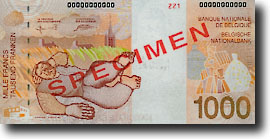
- In 1997 Belgium honored him by featuring his likeness on a 1,000 franc banknote, a token of national recognition until the country adopted the euro.
Permeke's work is studied for its combination of raw physicality and restrained emotion, and it continues to be displayed in public and private collections. For readers seeking images or exhibition histories, consult museum catalogues and specialized studies that survey Flemish expressionism and early 20th-century Belgian art.
Questions and answers
Q: When was Constant Permeke born?
A: Constant Permeke was born on July 31, 1886.
Q: Where did the Permeke family move to when he was six years old?
A: When Constant Permeke was six years old, his family moved to Ostend.
Q: What did his father do for a living?
A: His father worked as the curator of the Municipal Museum of Arts.
Q: Where did he live after returning from military service in 1908?
A: After returning from military service in 1908, Constant Permeke lived as a recluse in Latem.
Q: What happened to him during World War I?
A: During World War I, Constant Permeke was wounded in action near the town of Duffel and had to be evacuated to the United Kingdom.
Q: How did Belgium recognize him in 1997?
A: In 1997, Belgium recognized Constant Permeke by dedicating the 1,000 franc bill to him and his work.
Q: When did he die and where is he buried? A: Constant Permeke died on January 4th 1952 and is buried next to his wife at the cemetery in Jabbeke.
Related articles
Author
AlegsaOnline.com Constant Permeke: Flemish Expressionist Painter and Sculptor Leandro Alegsa
URL: https://en.alegsaonline.com/art/22641