
Conidae (cone snails): predatory marine gastropods
Conidae, known as cone snails, are a family of predatory marine gastropods with conical shells and a venomous harpoon-like radular tooth; their toxins are studied for medicine and can injure humans.
Conidae is a diverse family of mostly tropical sea snails within the superfamily Conoidea. Members of this group display the characteristic tapered, often brightly patterned shells that attract collectors and naturalists. Size varies from tiny species a few millimetres long to larger forms exceeding 10 centimetres. Conidae are marine animals and belong to the class of gastropod molluscs.
Image gallery
4 Images


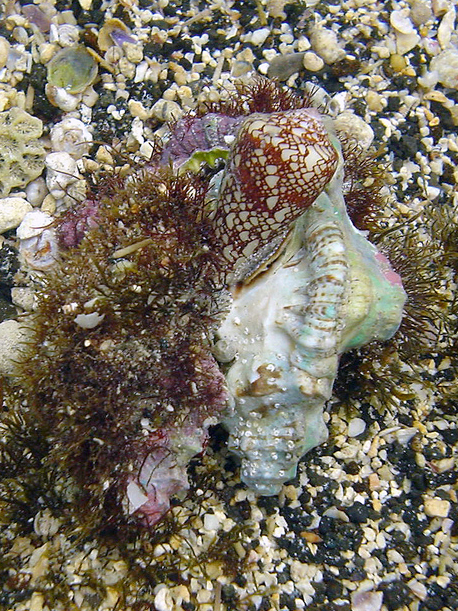
Distinctive characteristics
Cone snails are specialised predators. Their principal adaptations include a streamlined shell, a retractable proboscis, and an extraordinary feeding mechanism built around a modified radular tooth. This tooth functions like a detachable dart; it is loaded with venom composed of many small peptides, aimed to immobilize prey rapidly. These peptides often target nerve and muscle channels and are collectively known as neurotoxins. The tooth is fired in a rapid, harpoon-like action from the snail's mouth.
Behaviour, diet and habitat
Cone snails hunt worms, other molluscs, or small fish, depending on the species. Fish-hunting species use powerful, fast-acting venom to prevent prey escape, while worm-hunters may employ less potent cocktails tuned to invertebrate physiology. Most live on or near sandy bottoms, coral reefs, or under rocks in warm seas, though a few extend into temperate regions. Reproduction is sexual; many lay egg capsules from which juvenile snails hatch.
Taxonomy and research
The large and historically inclusive genus Conus contains hundreds of described species, and molecular studies in recent decades have prompted proposals to split the group into multiple genera and subfamilies. Taxonomic revision continues as genetic and morphological data are integrated. Research on cone snail venom has produced important biomedical leads: specific conotoxins are useful tools for neuroscience and have inspired drugs for severe pain.
Human significance and safety
- Collecting: The shells' shapes and color patterns make them prized by collectors and museums.
- Medical: Isolated peptides are valuable in pharmacology and as probes of nervous-system function.
- Hazards: Stings from some species can be painful and, in a minority of cases, medically serious; appropriate caution is advised when handling live animals.
Notable facts and conservation
Cone snails illustrate the intersection of natural beauty, evolutionary innovation and human utility. Their venoms have evolved into highly specific biochemical tools, and their taxonomy remains an active field of study. Some species face habitat loss, overcollection and environmental change, raising conservation concerns for localized populations.
Further general resources: family overview, collector's guides, marine biology, mollusc taxonomy, radula structure, venom research, neurotoxin studies, feeding mechanics, Conus species list.
Questions and answers
Q: What is Conidae?
A: Conidae is a family of sea snails that range in size from very small to quite large. They are a type of marine gastropod mollusk that belongs to the superfamily Conoidea.
Q: Why are the shells of Conidae highly collectible?
A: The shells of Conidae are highly collectible because of their beauty.
Q: What kind of animals are the snails of Conidae?
A: The snails of Conidae are sophisticated predatory animals.
Q: Do the snails of Conidae have eyes?
A: Yes, the snails of Conidae have eyes.
Q: How do the snails of Conidae immobilize their prey?
A: The snails of Conidae immobilize their prey with a modified radular tooth that delivers venom with neurotoxins.
Q: How many species are in the genus Conus?
A: The genus Conus has 600 species.
Q: Are there other subfamilies in Conidae besides Conus?
A: Yes, there are six other subfamilies in Conidae besides Conus.
Related articles
Author
AlegsaOnline.com Conidae (cone snails): predatory marine gastropods Leandro Alegsa
URL: https://en.alegsaonline.com/art/22526
Sources
- therightblue.blogspot.co.uk : therightblue.blogspot.co.uk/2009/03/collecting-cone-shells-special-handling.html
- therightblue.blogspot.co.uk : therightblue.blogspot.co.uk/2007/09/muck-diving-tale-of-cross-eyed-cone.html