
Congolian rainforests (Congo Basin)
The Congolian rainforests form the second‑largest tropical forest on Earth, spanning the Congo Basin; they are biodiversity hotspots, vital carbon stores, and home to diverse peoples and wildlife.
Overview
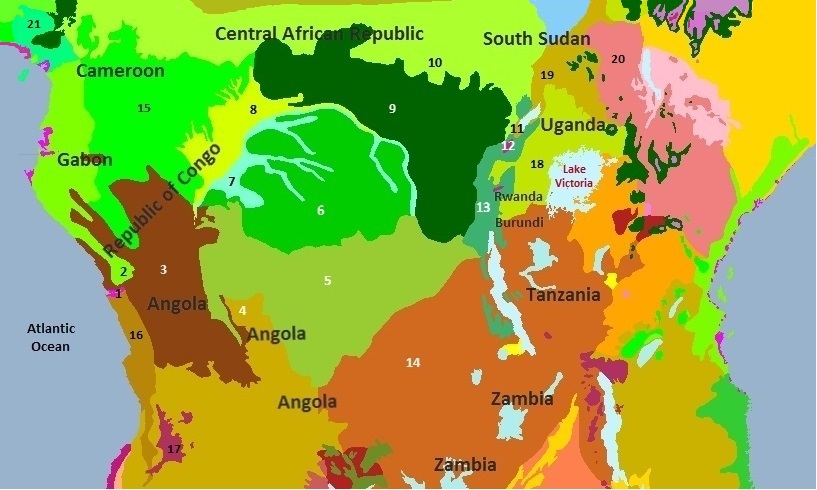
The Congolian rainforests, often called the Congo Basin rainforests, form a vast tropical forest block in central Africa. Covering roughly two million square kilometres, they are second only to the Amazon in size and include extensive lowland and swamp forests, patches of montane forest, and forest–savanna mosaics. The region is drained by the Congo River and its tributaries, which shape the ecology and human settlement of the basin. Congo Basin and the main waterway, the Congo River, are central features of the landscape; the river is one of the world’s great fluvial systems and a main artery for transport and life in the forest (river system, Congo River).
Image gallery
7 Images



Ecology and characteristics
The forest contains a mosaic of habitats: dense evergreen lowland rainforest, seasonally flooded swamp forest, gallery forests along rivers, and higher-elevation montane pockets. It hosts exceptional biodiversity, including forest elephants, western lowland gorillas, bonobos, chimpanzees, okapi and thousands of plant and insect species. Large peatlands and permanent wetlands in parts of the basin store substantial amounts of carbon and help regulate regional climate and hydrology. Scientific surveys and conservation programs continually update knowledge about species distributions and ecosystem functions (ecology, biodiversity).
Human history and cultural references
Humans have lived in and around the Congolian forests for tens of thousands of years; many Indigenous and local communities such as forest foragers and riverine farmers maintain strong ties to the land. European exploration in the 19th century and subsequent colonial exploitation altered social and economic systems. The river and the forest entered global literature through works like Joseph Conrad’s Heart of Darkness, which used the region as a setting and symbol, though that portrayal has been widely debated and critiqued (literary, history).
Uses and importance
The Congolian rainforests provide ecosystem services of global and local importance: they sequester carbon, support freshwater cycles, supply non‑timber forest products and protein through fisheries and bushmeat, and sustain the livelihoods and cultures of millions. Timber and mineral resources are economically significant, and the river network remains crucial for transport and commerce across remote areas (resources, livelihoods).
Threats and conservation
The forests face multiple pressures: commercial logging, agricultural expansion, mining, road building, and illegal wildlife hunting (poaching). Climate change and growing infrastructure also threaten ecosystem integrity. Conservation responses include protected areas, transnational agreements, sustainable development initiatives and peatland protection, carried out by governments, NGOs and community groups. International partnerships and mechanisms aim to reduce deforestation and support local economies while conserving biodiversity (conservation, policy).
Notable distinctions
- Size: second largest tropical rainforest after the Amazon.
- Hydrology: dominated by the Congo River system and extensive swamp forests.
- Carbon storage: includes large peat deposits that are important for global climate regulation.
- Cultural diversity: home to numerous Indigenous groups with distinct languages and forest-based lifeways.
Understanding and protecting the Congolian rainforests is important both for regional communities and for global biodiversity and climate stability. Ongoing research, careful land‑use planning and support for local stewardship are central to sustaining these forests into the future.
Questions and answers
Q: Where is the Congo rainforest located?
A: The Congo rainforest is located in central Africa.
Q: Which river runs through the Congo rainforest?
A: The Congo River, one of the longest rivers in the world, runs through the Congo rainforest.
Q: How much area does the Congo rainforest cover?
A: The Congo rainforest covers two million square kilometers (500 million acres), making it the second largest rainforest in the world after the Amazon rainforest.
Q: Which part of the Congo is covered by the rainforest?
A: The eastern part of the Congo is covered by the rainforest.
Q: What is the name of the famous book written about the Congo rainforest and its river?
A: The famous book written about the Congo rainforest and its river is called The Heart of Darkness, written by Joseph Conrad.
Q: What is the major threat to animal population living in the Congo rainforest?
A: Hunting and poaching is the major threat to animal population living in the Congo rainforest.
Q: Is the jungle itself being destroyed?
A: No, the jungle itself is not being destroyed like many other forests in the world.
Related articles
Author
AlegsaOnline.com Congolian rainforests (Congo Basin) Leandro Alegsa
URL: https://en.alegsaonline.com/art/22503
Sources
- rainforests.mongabay.com : rainforests.mongabay.com/congo/
- usaid.gov : "Congo Basin Forest Partnership"
- rstb.royalsocietypublishing.org : "Mayaux et al 2013"
- rainforests.mongabay.com : "Deforestation in the Congo Rainforest"