
Condenser (apparatus)
A laboratory condenser is a cooling device that converts vapour into liquid. This article explains designs, operation, common types, uses in distillation and reflux, and safety considerations.
A condenser is a piece of laboratory equipment used to cool vapour and turn it back into liquid. In most chemical setups the condenser links a heat source and a receiving flask so that evaporated solvents or reaction products can be collected. Condensers are standard items in organic and analytical chemistry and are commonly encountered in a laboratory setting where controlled cooling and recovery of volatile components are required.
Image gallery
6 Images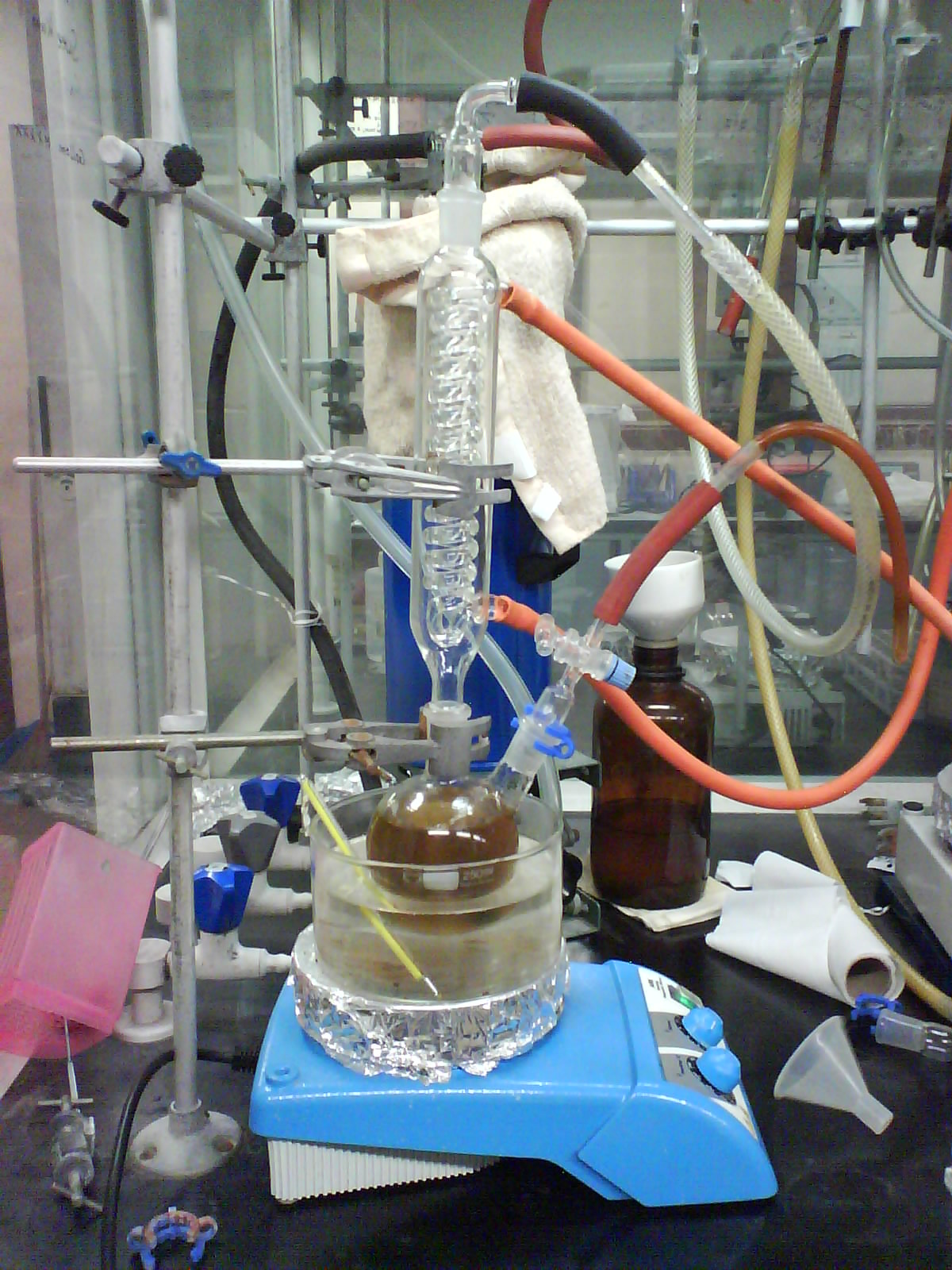


Design and operation
Typical condensers are tubular and often made from transparent glass so that the flow of vapour and condensate is visible. They are usually constructed as a tube within a tube: the vapour flows through the inner tube while a cooling fluid circulates through the outer jacket. Water is the usual cooling medium, introduced at the bottom of the jacket and leaving at the top to maintain complete filling and efficient heat transfer; this counter-current arrangement maximizes the temperature difference between the vapour and the coolant. In some applications other coolants or recirculating chillers are used where lower temperatures are needed.
Common types
- Liebig condenser: a straight inner tube with a surrounding jacket; simple and widely used for basic distillations.
- Allihn (bulb) condenser: has a series of bulbs along the inner tube to increase surface area and promote condensation.
- Graham condenser: features a coiled inner tube for extended surface area within a straight outer jacket.
- Dimroth condenser: uses a double helix jacket to improve cooling efficiency in a compact form.
- Air condensers and condensers made of metal are also used when waterless cooling or greater mechanical strength is preferred.
Applications and examples
Condensers have several practical roles. In simple or fractional distillation, they convert hot vapour into condensate that drips into a collection flask. In reflux setups a condenser returns evaporated solvent to the reaction vessel so the solvent does not escape, allowing prolonged heating without loss of volume. Condensers are also used in solvent recovery, preparative work, and in apparatus for gas washing or scrubbing where vapours must be condensed to liquids for further processing or analysis.
Variants, selection and notable distinctions
Selection of a condenser depends on factors such as volatility of the substance, required throughput, and available cooling. For low-boiling compounds or when working under reduced pressure a condenser with greater surface area or active cooling is preferable. For non-aqueous systems or when avoiding contamination, closed-loop chillers or nonreactive jacket fluids may be used. An air condenser (without a water jacket) can suffice for low-rate condensation of less volatile vapours but is much less efficient for rapid distillation of high-vapour-pressure compounds.
Practical considerations and safety
When using a condenser, ensure coolant hoses are securely attached and that flow direction is from the bottom inlet to the top outlet so the jacket remains filled. All glass connections should be supported to prevent mechanical stress, and pressure should never build up within a closed condenser. When condensers handle hot corrosive vapours or operate under vacuum, appropriate materials and fittings must be chosen. Routine cleaning and inspection extend service life and avoid blockages that would reduce cooling performance.
Further reading and technical specifications can be consulted via supplier datasheets or laboratory manuals; for general technique references see resources on basic distillation and reflux procedures. For additional details about apparatus setup, troubleshooting and best practices consult standard lab protocol collections: gases, water, solvent handling, and other operational guides available in chemical laboratory handbooks and online laboratory resource pages.
Notes: Condensers are versatile devices whose form is tailored to the task — from simple water-jacketed tubes to complex coiled designs — but all share the same basic function: to remove heat from vapour so it becomes liquid again for collection, reuse, or safe disposal.
Questions and answers
Q: What is a condenser apparatus?
A: A condenser apparatus is a laboratory device used to cool hot gases into liquids.
Q: How does a condenser work?
A: A condenser works by having hot gas go through the smaller tube inside a long, circular glass tube while cold water goes around the outside tube, which cools down the hot gas to turn it into a liquid.
Q: Why is water put into a condenser?
A: Water is put into a condenser to ensure that cooling is quick and the tube is always full of water.
Q: What is the purpose of a condenser in distillation?
A: The purpose of a condenser in distillation is to cool down the hot vapour back into a liquid to be collected.
Q: What is the purpose of a condenser in reflux?
A: The purpose of a condenser in reflux is to prevent the solvent from boiling and going away.
Q: What kind of tube does a condenser usually have?
A: A condenser usually has a long, circular glass tube with another, smaller tube inside it.
Q: Where does the water go in a condenser?
A: The water goes in from the tap and travels through the outer tube of the condenser, entering at the bottom and exiting at the top.
Related articles
Author
AlegsaOnline.com Condenser (apparatus) Leandro Alegsa
URL: https://en.alegsaonline.com/art/22434