
Compact Fluorescent Lamp (CFL): design, history, uses and environmental notes
An overview of compact fluorescent lamps: how they work, components, advantages and drawbacks, history, common applications, and safe disposal considerations.
A compact fluorescent lamp (CFL) is a type of electric light designed to provide the benefits of fluorescent lighting in the physical envelope and socket of a traditional incandescent bulb. By using a folded or coiled discharge tube and an integrated ballast, CFLs deliver more visible light per watt than incandescent lamps while fitting many existing fixtures. They became widely used in the late 20th and early 21st centuries as an energy-saving alternative in homes, offices and public spaces.
Image gallery
10 Images
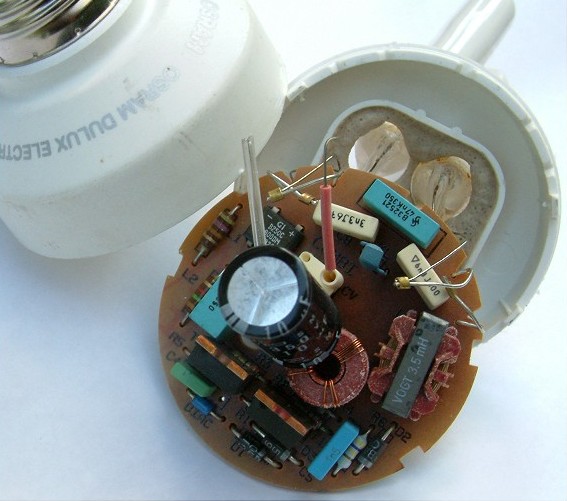


Design and components
Like other fluorescent lamps, a CFL produces light when an electric current excites mercury vapor and the resulting ultraviolet radiation is converted to visible light by a phosphor coating on the inside of the glass. The principal parts are the glass tube, the phosphor layer, a small amount of mercury, electrodes at each end, and a ballast that controls the current. Many modern CFLs use electronic ballasts mounted in the bulb base and are therefore called self-ballasted lamps.
Common form factors include spiral tubes, twin-tube and folded designs that allow a longer discharge path in a compact shape. Variations also exist in base types, color temperatures and brightness levels so that many CFLs can replace standard incandescent lamps directly. For background on how tubular discharge lamps function, see fluorescent lamp technology.
History and adoption
CFLs were developed to combine fluorescent efficiency with a compact form suitable for consumer sockets. They became commercially important after energy efficiency concerns and regulations encouraged alternatives to incandescent lighting. Over time improvements in electronic ballasts, phosphor mixes and manufacturing reduced cost and improved color rendering, increasing consumer acceptance.
Advantages and disadvantages
Compared with incandescent bulbs, CFLs use significantly less electrical power for the same perceived brightness and have a substantially longer operational life. Many consumers noticed lower electricity bills and fewer bulb replacements. However, CFLs have some drawbacks: they contain a small amount of mercury and require proper disposal, take a short time to reach full brightness in some models, and are not always compatible with existing dimmer switches. Light appearance can differ from incandescent warmth, though a range of color temperatures is available.
- Advantages: higher luminous efficacy, longer life, lower lifetime energy cost.
- Disadvantages: mercury content, warm-up time, sensitivity to frequent on/off cycling, dimmer compatibility issues.
Uses, safety and disposal
CFLs are commonly used for general room lighting, task lamps and some outdoor fixtures where rapid on/off is not required. Because CFLs rely on ultraviolet emission converted by a phosphor, the visible spectrum and color rendering depend on the phosphor formulation. The lamp’s efficiency also stems from the energy released by mercury vapor when excited.
When handling or discarding CFLs, follow local recycling programs and avoid placing broken lamps in household trash. Many communities and retailers accept spent CFLs for safe recycling due to the mercury they contain. For guidance on energy savings and performance comparisons, consult trusted energy resources such as those covering lighting and electricity use.
Notable distinctions: CFLs occupy a transitional role between traditional incandescent bulbs and newer solid-state lighting such as LEDs. While CFLs offered an early mass-market path to lower energy use, LEDs have since become dominant in many applications because they avoid mercury and can outperform CFLs in efficiency, lifetime and instant-on behavior.
Questions and answers
Q: What is a compact fluorescent lamp?
A: A compact fluorescent lamp (CFL) is a type of light bulb designed to fit into the same socket as an incandescent bulb, but with the advantages of a fluorescent lamp.
Q: How do CFLs differ from incandescent lamps?
A: CFLs have a longer rated life and use less energy than an incandescent lamp of the same brightness, but their purchase price is often higher and the light they produce looks different.
Q: How much money can a CFL save compared to an incandescent lamp?
A: A CFL can save over US$30 in electricity costs over the lamp’s lifetime compared to an incandescent lamp.
Q: Why does a CFL use less energy than an incandescent lamp?
A: CFLs use less energy than incandescent lamps because they emit light through fluorescence, rather than heat.
Q: What is the role of the ballast in a CFL?
A: The ballast in a CFL prevents too much electricity from flowing through the tube, and is usually in the plastic base of the bulb.
Q: What is a self-ballasted lamp?
A: A self-ballasted lamp is a CFL where the ballast is in the bulb itself.
Q: What type of ballasts are most frequently found in CFLs?
A: Most CFLs contain electronic ballasts.
Related articles
Author
AlegsaOnline.com Compact Fluorescent Lamp (CFL): design, history, uses and environmental notes Leandro Alegsa
URL: https://en.alegsaonline.com/art/22203
Sources
- darksky.org : "Spectra of Different Light Sources" · web.archive.org
- energystar.gov : Energy Star CFL Introduction Page
- nef.org.uk : The National Energy Foundation - Low Energy Lighting - How to Save with CFLs
- osram.com : "Osram Dulux EL Energy-Saving Lamps"
- clasponline.org : "IEC 60969 - Self-ballasted lamps for general lighting services - Performance requirements" · web.archive.org
- energysavers.gov : "When to turn off your lights"