
Compact Disc (CD): structure, formats, history and uses
Compact Disc (CD): a recordable or read-only optical disc format introduced in the early 1980s for digital audio and data storage; includes physical structure, formats, and legacy.
Overview
The compact disc, commonly called a CD, is an optical storage medium introduced in the late 20th century to store digital audio and computer data. CDs are circular plastic discs with information encoded as microscopic marks on their surface; they are read by a focused laser beam. A standard CD can store roughly 700 MB of computer data or about 80 minutes of stereo audio. The format replaced many magnetic media in consumer and business use because it offers higher capacity, durability, and fast sequential access compared with older floppy disks such as the floppy disk.
Image gallery
10 Images




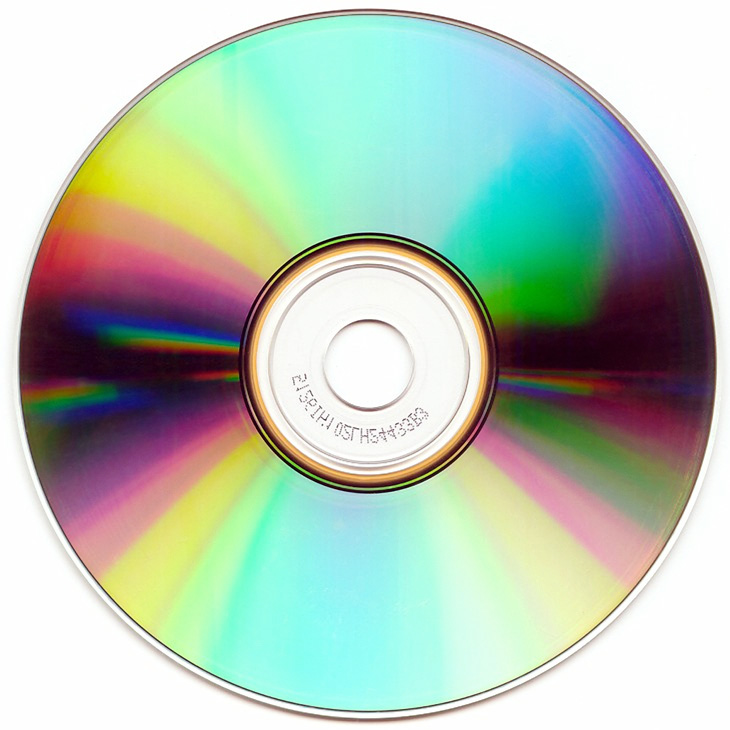


Physical characteristics and construction
A conventional CD is 120 mm in diameter with a central hole of about 15 mm; smaller "mini" discs with reduced diameters were also produced for special applications. The construction of a typical CD includes a molded polycarbonate substrate, an extremely thin reflective metal layer (often aluminum), a protective lacquer coating, and a printed label. The readable surface contains a spiral track of pits and lands whose pattern encodes binary data; the track begins near the center and spirals outward.
How data is encoded and read
Data on a CD is represented by microscopic changes in the surface that affect how light reflects back to a photodetector. A semiconductor laser (commonly near-infrared) is focused through the polycarbonate and scans the spiral track while the disc spins. The optical system converts the reflected light pattern into electrical signals, which are decoded into digital bits and then processed by error-correction algorithms. Audio CDs use 16-bit samples at a 44.1 kHz sampling rate for two channels; data discs add file systems and error-correction layers to support general-purpose storage.
Formats and common variants
- Audio CD (Red Book): the original commercial format for music playback on standalone players.
- CD-ROM: read-only discs containing computer files and software.
- CD-R: recordable once by users; widely used for backups and distributing data.
- CD-RW: rewritable discs that allow multiple erase/write cycles.
- Mini CDs and business-card-shaped discs: smaller or novelty forms used for single tracks, drivers, or promotional materials.
History and standardization
The compact disc emerged from parallel developments by major electronics firms; Philips and Sony cooperated to establish common standards that enabled mass-market adoption of compatible players and discs. The audio CD standard and compatible players reached the market in the early 1980s, and the technology quickly spread to computer applications once CD-ROM extensions and data formats were defined. Standardization ensured that discs from different manufacturers could be read on different players and drives.
Uses, impact and legacy
CDs were widely used for music distribution, software packaging, photo storage, and data backup. They played a central role in the transition from analog to digital media, enabling compact distribution of high-quality audio and large software titles. Over time, optical media evolved to higher-capacity formats (DVD, Blu-ray) and many uses migrated to online distribution and solid-state storage. Nevertheless, CDs remain in use for archival purposes, legacy hardware, and some audio collectors. Important technical elements such as optical reading, error-correction coding, and standard physical dimensions (for example, 120 mm) demonstrate why the CD was a durable and influential medium. For information on earlier storage technologies and comparison, see floppy disks and the companies behind the format, Philips and Sony.
Although digital distribution has reduced CD sales, the format's engineering—combining optical sensing, compact packaging, and standardized encoding—remains a foundational example in the history of consumer electronics and data storage.
Questions and answers
Q: What is a Compact Disc?
A: A Compact Disc, also called a CD, is a small plastic disc used to store and retrieve computer data or music using light.
Q: Why were Compact Discs invented?
A: Compact Discs were invented because they were faster and could hold more information than floppy disks. They replaced floppy disks and made them obsolete.
Q: Who invented Compact Discs?
A: Compact Discs were invented by both Philips and Sony at the same time, but not together.
Q: When did Sony and Philips work together to create a standard format and technology to read CDs?
A: Sony and Philips worked together to create a standard format and technology to read CDs in 1982.
Q: How much data can a CD hold?
A: A CD can hold up to 700 MB worth of data, which is about 80 minutes of music.
Q: What are Mini CDs used for?
A: Mini CDs were made for special small programs like drivers.
Q: What is the diameter of a normal CD?
A: The diameter of a normal CD is 120 mm. The middle hole in a CD is about 1.5 cm.
Related articles
Author
AlegsaOnline.com Compact Disc (CD): structure, formats, history and uses Leandro Alegsa
URL: https://en.alegsaonline.com/art/22202