
Communes of the Eure department (France): overview and intercommunal organization
The 675 communes of Eure (Normandy, France) are the department's basic local governments. This article explains their roles, distribution, history, and principal intercommunal structures.
Overview
The communes of the Eure department are the smallest statutory units of local government in this part of Normandy, in northern France. As of the source data there are 675 communes in Eure. Communes range from small rural villages with only a handful of residents to larger towns that serve as local service centres. The department itself takes its name from the Eure River and has Évreux as its prefecture.
Image gallery
1 Image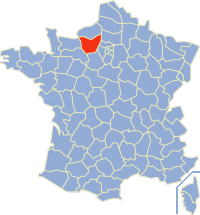
Governance and functions
Each commune is administered by a municipal council and a mayor, elected by local residents. Typical responsibilities include civil registration (births, marriages, deaths), elementary schooling, local road maintenance, land-use planning, and certain social and cultural services. Communes can levy local taxes and manage municipal budgets, often cooperating with neighboring communes for services that exceed local capacity.
Intercommunal cooperation
To provide services more efficiently, many communes join together in intercommunal structures (EPCI). These groupings pool resources for economic development, waste management, public transport and infrastructure. Major examples in Eure include:
- Communauté d'agglomération d'Évreux (CAE), created in 2000.
- Communauté d'agglomération Seine-Eure (CAL), created in 2001.
- Communauté d'agglomération des Portes de l'Eure (CAV), created in 2003.
For an index and official enumeration, see the full list of communes in the department.
Geography, demographics and settlement patterns
Eure's communes reflect a mixed landscape of river valleys, agricultural plains and small wooded hills. Population and services are concentrated around larger towns, while many communes remain predominantly rural. Because communes can be very small, intercommunal cooperation helps sustain schools, public transport and cultural facilities that individual communes could not maintain alone.
History and recent reforms
The commune as an administrative unit dates to the French Revolution. Since the late 20th and early 21st centuries, France has encouraged cooperation and, in some cases, voluntary mergers into "communes nouvelles" to improve administrative efficiency and service delivery. These changes affect the precise number and boundaries of communes over time.
Notable distinctions and practical importance
While communes are not sovereign entities, they are central to everyday life: local identity, community activities, municipal services and local democracy all operate at the commune level. Researchers, planners and residents often consult commune-level data to understand local needs; authoritative compilations and administrative information are maintained through departmental and national channels for those seeking detailed statistics or official documents.
Questions and answers
Q: How many communes are in the Eure département in France?
A: There are 675 communes in the Eure département in France.
Q: What is the CAE in relation to the communes in the Eure department?
A: The CAE is a Communauté d'agglomération in the Eure department, which was created in 2000.
Q: When was the CAL created and what is it?
A: The CAL was created in 2001 and it is a Communauté d'agglomération in the Eure department.
Q: What is the CAV and when was it created?
A: The CAV is a Communauté d'agglomération in the Eure department, which was created in 2003.
Q: What is a Communauté d'agglomération?
A: Communauté d'agglomération is a term for a type of intercommunal structure in France which aims to promote cooperation between local municipalities.
Q: What is the purpose of creating a Communauté d'agglomération?
A: The purpose of creating a Communauté d'agglomération is to foster cooperation between different municipalities in a region.
Q: How many Communauté d'agglomération are mentioned in the text and what are their names?
A: There are three Communauté d'agglomération mentioned in the text, which are the CAE (Communauté d'agglomération d'Évreux), the CAL (Communauté d'agglomération Seine-Eure), and the CAV (Communauté d'agglomération des Portes de l'Eure).
Related articles
Author
AlegsaOnline.com Communes of the Eure department (France): overview and intercommunal organization Leandro Alegsa
URL: https://en.alegsaonline.com/art/22088