
Communes of the Côtes-d'Armor department
Overview of the 373 communes of Côtes-d'Armor in Brittany, their roles, history, intercommunal cooperation, geographic variety and notable towns in the French administrative system.
The Côtes-d'Armor department in northwestern France comprises 373 communes, the smallest administrative units in the French territorial system. A complete list of these communes records names, INSEE codes and basic data used by public services and statisticians. Côtes-d'Armor itself is one of the departments of Brittany; see the department entry for general context (Côtes-d'Armor) and the institutional concept of a French département.
Image gallery
1 Image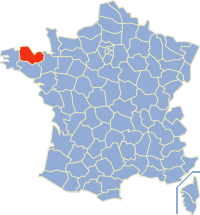
Administrative role and local government
Each commune is governed by a municipal council and a mayor elected by council members. Responsibilities typically include civil registry (births, marriages, deaths), local planning, primary schools, basic roads and local services. Communes range from small hamlets with a few dozen inhabitants to larger towns with municipal administrations capable of broader public works and cultural programming.
Geography and characteristics
The communes of Côtes-d'Armor display geographic variety: coastal fishing ports, braided river valleys, inland agricultural villages and small islands. Many are rural in character, with dispersed settlement patterns, while a handful concentrate population and services. Local identity often remains strong at the commune level, reflected in festivals, parish enclosures and place names in both French and Breton languages.
History and territorial change
Communes in France were created during the Revolution to replace older parishes and seigneuries; their borders have been stable in some areas and changing in others. Since the early 21st century there has been a trend toward voluntary mergers and the creation of "communes nouvelles" to pool resources, improve administration and meet modern service demands while preserving local identity.
Intercommunal cooperation
To manage services that exceed the capacity of individual communes, local authorities participate in intercommunal structures (communautés de communes, communautés d'agglomération). These entities coordinate economic development, waste management, transport and major infrastructure, allowing small communes to share costs and planning while retaining municipal councils.
Notable communes and observations
Among the department's better-known communes are its prefecture and larger towns, historic ports and island communities. Towns such as Saint-Brieuc or Lannion act as service and cultural centres, while coastal communes preserve maritime traditions. For details on specific localities and their boundaries consult the regional lists and official registers (communes list or the department page at Côtes-d'Armor).
- Administrative unit: commune (basic local government)
- Number in department: 373
- Common arrangements: intercommunal cooperation and occasional mergers
- Cultural note: bilingual French–Breton place names are common
Questions and answers
Q: How many communes are in the Côtes-d'Armor department?
A: There are 373 communes in the Côtes-d'Armor department.
Q: What is a commune?
A: In France, a commune is the smallest administrative division of the national government.
Q: What is the Côtes-d'Armor département?
A: The Côtes-d'Armor département is an administrative division of France, located in the Brittany region.
Q: What information is included in the list of communes?
A: The list includes the names of all 373 communes in the Côtes-d'Armor département.
Q: Why might someone need to refer to this list?
A: This list may be helpful for researchers, officials, or citizens who need to know the names and locations of all the communes in the Côtes-d'Armor département.
Q: Is the Côtes-d'Armor département a large or small area in France?
A: This information is not provided in the text, but it could be researched or inferred from other sources.
Q: What other administrative divisions are there in France?
A: France is divided into regions, which are made up of departments, which are further divided into communes.
Related articles
Author
AlegsaOnline.com Communes of the Côtes-d'Armor department Leandro Alegsa
URL: https://en.alegsaonline.com/art/22081