
Combined gas law
Relationship among pressure, volume and temperature of a fixed amount of gas; combines Boyle's, Charles's and Gay-Lussac's laws and leads toward the ideal gas law.
Overview
The combined gas law is a single relation that describes how the pressure, volume and temperature of a fixed amount of an ideal gas change together. It is useful when the quantity of gas (number of moles) is constant and two states of the same gas are compared. The law is commonly written in the proportional form PV/T = constant and is applied to predict how one variable will respond when the other two change.
Image gallery
2 Images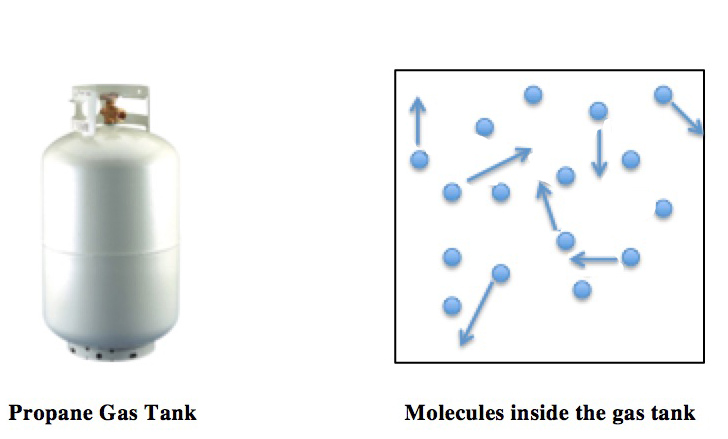

Formula and variables
In words, the combined gas law states that the ratio of the product of pressure and volume to absolute temperature remains constant for a given sample of gas: PV/T = k. In its comparative form this becomes (P1 V1)/T1 = (P2 V2)/T2, where:
- P denotes pressure,
- V denotes volume,
- T denotes temperature measured on the absolute scale (Kelvin, K),
- k is a constant for that fixed amount of gas.
Derivation from three simple gas laws
The combined gas law is obtained by combining three classical relationships that each hold when one variable is kept constant. Charles's law asserts that volume is proportional to temperature at constant pressure (isobaric conditions). Boyle's law shows that pressure and volume are inversely proportional at constant temperature. Gay-Lussac's law (often also called Gay-Lussac or Amontons) expresses that pressure is proportional to temperature when volume is fixed. Combining these three proportionalities eliminates the restriction of holding one variable strictly constant, yielding PV/T = constant.
Applications and examples
The combined gas law is widely used in laboratory practice and engineering when a sealed sample of gas is subjected to changes in conditions. Typical uses include calculating the change in pressure when a gas is compressed and warmed, predicting how volume changes when temperature drops under constant pressure, and estimating behaviour in sealed containers exposed to temperature swings. It is often the first tool for solving problems that involve two states of the same gas without invoking the gas constant or molar amount explicitly.
Relation to the ideal gas law and limitations
Adding Avogadro's law (which relates volume to amount of substance at fixed temperature and pressure) extends the combined gas law into the full ideal gas law, PV = nRT, where n is moles and R is the gas constant. The combined gas law assumes ideal behaviour: molecules have negligible volume and no intermolecular forces. Real gases deviate under high pressures and low temperatures, so corrections (for example, the van der Waals equation) are used when precision is required.
Notable points and distinctions
Several practical cautions help avoid mistakes: always use absolute temperature (Kelvin) when applying the law; ensure the amount of gas is unchanged between the two states; and remember that pressure units must be consistent on both sides of the equation. While the combined gas law is a compact and helpful relation for many problems, it is a special-case result of the more general ideal gas law and loses accuracy when gases behave nonideally.
For further reading on each component law and on how to apply the combined relation in calculations, consult introductory resources on gas behaviour and thermodynamics: combined gas law, ideal gases, pressure, volume, temperature, Charles's law, isobaric descriptions, Boyle's law, Kelvin scale, Avogadro's law and the ideal gas law.
Questions and answers
Q: What is the combined gas law?
A: The combined gas law is a formula about ideal gases that shows how three variables (pressure, volume, and temperature) are related to each other.
Q: What are the three laws that make up the combined gas law?
A: The three laws that make up the combined gas law are Charles's Law, Boyle's Law, and Gay-Lussac's Law.
Q: What does Charles's Law say?
A: Charles's Law states that volume and temperature are directly proportional to each other as long as pressure stays the same.
Q: What does Boyle's Law say?
A: Boyle's Law states that pressure and volume are inversely proportional to each other at the same temperature.
Q: What does Gay-Lussac's Law say?
A: Gay-Lussac's Law states that temperature and pressure are directly proportional as long as the volume stays the same.
Q: How is Avogadro’s law connected to the combined gas law?
A: When Avogadro’s law is added to the combined gas law it creates what is called an ideal gas law.
Related articles
Author
AlegsaOnline.com Combined gas law Leandro Alegsa
URL: https://en.alegsaonline.com/art/21875