
Coloured (Southern Africa): identity, history, language and culture
Coloured is a historical and social classification in parts of Southern Africa for people of mixed ancestry. This article outlines origins, languages, culture, regional distribution, and contemporary identity debates.
Overview
The term Coloured is used in several Southern African countries to describe a heterogeneous population with mixed ancestry. In contemporary usage it most commonly refers to communities in South Africa and adjacent countries such as Namibia, Zambia, Botswana and Zimbabwe. Origins, cultural practices and self-identification vary widely within and between regions. The term has legal and social history dating from colonial administrations and was formalized under 20th-century policies that sought to classify populations by race.
Image gallery
10 Images




Origins and historical development
Populations described as Coloured trace descent to multiple sources: indigenous Khoisan communities, Bantu-speaking groups, enslaved people brought by European colonial powers, settlers of European origin, and later migrants from other regions. The mixing of these groups began during early colonial contact and intensified through centuries of trade, migration and slavery. During the 20th century the designation was codified by segregationist and apartheid-era laws, which assigned social, residential and political consequences to racial categories. Those policies shaped community boundaries, access to land and employment, and public perceptions that continue to influence identity today.
Language, community and culture
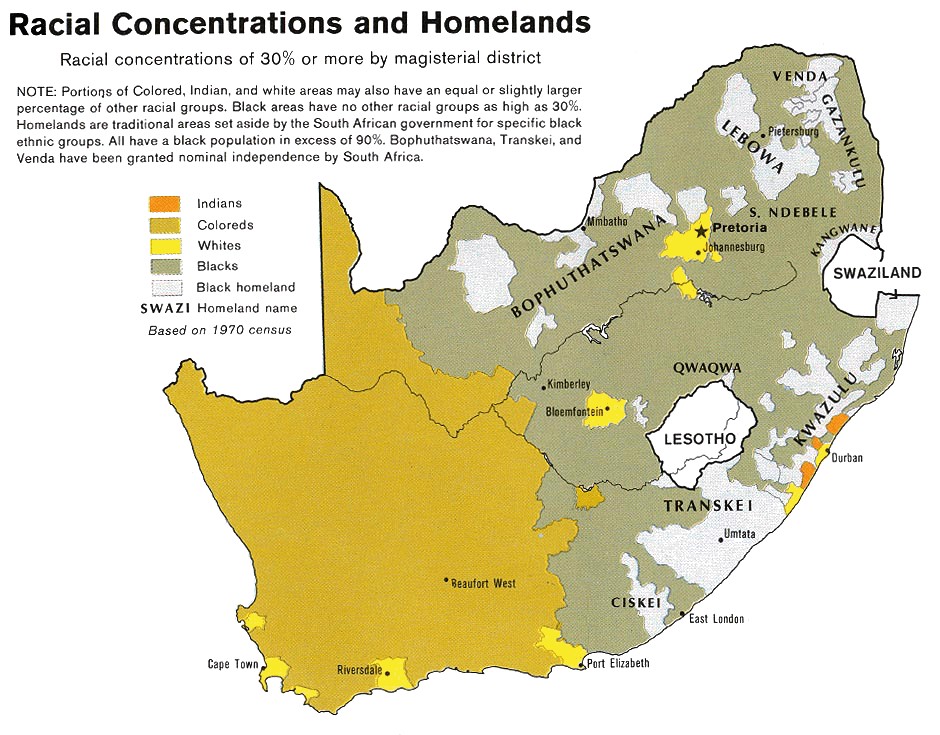
Most people described as Coloured speak Afrikaans or English, often as bilinguals; Afrikaans has been the primary home language for many communities, and some are native Afrikaans speakers while others are native English speakers. Cultural life combines elements from indigenous, European and slave-descended heritages: family structures, music, cuisine and religious practice reflect this blended background. Coloured communities constitute a significant proportion of the populations in coastal and western regions of South Africa, notably the provinces of Northern Cape and Western Cape, and many urban Coloured residents in cities such as Cape Town are multilingual and urbanized.
Identity, terminology and contemporary issues
The label "Coloured" is contested. Some community members accept it as a shared identity that acknowledges a distinct historical experience; others reject it because of its origins in colonial and apartheid classification systems and because it can be perceived as derogatory in certain contexts. Alternatives used by individuals include identifying as "Black", claiming specific indigenous roots such as "Khoisan", or using nationality-based terms like "South African". Debates over the term intersect with broader discussions about representation, affirmative action, socioeconomic inequality and cultural recognition.
Characteristics and notable facts
- Composition: a mix of European, indigenous Khoisan, Bantu and other ancestries.
- Language: Afrikaans and English are widely spoken; local dialects and community vernaculars persist.
- Geography: concentrated in parts of South Africa but present across several neighboring states.
- Historical impact: classification under apartheid affected land rights, employment and social status.
Understanding Coloured identity requires attention to local histories and individual self-identification rather than assuming uniformity. For more contextual or historical source material see links referenced above and specialist studies that focus on regional variation and contemporary perspectives.
South Africa | Namibia | Zambia | Botswana | Zimbabwe | Afrikaans | European | Khoisan | Northern Cape | Western Cape | English | Cape Town
Questions and answers
Q: What is the term Coloured used for in South African, Namibian, Zambian, Botswanan, and Zimbabwean context?
A: The term Coloured is used to refer to people of mixed European and Khoisan or Bantu ancestry.
Q: Which regions have the majority of the Northern Cape and Western Cape populations?
A: The majority of the Northern Cape and Western Cape populations are Coloured people.
Q: What is the first language of most Coloured people?
A: Most Coloured people speak Afrikaans as their first language.
Q: Do all Coloured people speak Afrikaans?
A: No, some Coloured people are native English speakers.
Q: Can most Coloureds living in Cape Town speak both Afrikaans and English?
A: Yes, most Coloureds living in Cape Town are able to speak both languages.
Q: Why do many Coloureds feel that the term coloured is derogatory?
A: Because of South Africa's history of racial discrimination, many Coloureds feel that the term coloured is derogatory.
Q: What are some other terms that Coloureds prefer to call themselves?
A: Some Coloureds prefer to call themselves "Black", "Khoisan", or just "South African".
Related articles
Author
AlegsaOnline.com Coloured (Southern Africa): identity, history, language and culture Leandro Alegsa
URL: https://en.alegsaonline.com/art/21769
Sources
- joshuaproject.net : "The Coloured people group are reported in 17 countries"
- statssa.gov.za : "Statistical Release P0302: Mid-year population estimates, 2015"
- cia.gov : "Namibia"
- zimstat.co.zw : "Zimbabwe Population Census 2012"
- ncbi.nlm.nih.gov : "A Panel of Ancestry Informative Markers for the Complex Five-Way Admixed South African Coloured Population"
- doi.org : 10.1371/journal.pone.0082224
- worldcat.org : 1932-6203
- pubmed.ncbi.nlm.nih.gov : 24376522