
Colour vision: how organisms detect and interpret hue
Colour vision is the sensory ability to distinguish light by wavelength. This article explains mechanisms, variations across species, colour constancy, applications and notable distinctions.
Overview
Colour vision is the sensory capacity of an organism to distinguish stimuli according to the spectral composition of the light they reflect, emit, or transmit. Physically, light can be described by wavelengths or frequencies, but the experience of colour is created by the visual brain, not by the objects themselves. In other words, colour is not an intrinsic property of objects, although the spectrum they reflect strongly influences what is perceived.
Image gallery
6 Images


Biological mechanisms
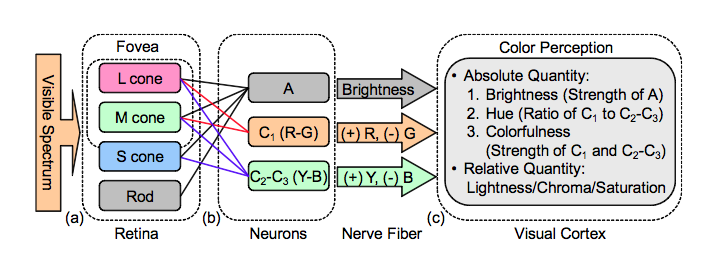
At the front line of colour detection are photoreceptors in the retina. Two broad classes contribute to vision: rods, which are sensitive to low light but do not mediate colour, and cones, which respond to different parts of the visible spectrum and enable colour discrimination. In humans, three types of cone photopigment provide trichromatic vision. Neural circuits in the retina and visual cortex compare signals from these receptors to produce the sensations we label as red, green, blue and intermediate hues.
Key components
- Retina: contains rods and cones that transduce light into electrical signals.
- Photopigments: different pigments absorb different spectral bands.
- Neural pathways: ganglion cells and cortical areas compute contrasts and opponency.
- Perceptual processes: adaptation and context shape final colour appearance.
Variations and evolution
Colour vision varies widely among animals. Many mammals are dichromats with two cone types; most birds and many insects are tetrachromats or have ultraviolet sensitivity, expanding their perceptual palette. Human populations also show variation: common inherited anomalies (often called colour blindness) alter cone function and reduce discrimination between particular hues.
Perception, constancy and examples
Perception of colour depends on illumination, surrounding colours and memory. Colour constancy is the brain's ability to judge object colour as stable across changes in lighting. For example, a ripe apple appears red because it reflects a band of wavelengths more than others; it does not emit red light itself, yet our visual system interprets that reflected spectrum as the colour "red." Metamerism is another important phenomenon: different spectral mixes can look identical to an observer with a given set of photoreceptors.
Uses and significance
Understanding colour vision matters in design, safety signaling, display technology, art and medical diagnosis. Knowledge of species differences informs ecology and animal behaviour studies. Practical applications range from calibrating monitors and cameras to creating accessible materials for people with reduced colour discrimination.
For further reading see related resources: organism, wavelengths, frequencies, light, reflect, transmit, visual brain, property, objects, perceived.
Questions and answers
Q: What is colour vision?
A: Colour vision is the ability of an organism to distinguish objects based on the wavelengths or frequencies of light they reflect, emit, or transmit.
Q: Is colour a property of objects?
A: No, colour is not a property of objects. It is a quality made by the visual brain and so it does not depend upon perception.
Q: Does a 'red' apple emit red light?
A: No, a 'red' apple does not emit red light. It absorbs all the frequencies of visible light shining on it except for a group of frequencies that are reflected which are perceived as red.
Q: How do we perceive colours?
A: We perceive colours through our visual brain which interprets the wavelengths or frequencies of light that are reflected from an object.
Q: Are different wavelengths associated with different colours?
A: Yes, different wavelengths are associated with different colours and this helps us to distinguish between objects based on their wavelength or frequency of light that they reflect, emit, or transmit.
Q: Does perception affect colour?
A: No, perception does not affect colour since it is an objective fact and does not depend upon perception.
Q: What happens when visible light shines on an object?
A: When visible light shines on an object, all the frequencies except for a group of frequencies that are reflected will be absorbed by the object and these frequencies will be perceived as its particular colour.
Related articles
Author
AlegsaOnline.com Colour vision: how organisms detect and interpret hue Leandro Alegsa
URL: https://en.alegsaonline.com/art/21767
Sources
- springerlink.com : On-line PDF
- ncbi.nlm.nih.gov : ncbi.nlm.nih.gov/pubmed/8347768