
Colossal squid (Mesonychoteuthis hamiltoni)
Mesonychoteuthis hamiltoni, the colossal squid, is a large, deep‑sea cephalopod of the Southern Ocean known for great mass, enormous eyes, distinctive tentacular hooks, and a role in Antarctic food webs.
The colossal squid (Mesonychoteuthis hamiltoni) is a deep‑sea cephalopod found in the cold waters surrounding Antarctica. It is widely regarded as the largest squid by mass and is notable for its robust body, heavy tentacular hooks and exceptionally large eyes. Intact specimens are rare, so much of what is known comes from occasional captures, museum specimens and material recovered from the stomachs of predators such as sperm whales. Many physical and ecological details remain under study because direct observations of living animals are uncommon.
Image gallery
6 Images


Physical characteristics
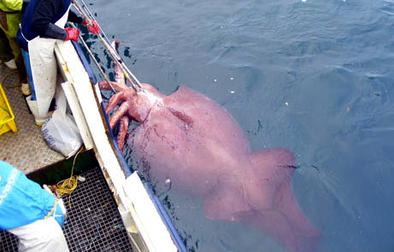
Colossal squid have a thick, muscular mantle and a reddish to brownish coloration in preserved specimens. Adults are frequently described in the literature with total lengths commonly estimated around 9–10 m (30–33 ft), although complete measurements are difficult and published figures vary. The species is often emphasised for its mass rather than extreme length: individuals appear heavier and more robust than many giant squid of comparable length.
- Eyes: Measurements from a partly collapsed specimen record an eye diameter around 27 cm with a lens roughly 12 cm across; a living eye was probably larger, perhaps 30–40 cm, making it among the largest known in the animal kingdom.
- Buoyancy and taste: Body tissues contain ammonium compounds that reduce overall density and assist buoyancy at depth; these compounds also give the flesh a bitter taste that is unpalatable to humans.
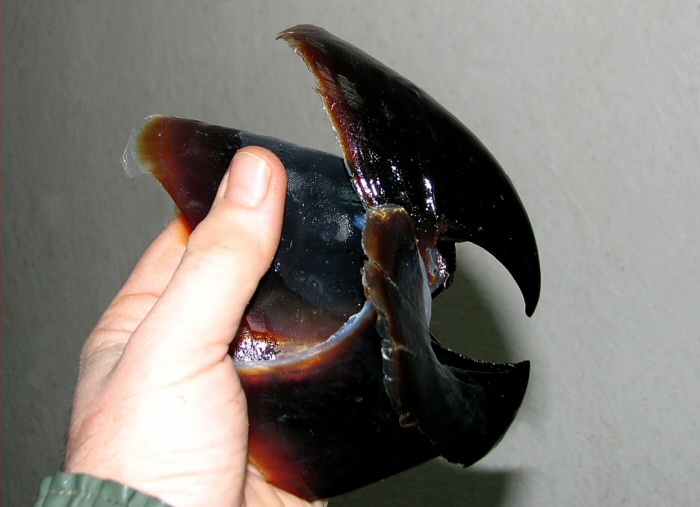
- Appendages: Arms and tentacles bear large, swivelling hooks rather than just suckers, adapted for grasping large, muscular prey.
Distribution and habitat
Mesonychoteuthis hamiltoni inhabits the Southern Ocean, occurring across Antarctic and subantarctic waters. It is adapted to the cold, high‑pressure, low‑light environments of the mesopelagic and bathypelagic zones and has been recorded from depths down to around 2,000 m. Because specimens are seldom observed in situ, detailed distributional maps are incomplete and subject to refinement with new sampling and remote observations.
Feeding, behaviour and ecology
Stomach content analyses and recovered prey remains indicate a diet of large deep‑water fish (notably Patagonian toothfish), other squid species and assorted invertebrates; chaetognaths and smaller animals have also been reported in some samples. Evidence suggests a relatively low metabolic rate consistent with life in cold waters; some energetic estimates indicate modest daily food requirements, implying a slow‑moving or ambush strategy rather than sustained, high‑speed pursuit. The colossal squid's large eyes are well suited to detecting faint bioluminescent signals and silhouettes in dim light, which likely helps in predator avoidance and locating prey.
Life history and reproduction
Basic aspects of the species' life history—such as age at maturity, lifespan and detailed reproductive behaviour—remain poorly known. Like other large squids, reproduction is assumed to involve separate sexes and production of numerous eggs, but direct observations of mating and spawning in the wild are lacking. Growth rates and development are inferred from limited specimen data and comparisons with related cephalopods.
Predators, human interactions and research
Sperm whales are the primary known predator of colossal squid and have supplied much indirect evidence through stomach contents and scarring patterns. Human encounters are uncommon; most specimens come to scientific attention via commercial fishing bycatch, trawl catches, or retrieval from predators. Notable museum specimens have enabled anatomical study and public exhibition; one famous specimen is publicly displayed and was the subject of a museum exhibition that opened in 2008.
Conservation and scientific interest
The conservation status of Mesonychoteuthis hamiltoni is not well quantified because of limited data on population size and trends. Potential threats include deep‑sea fishing and ecosystem changes in the Southern Ocean, but explicit impacts are uncertain. Scientific interest remains high: researchers use recovered specimens, deep‑water cameras, remotely operated vehicles (ROVs), and analysis of predator remains to improve understanding of anatomy, physiology, trophic role and adaptations to extreme environments.
Notable features and comparisons
Colossal squid are frequently compared with giant squid (Architeuthis). While giant squid may rival or exceed colossal squid in total length in some estimates, Mesonychoteuthis hamiltoni is typically heavier and more powerfully built. Distinguishing traits include very large eyes, massive tentacular hooks and buoyancy adaptations involving ammonium compounds. Continued technological advances in deep‑ocean exploration are expected to yield new observations and specimens that will refine current knowledge.
Further information and resources: species overview, size and measurements, comparison with giant squid, Southern Ocean environment, ammonium buoyancy chemistry, recorded prey items, toothfish interactions, deep ocean ecology, bioluminescence and vision, metabolic and energetic studies.
Researchers and museums continue to document specimens and publish findings; interested readers may consult specialist literature and museum resources for the most recent and detailed accounts.
Questions and answers
Q: What is the colossal squid?
A: The colossal squid, Mesonychoteuthis hamiltoni, is the largest squid in the world, measuring 9-10 metres (30-33 feet) long.
Q: How does the colossal squid compare to the giant squid?
A: The colossal squid is larger than the giant squid.
Q: What colour is the body of the colossal squid?
A: The body of the colossal squid is reddish brown.
Q: Where does the colossal squid live?
A: The colossal squid lives up to 2000m below the surface of the Southern Ocean.
Q: What is the main food eaten by sperm whales?
A: The main food eaten by sperm whales is the colossal squid.
Q: What does the colossal squid taste like for humans?
A: The colossal squid has ammonium chloride in its body, so it tastes bad for humans.
Q: What does the colossal squid feed on?
A: The colossal squid is believed to feed on prey such as chaetognatha, large fish like the Patagonian toothfish and other squid in the deep ocean using bioluminescence.
Tags
Related articles
Author
AlegsaOnline.com Colossal squid (Mesonychoteuthis hamiltoni) Leandro Alegsa
URL: https://en.alegsaonline.com/art/21761
Sources
- fao.org : Cephalopods of the world. An annotated and illustrated catalogue of species known to date. Volume 2. Myopsid and Oegopsid Squids
- journals.cambridge.org : Cambridge Journals Online - Abstract
- news.bbc.co.uk : Monster colossal squid is slow not fearsome predator
- afp.google.com : World's biggest squid reveals 'beach ball' eyes
- blog.tepapa.govt.nz : Te Papa's Blog entry. 5 September 2008
- squid.tepapa.govt.nz : Tepapa.govt.nz · webcitation.org
- species.wikimedia.org : Mesonychoteuthis hamiltoni