
Colony of Aden (British Crown colony, 1937–1963)
A brief encyclopedia entry on the Colony of Aden: its territory, administration, strategic role as a Red Sea port, historical development under British rule, and its transition into the State of Aden and South Yemen.
Overview
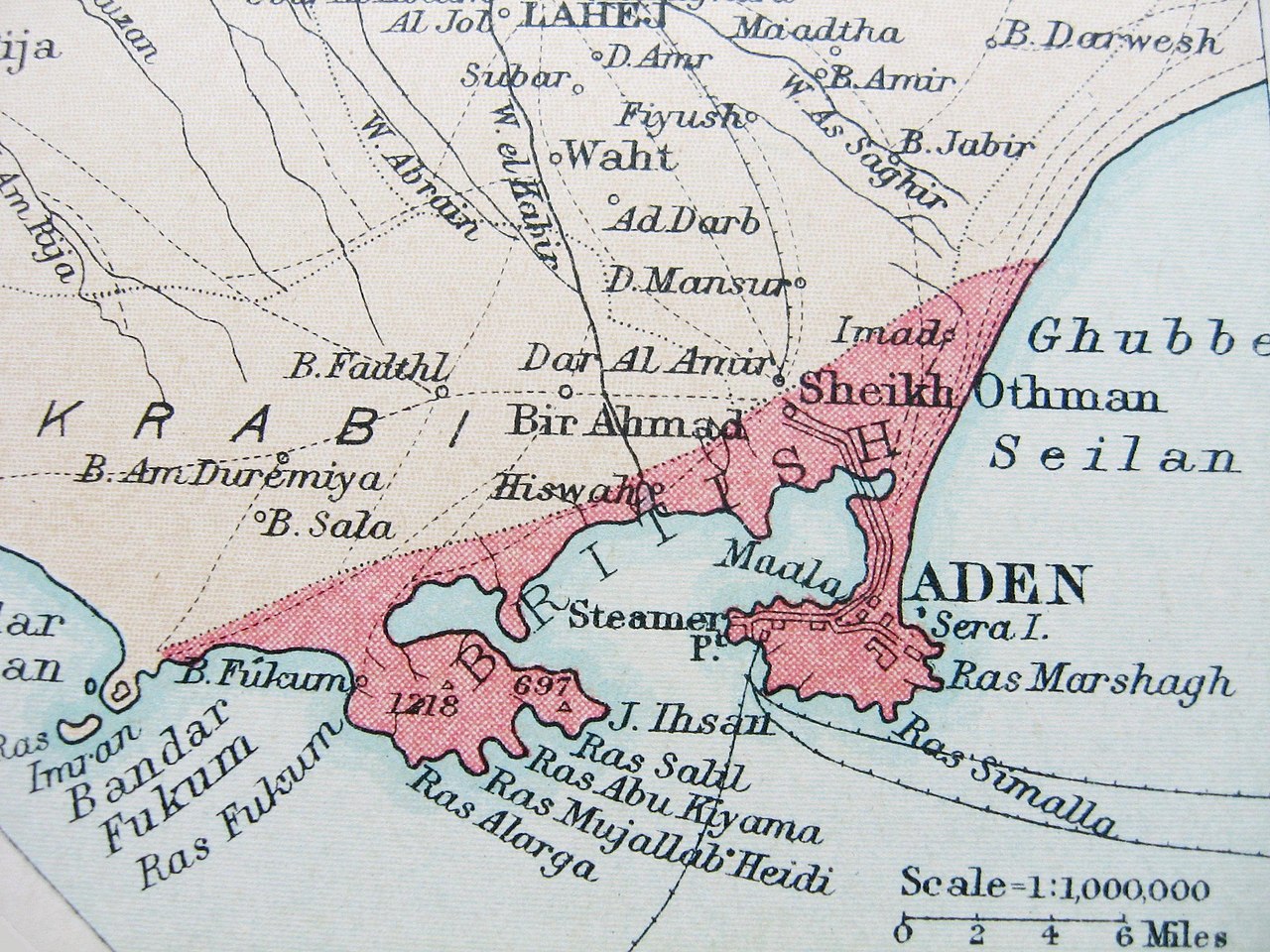
The Colony of Aden was a small but strategically significant British possession on the southern Arabian coast that existed as a distinct Crown colony from 1937 until 1963. Its core was the port city and immediate environs traditionally known as Aden. Before becoming a separate colony, the territory had been administered as part of British India; after separation under the Government of India Act 1935 it became directly governed by the United Kingdom.
Image gallery
10 Images


Territory and administration
The formal colony comprised the port of Aden and a compact surrounding district. Administratively it was governed by a British-appointed governor and retained legal and institutional links to Britain rather than to the neighboring protectorates on the hinterland. The term Crown colony describes its constitutional status: a dependent territory administered in the name of the British Crown with limited local self-government.
Characteristics and strategic importance
Located at the mouth of the Red Sea, adjacent to major east–west shipping routes, Aden served as a coaling and refuelling station in the era of steam navigation and later as a key naval and commercial anchorage. Its deep-water port handled maritime traffic transiting between the Mediterranean, via the Suez Canal, and the Indian Ocean. Economically the colony centred on port services, trade, and related urban activities; its population was multiethnic, including Arab inhabitants alongside substantial communities of Indians, Africans and Europeans drawn by commerce and maritime employment.
Historical development and timeline
- Pre-1937: Aden administered as part of British India following the island's occupation and subsequent development as a coaling station in the 19th century.
- 1 April 1937: Formal detachment from British India and establishment as the Colony of Aden under the terms that followed the Government of India Act 1935.
- 18 January 1963: The colony was reconstituted as the State of Aden and incorporated into the newly formed Federation of South Arabia.
- 30 November 1967: British rule ended when the federation and its member states were superseded by the People's Republic of South Yemen; the hinterland had earlier been administered separately as the Aden Protectorate.
Uses, economy and social life
As a service and transshipment hub, Aden's economy depended on port operations, shipping agencies, bunkering, warehousing, and services for seafarers. The presence of British military installations and Royal Navy facilities reinforced its role as a strategic supply point. Urban life reflected the intersection of Arab local culture and cosmopolitan influences from traders, migrant workers and colonial administrators; commercial streets, docksides and neighborhoods bore this multicultural imprint.
Legacy and distinctions
The Colony of Aden is often discussed in two linked but distinct contexts: the compact coastal colony under direct British administration and the larger Aden Protectorate that covered tribal hinterlands under treaties with local rulers. Its history illustrates patterns of imperial strategic control of maritime choke points, colonial urban governance, and mid-20th-century decolonization. Modern references to Aden place it within the sovereign state of Yemen, while its colonial-era documentation is preserved in British records and academic studies accessible through institutional resources such as archival descriptions in Arabic and English and online bibliographies and gazetteers referenced by researchers (port histories, constitutional studies, and legislative histories like the Government of India Act).
For readers interested in administrative details or primary sources, consult archival collections, naval and shipping registers, and contemporary gazetteers that document the colony's institutions, population composition, and role in regional geopolitics. A short account of its administrative transition and eventual incorporation into post-colonial Yemen can be found in outlines of decolonization and Middle Eastern political history (imperial administrative records, national histories).
Questions and answers
Q: What was the Colony of Aden?
A: The Colony of Aden was a British Crown colony from 1937 to 1963 that was located in the south of contemporary Yemen.
Q: What did the Colony of Aden consist of?
A: The Colony of Aden consisted of the port of Aden and its surroundings, which is an area of 192km2 (74 sq mi).
Q: How was Aden governed before 1937?
A: Before 1937, Aden had been governed as part of British India.
Q: When was the Colony of Aden made a separate colony of the United Kingdom?
A: The Colony of Aden was made a separate colony of the United Kingdom on 1 April 1937.
Q: What happened to the Colony of Aden on 18 January 1963?
A: On 18 January 1963, the colony was reconstituted as the State of Aden within the new Federation of South Arabia.
Q: What did the Federation of South Arabia become on 30 November 1967?
A: The Federation of South Arabia became the People's Republic of South Yemen on 30 November 1967, marking the end of British rule.
Q: How was the hinterland of the Colony of Aden governed?
A: The hinterland of the Colony of Aden was separately governed as the Aden Protectorate.
Related articles
Author
AlegsaOnline.com Colony of Aden (British Crown colony, 1937–1963) Leandro Alegsa
URL: https://en.alegsaonline.com/art/21726