
Collective animal behaviour: principles, examples and significance
Study of how and why animals act together in groups, the rules individuals follow, emergent patterns, history of research, ecological importance and applications in science and technology.
Overview
Collective animal behaviour examines how individuals in a group interact to produce coordinated patterns at the level of the whole group. Researchers ask what simple rules each animal follows, how information is shared, and how group decisions emerge that differ from the behaviour of isolated individuals. For introductions to core concepts see behavioural rules and literature on groups of animals studied across taxa.
Image gallery
6 Images


Characteristic mechanisms
Common mechanisms that generate group patterns include local alignment, attraction, repulsion and density-dependent responses. Alignment causes neighbours to match direction, attraction draws individuals together and short-range repulsion prevents collisions; the balance of these produces formations such as lines, clusters or synchronous waves. Sensory modalities (vision, hearing, lateral line sensing in fish, chemical cues in insects) determine interaction range and timing, and therefore the shape of the collective response. For discussions about species composition and similarity within groups see same-species groups.
Typical examples
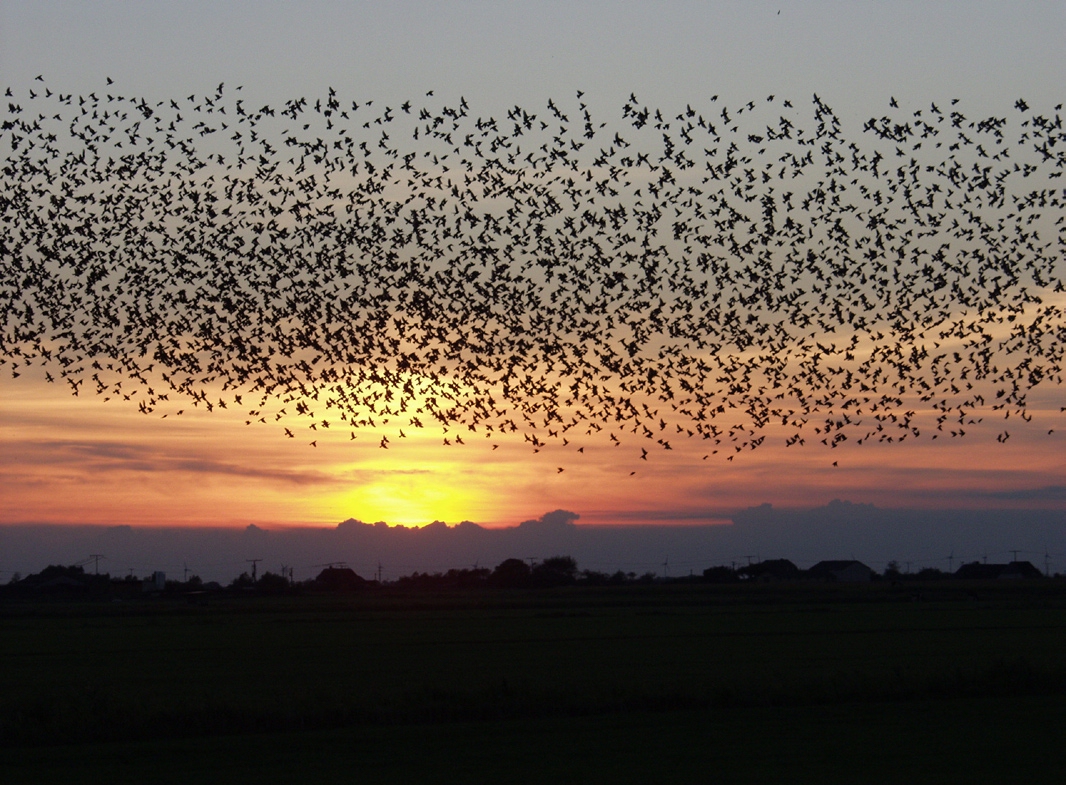
- Flocks of birds: rapid aerial manoeuvres and coordinated turns as seen in starlings and other passerines — often studied as striking examples of emergent coordination (flock of birds).
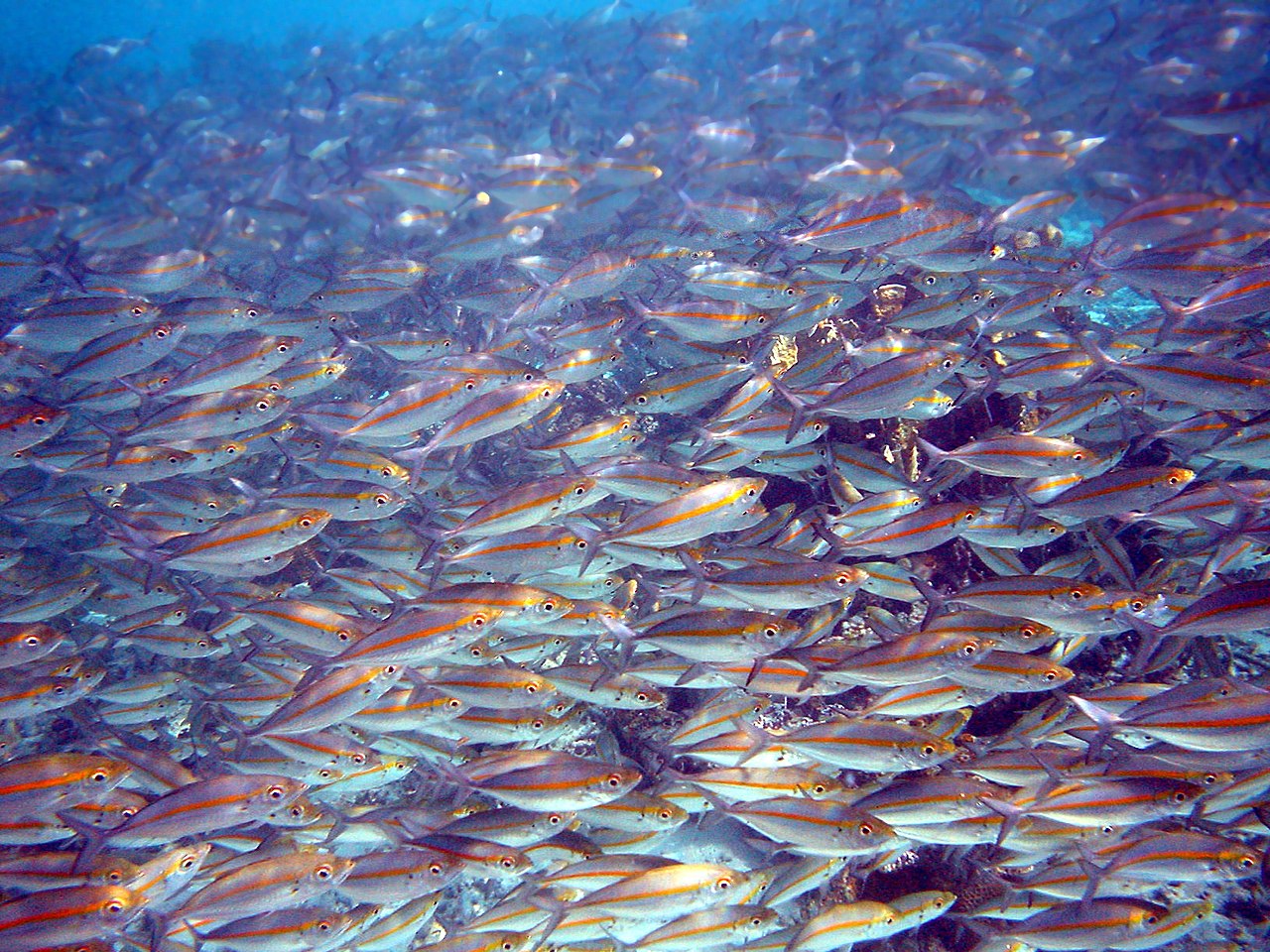
- Schools of fish: dense, polarized groups that reduce predation risk and improve foraging efficiency (school of fish).
- Herds of mammals: large aggregations such as grazing ungulates where individuals are generally herds of hoofed herbivorous mammals.
- Social insects and swarms: ants, bees and locusts show collective decision-making, trail formation and task allocation through simple local interactions.
History and scientific development
Interest in collective behaviour dates back to naturalists who described migrations and swarms, but the field became quantitative with the introduction of mathematical models and computer simulations. Agent-based models and ideas from statistical physics made it possible to show how simple, local interaction rules can lead to complex group-level patterns. Empirical advances from high-speed photography and tracking technology allowed precise measurement of individual trajectories, fostering tighter links between theory and observation.
Functions and applications
Collective behaviour serves ecological and evolutionary purposes including predator avoidance, improved navigation, and efficient exploitation of patchy resources. Understanding these systems has practical applications: conservation and fisheries management use schooling and migration knowledge, while robotics borrows swarm principles to design teams of simple robots that perform distributed tasks. Studies also inform epidemiology (how disease spreads in aggregations) and human crowd dynamics.
Distinctions and notable facts
Collective behaviour differs from individual social behaviour by emphasizing emergent properties that cannot be predicted from single-animal actions alone. Leadership and consensus can arise without fixed leaders; small numbers of informed individuals can guide large groups. Comparative work shows variation in interaction rules across species, reflecting sensory capabilities and ecological pressures. For further resources and overviews see behavioural rules, regional surveys at group studies and species-specific accounts such as fish schooling and bird flocking.
More technical introductions and datasets are collated in research databases and review articles; useful entry points and reading lists are available via collections and portals referenced here: species composition, herd dynamics, ungulate studies and grazing mammal literature.
Questions and answers
Q: What is collective animal behaviour?
A: Collective animal behaviour is the study of the behaviour of groups of animals, usually of the same species, and how they interact and work together.
Q: Can you give an example of collective animal behaviour?
A: Yes, a school of fish or a flock of birds are examples of collective animal behaviour.
Q: Why do animals tend to behave in groups?
A: Animals behave in groups because it offers them benefits such as increased safety or access to resources.
Q: Do groups of animals behave differently than single animals?
A: Yes, groups of animals behave differently than single animals as they work together and communicate with each other in order to achieve a common goal.
Q: What does the study of collective animal behaviour aim to find out?
A: The study of collective animal behaviour aims to find out the rules each animal follows, how it communicates with other members of the group, and how decisions are made within the group.
Q: What is a herd?
A: A herd is a large group of hoofed, herbivorous mammals.
Q: Are animals in a group usually of the same species?
A: Yes, animals in a group are usually of the same species.
Tags
Related articles
Author
AlegsaOnline.com Collective animal behaviour: principles, examples and significance Leandro Alegsa
URL: https://en.alegsaonline.com/art/21565
Sources
- jeb.biologists.org : "Energy savings in formation flight of Pink-footed Geese"
- pubmed.ncbi.nlm.nih.gov : 9317742
- news.bbc.co.uk : "Locust swarms 'high' on serotonin"
- clone.concordia.ca : "Mechanosensory-induced behavioural gregarization in the desert locust Schistocerca gregaria"
- doi.org : 10.1242/jeb.00648
- pubmed.ncbi.nlm.nih.gov : 14555739
- books.google.com : Encyclopedia of Entomology