
Cocos Plate
A relatively young oceanic tectonic plate in the eastern Pacific off Central America; formed by the breakup of an older plate and subducting beneath Central America to create volcanism and earthquakes.
Overview
The Cocos Plate is an oceanic tectonic plate located in the eastern Pacific Ocean off the western coast of Central America. It carries seafloor features such as Cocos Island and a number of seamount chains and interacts closely with nearby plates. Geologists describe it as a relatively young plate in tectonic terms, whose movements and interactions influence seismicity and volcanism along the Central American margin.
Image gallery
1 Image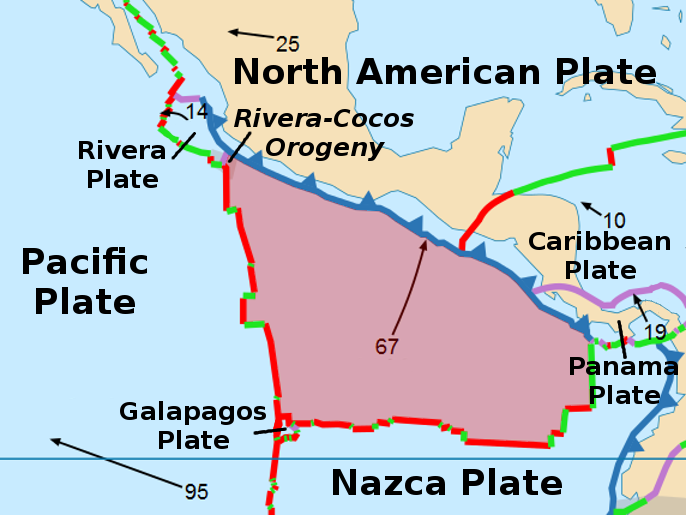
Boundaries and neighbors
The Cocos Plate sits among several other plates and microplates. Major neighbors include:
- Pacific Ocean to the west and southwest, where it shares spreading and transform features with the broader oceanic domain.
- The western margin of Central America, along which the plate's leading edge descends beneath continental and island arc crust.
- The eastern and southern border with the Nazca Plate, created by divergent spreading and later adjustments in plate geometry.
- Contacts to the north with the North American Plate and with the Pacific Plate farther west, including transform and convergent segments.
- Smaller fragments such as the Rivera microplate originated when the Cocos and surrounding plates reorganized, illustrating a complex regional mosaic.
Origin and development
The Cocos Plate formed when a larger oceanic plate fragmented during the Neogene, a process tied to the breakup of the older Farallon system. Approximately twenty to twenty-five million years ago, tectonic forces split that larger plate into distinct pieces, producing the modern Cocos and Nazca plates and leaving remnants such as the Rivera microplate. Since its formation, seafloor spreading and interaction with mantle upwellings and nearby hotspots have shaped its morphology.
Geological effects and significance
The leading edge of the Cocos Plate is being forced under the margin of Central America in a process known as subduction. This subduction zone generates the Central American Volcanic Arc, a chain of active volcanoes that stretches from southern Mexico through Guatemala, El Salvador, Nicaragua and Costa Rica to western Panama. The collision and descent of oceanic lithosphere also produce frequent earthquakes and have the potential to trigger tsunamis along the Pacific coast.
Islands, hotspots and notable features
Cocos Island is one of the landforms carried on the plate and is known for its rugged terrain and biological significance. The plate lies near the Galapagos hotspot, a mantle plume that has contributed to seamount and island formation in the eastern Pacific and influenced volcanic activity and topography on adjacent plates. Interactions between plate motion, slab geometry and mantle processes create diverse seafloor structures, including ridges and fracture zones.
Why the Cocos Plate matters
Although small in area compared with the major oceanic plates, the Cocos Plate plays a central role in the tectonics of Central America. Its subduction fuels volcanism that shapes landscapes and ecosystems, its earthquakes affect large populations, and its formation records a key episode in the breakup of ancient Pacific plates. For research and hazard assessment, understanding its motions and boundaries remains a priority for geologists and geophysicists.
Further technical details and maps can be consulted via specialist resources and regional tectonic studies: see general maps of the Pacific Ocean region, tectonic summaries for Central America, plate diagrams including the Nazca Plate, and literature on the North American and Pacific plate boundaries. Studies of subduction processes are helpful introductions to the causes of regional volcanism and seismicity (subduction), and investigations of the Galapagos hotspot illuminate the role of mantle plumes in generating islands and seamount chains.
Questions and answers
Q: What is the Cocos plate?
A: The Cocos plate is a geologically young oceanic tectonic plate located beneath the Pacific Ocean off the west coast of Central America.
Q: When was the Cocos plate created?
A: The Cocos plate was created about 23 million years ago when a larger plate broke into two pieces.
Q: What is the name of the island that rides on the Cocos plate?
A: The island that rides on the Cocos plate is called Cocos Island.
Q: What other plate was created when the larger plate broke into two pieces?
A: The other plate that was created when the larger plate broke into two pieces is the Nazca plate.
Q: What complicated set of little plates is caused by the Cocos-Nazca spreading system?
A: The complicated set of little plates caused by the Cocos-Nazca spreading system includes the Cocos, Nazca, and Rivera plates.
Q: What is the leading edge of the Cocos plate doing?
A: The leading edge of the Cocos plate is subducting (going under existing plates), which causes the Central American Volcanic Arc.
Q: What caused the Galapagos Islands?
A: The Galapagos Islands were caused by the Galapagos hotspot, which is located near the Cocos plate.
Related articles
Author
AlegsaOnline.com Cocos Plate Leandro Alegsa
URL: https://en.alegsaonline.com/art/21361
Sources
- ac.els-cdn.com : "A geodynamical perspective on the subduction of Cocos and Rivera plates beneath Mexico and Central America"
- doi.org : 10.1016/j.tecto.2012.12.039