
Cochlear implant
A cochlear implant is a surgically implanted electronic device that provides a sense of sound to people with severe to profound sensorineural hearing loss by directly stimulating the auditory nerve.
A cochlear implant is a medical device that restores a useful level of hearing for many people with severe to profound sensorineural hearing loss. Unlike a hearing aid, which amplifies sound, a cochlear implant converts acoustic signals into electrical impulses that directly stimulate the auditory nerve inside the inner ear, allowing the brain to perceive sound. The device is intended for those whose inner-ear hair cells are damaged and cannot transmit sound effectively to the nerve.
Image gallery
7 Images


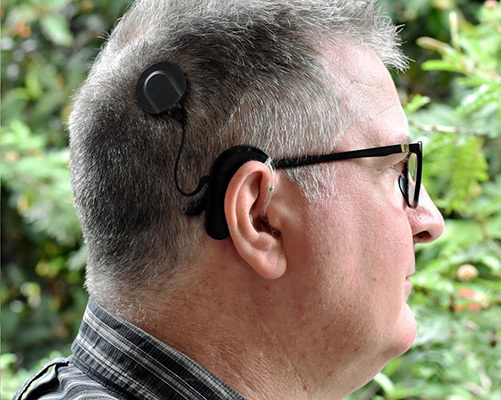

How it works
The system has external and internal components that work together. Externally, a microphone captures sounds and a speech processor analyzes and converts them into coded signals. Those signals are sent to a transmitter held in place on the skin by a magnet. Internally, an implanted receiver/stimulator accepts the transmitted signal and delivers precise electrical pulses to an electrode array surgically threaded into the cochlea. The electrodes stimulate fibres of the auditory nerve, which carry the information to the brain for interpretation.
Main parts
- Microphone — picks up environmental sounds from the front end of the system (microphone technology influences directionality and noise suppression).
- Speech processor — converts sound to a digital code that represents frequency and intensity information.
- External transmitter — sends coded signals across the skin to the internal receiver via radio or electromagnetic induction.
- Internal receiver/stimulator — implanted beneath the skin behind the ear; decodes incoming signals and controls the electrodes.
- Electrode array — a thin set of contacts inserted into the cochlea to stimulate auditory nerve fibers at different positions corresponding broadly to pitch.
History and development
Research into electrical stimulation of the auditory system began in the mid‑20th century and progressed through decades of engineering, medical trials and incremental improvements. Early experimental implants demonstrated that electrical stimulation could elicit auditory sensations; later work refined multichannel arrays and signal‑coding strategies that improved speech understanding. Over time, devices have become smaller, more reliable and better at processing complex sound, and surgical techniques have advanced to preserve residual hearing when possible.
Uses, candidacy and outcomes
Cochlear implants are typically recommended for people with severe to profound sensorineural hearing loss who receive limited benefit from conventional hearing aids. Candidates include both adults and children; early implantation in young children is often emphasized because auditory stimulation supports spoken-language development. Outcomes vary: many recipients achieve substantial improvement in speech perception and communication, while others may gain better environmental sound awareness or improved lip‑reading support. Success depends on factors such as duration of deafness, residual nerve function, rehabilitation and device programming (often called "mapping").
Limitations and notable considerations
Cochlear implants do not restore natural hearing and performance varies across individuals. Surgery carries general risks and long‑term device maintenance may include battery care, software updates and occasional hardware replacement. Certain medical imaging procedures require special precautions because of the implanted magnet. Bilateral implantation (implants in both ears) or combined electroacoustic devices for people with some residual low‑frequency hearing are options that can enhance localization and sound quality in selected cases.
Rehabilitation after implantation — including auditory training, speech therapy and regular clinical programming — is an essential part of maximizing benefit. Advances continue in electrode design, signal processing and wireless accessories, improving performance for increasingly diverse populations of users.
Questions and answers
Q: What is a cochlear implant?
A: A cochlear implant is an electronic device that is inserted by surgery into a part of the ear called cochlea, which helps persons who are having difficulty in hearing or are completely deaf to hear better.
Q: How does a cochlear implant work?
A: Cochlear implants have a microphone and some electronics that are usually placed behind the ear. These electronics send signals to the device implanted in the ear to make hearing possible.
Q: What are the external and internal parts of a cochlear implant?
A: Most cochlear implants have external parts, which are visible outside, and internal parts, which are implanted.
Q: What is the purpose of the microphone in a cochlear implant?
A: The microphone in a cochlear implant picks up sound and sends it to the electronics inside the device.
Q: Who can benefit from a cochlear implant?
A: Persons who have difficulty in hearing or are completely deaf can benefit from a cochlear implant.
Q: Is a cochlear implant fully implanted in the ear?
A: Not all parts of the cochlear implant are inside the ear. They have a microphone and some electronics that are usually placed behind the ear.
Q: What does a cochlear implant do for people who use it?
A: Cochlear implants help people who use them hear better by providing electronic signals to the inner ear.
Related articles
Author
AlegsaOnline.com Cochlear implant Leandro Alegsa
URL: https://en.alegsaonline.com/art/21320