
Cobalt(II) chloride
Cobalt(II) chloride (CoCl2) is a hygroscopic inorganic salt of cobalt in the +2 oxidation state, known for its reversible color change with hydration and its use as a humidity indicator and laboratory reagent.
Cobalt(II) chloride is an inorganic compound composed of cobalt and chloride with the empirical formula CoCl2. It contains cobalt in the +2 oxidation state, often written as Co(II) or cobalt(II), and chloride anions. The compound occurs in several hydrated forms and as an anhydrous solid; these forms differ in color and physical behavior.
Image gallery
10 Images


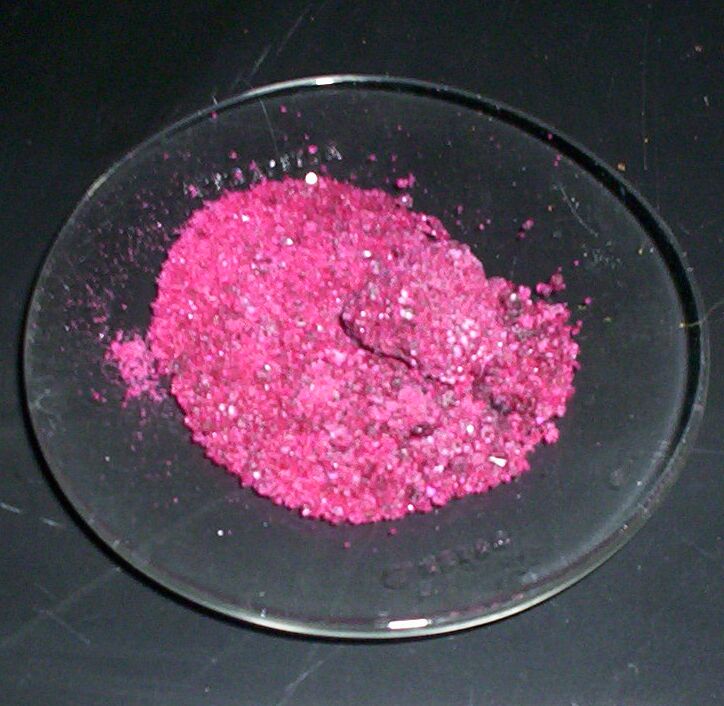


Physical and chemical characteristics
The most familiar distinction is between the anhydrous salt, which is typically blue, and the common hexahydrate, CoCl2·6H2O, which appears pink. This reversible color change on gaining or losing water makes the material strongly hygroscopic. In solution and in many coordination complexes cobalt(II) adopts an octahedral coordination geometry and participates readily in ligand exchange and redox chemistry under suitable conditions.
Preparation and reactions
Laboratory preparation typically involves dissolving cobalt metal, oxide or carbonate in hydrochloric acid, followed by crystallization to give hydrated forms. Heating the hydrate removes water to yield the blue anhydrous salt; exposure to moisture returns it to the pink hydrate. Cobalt(II) chloride can form complexes with ammonia, water and other ligands and reacts with bases to give cobalt(II) hydroxide and related species.
Uses and examples
Because of its pronounced and reversible color change with humidity, cobalt(II) chloride has been widely used as a moisture indicator in desiccants, humidity test papers and some laboratory applications. Other uses include its role as a reagent in chemical synthesis, as a precursor in electroplating or catalyst preparation, and in academic demonstrations of coordination chemistry.
Safety, handling and notable facts
Cobalt salts can be toxic and may cause skin sensitization or other adverse health effects; some cobalt compounds are regarded as hazardous and must be handled with appropriate protective measures and waste controls. In many jurisdictions their use as consumer humidity indicators has been reduced or regulated for safety reasons. The element name "cobalt" derives from a historical term for troublesome ores, reflecting the metal's long association with colored pigments and minerals.
Quick reference
- Formula: CoCl2
- Common hydrated form: hexahydrate (pink)
- Anhydrous form: blue, hygroscopic
- Typical applications: humidity indicators, reagents, catalysts (chloride ions and coordination chemistry)
- Further reading and suppliers: see technical and safety sources (material safety data)
Questions and answers
Q: What is cobalt(II) chloride?
A: Cobalt(II) chloride is a chemical compound that contains cobalt in its +2 oxidation state and has the chemical formula CoCl2.
Q: What are the other names for cobalt(II) chloride?
A: Cobalt(II) chloride is also known as cobaltous chloride and cobalt dichloride.
Q: What is the oxidation state of cobalt in cobalt(II) chloride?
A: The oxidation state of cobalt in cobalt(II) chloride is +2.
Q: What chemical formula does cobalt(II) chloride have?
A: The chemical formula of cobalt(II) chloride is CoCl2.
Q: What ions does cobalt(II) chloride contain?
A: Cobalt(II) chloride contains cobalt and chloride ions.
Q: Is cobalt(II) chloride a pure element or a compound?
A: Cobalt(II) chloride is a compound.
Q: What is the significance of the +2 oxidation state of cobalt in cobalt(II) chloride?
A: The +2 oxidation state of cobalt in cobalt(II) chloride indicates the number of electrons that cobalt has lost or gained, which is essential for understanding the chemical behavior and reactivity of the compound.
Related articles
Author
AlegsaOnline.com Cobalt(II) chloride Leandro Alegsa
URL: https://en.alegsaonline.com/art/21284