
Coat of arms of the State of New York
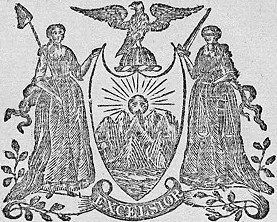
The coat of arms of New York, adopted in 1778, features a river landscape on a shield, supporters Liberty and Justice, a crested eagle on a globe, and the motto Excelsior; it appears on the state flag and seal.
Overview
The coat of arms of the state of New York was formally adopted in 1778 and serves as the central device on the state seal and flag. The design combines a pictorial shield, human supporters, a crest, and a motto to express political ideals and regional identity. Variations of the artwork have been used by state government, on official documents, and on public buildings.
Image gallery
7 Images


Principal elements and symbolism
- Shield: The central shield shows a river scene with a fully rigged ship and a smaller sloop on the Hudson River, a grassy shore and a distant range of mountains, and a rising sun with a human face. The ships symbolize inland and foreign commerce while the sunrise suggests renewal and a new era.
- Crest: Above the shield sits an American bald eagle perched on a globe, a common symbol linking the state to the federal union and to wider maritime and commercial horizons.
- Supporters: Flanking the shield are two allegorical figures: Liberty, who holds a staff topped by a liberty cap and stands with a foot on a crown, and Justice, often depicted blindfolded and bearing scales and a sword. Together they represent freedom and the rule of law.
- Motto: Beneath the shield a ribbon bears the single-word motto "Excelsior," Latin for "Ever upward," adopted as an aspirational state motto.
The pictorial Hudson River landscape is notably naturalistic rather than strictly heraldic, a feature that reveals the design's modern, post‑colonial origins and distinguishes it from older European coats of arms. The sun with a face is a decorative touch found in several 18th‑century American emblems.
History and development
First chosen during the Revolutionary period, the composition has been refined over time; artists and engravers altered proportions, coloring, and detail in subsequent reproductions. During the 19th century the elements and colors were increasingly standardized for use on flags, seals, and official stationery, though minor variations still appear in different media and restorations.
Uses and distinctions
The coat of arms appears at the center of the New York state flag and within the circular great seal used for formal acts of government. It also figures on judicial and legislative documents, some license plates, and other state insignia. When discussing New York's symbols it is useful to distinguish between the coat of arms (the heraldic composition itself), the state seal (a stamped or embossed device that includes the arms), and the flag (a blue field bearing the coat of arms).
For further official descriptions and visual examples see the state's pages on the coat of arms, the state of New York emblem pages, and reproductions on the state flag. Scholarly discussions of design choices—such as the unheraldic landscape treatment—or the role of the Hudson River in regional symbolism can provide deeper historical context.
Questions and answers
Q: When was the coat of arms of New York adopted?
A: The coat of arms of New York was formally adopted in 1778.
Q: What components does the coat of arms of New York appear on?
A: The coat of arms of New York appear as a component of the state's flag and seal.
Q: What symbols are displayed on the shield?
A: The shield displays a masted ship and a sloop on the Hudson River, which are symbols of inland and foreign commerce.
Q: What is bordered by a grassy shore and a mountain range in the background with the sun rising behind it?
A: The masted ship and sloop on the Hudson River are bordered by a grassy shore and a mountain range in the background with the sun rising behind it.
Q: What is the unheraldic nature of the Hudson River landscape a reveal of?
A: The unheraldic nature of the Hudson River landscape reveals the modern origin of the design.
Q: What does the sun have on it?
A: The sun has a face on it.
Q: What is the coat of arms of New York?
A: The coat of arms of New York is a symbol of the state of New York, appearing on its flag and seal. It features a masted ship and sloop on the Hudson River, a grassy shore, and a mountain range, with the sun rising behind it. It was formally adopted in 1778 and has a modern origin.
Related articles
Author
AlegsaOnline.com Coat of arms of the State of New York Leandro Alegsa
URL: https://en.alegsaonline.com/art/21262