
Clouded leopard (Neofelis nebulosa): description, behavior, and conservation
Medium-sized Asian forest cat with distinctive 'cloud' markings. Arboreal hunter found from the Himalayas through Southeast Asia to China; vulnerable due to habitat loss and poaching.
Overview
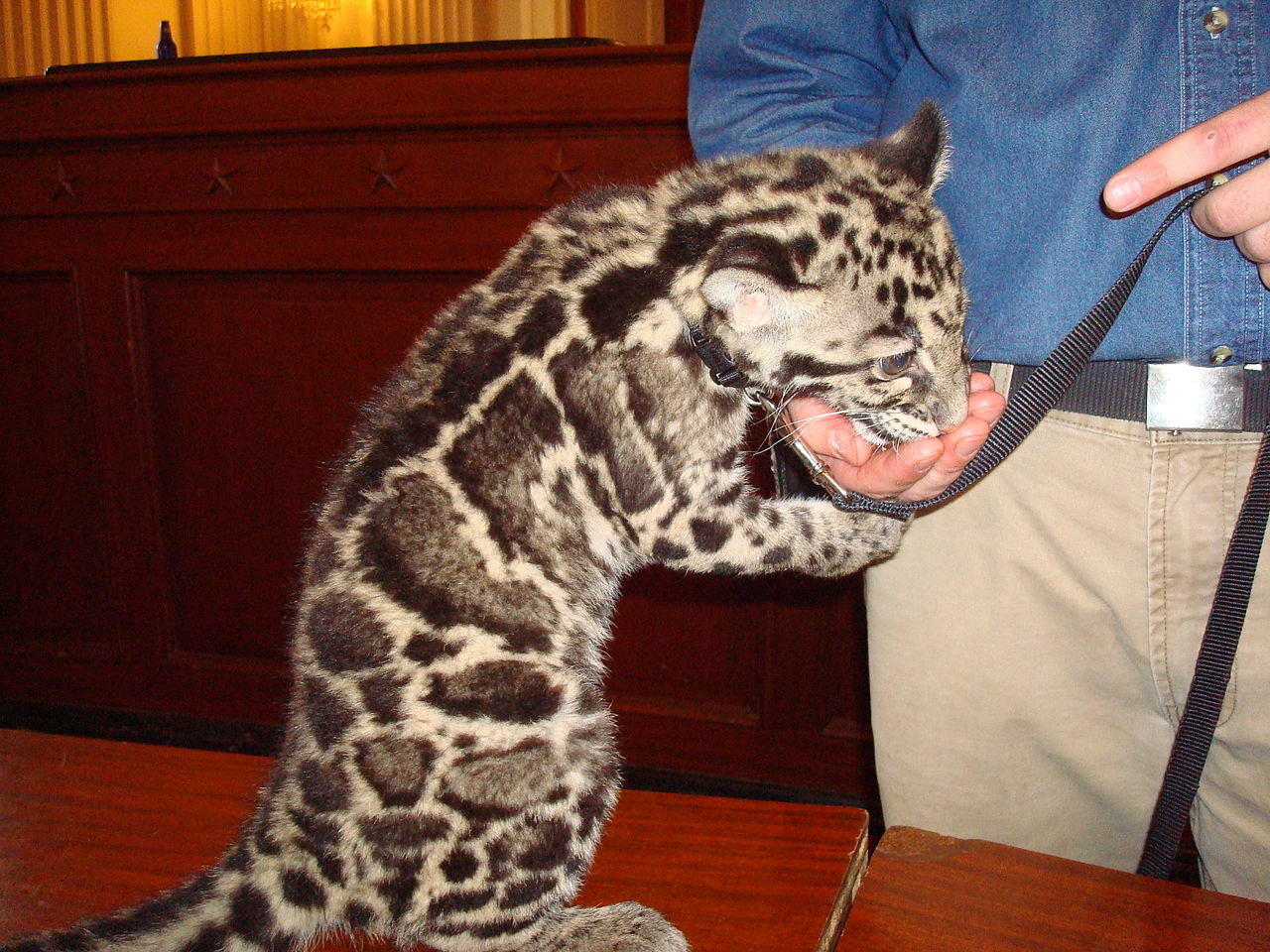
The clouded leopard (Neofelis nebulosa) is a medium-sized wild cat native to forests of South and Southeast Asia. It is named for its striking coat pattern: large, irregular dark-edged blotches with paler centers that resemble clouds. Adults typically measure about 55–110 cm in body length and weigh around 15–23 kg. The species occurs from the Himalayan foothills through mainland Southeast Asia into parts of China. The IUCN lists the clouded leopard as vulnerable, and estimates suggest fewer than 10,000 mature individuals remain in the wild.
Image gallery
10 Images




Physical characteristics
Clouded leopards combine a compact, muscular build with adaptations for climbing. Their coat provides cryptic camouflage in dappled forest light, and males are generally larger than females. One of the most notable features is their relatively long canine teeth compared with body size, which give them a distinctive skull profile. They have strong, flexible limbs and a long tail that aids balance in trees. These morphological traits allow the species to move easily along branches, leap between trunks, and ambush prey both arboreally and on the ground.
Behavior and ecology
Primarily solitary and secretive, clouded leopards are most active at night or during twilight hours. They are competent hunters in the trees as well as on the forest floor, taking a variety of prey including primates, small ungulates, birds and other vertebrates. Their climbing skills are exceptional: they can descend trees headfirst, climb down trunks with ease, and suspend themselves from branches using their hind limbs. This arboreal ability distinguishes them from many other felids and enables hunting strategies that exploit canopy-dwelling species. For more on arboreal adaptations, see arboreal resources.
Taxonomy and evolutionary history
The genus Neofelis contains closely related forms including the mainland clouded leopard and the Sunda clouded leopard. Genetic studies indicate that the mainland species diverged from its Sunda relatives in the distant past; one estimate places the split between the two Neofelis lineages at roughly 1.4 million years ago. During cycles of lower sea level in the Pleistocene, ancestral populations likely crossed now-submerged land bridges to reach islands such as Borneo and Sumatra. Populations on the Sunda islands have distinctive traits and are often treated as separate taxa or subspecies by some authorities. Later geological and climatic events, including the massive eruption of the Toba supervolcano tens of thousands of years ago, and subsequent sea level rises during the Pleistocene, helped shape current patterns of distribution and genetic divergence.
Conservation status and threats
Clouded leopards face several threats across their range. Habitat loss and fragmentation from logging, agricultural expansion and infrastructure development reduce available forest and disrupt movement and breeding. Illegal hunting and commercial trade for pelts, skulls and body parts also contribute to declines. Small, isolated populations are vulnerable to inbreeding and local extirpation. Conservation measures focus on habitat protection, anti-poaching law enforcement, and research to improve understanding of population size, connectivity and ecology.
Importance, management and notable facts
- Role in ecosystems: as mid-sized predators, clouded leopards help regulate populations of arboreal and terrestrial prey species and contribute to forest ecosystem balance.
- Captive care and research: zoological institutions often participate in breeding programs and behavioral studies to inform conservation planning.
- Distinctive climbing ability: among felids, clouded leopards are especially adapted to life in the trees, capable of hunting and resting high in the canopy.
- Public awareness: protecting clouded leopards also preserves forest habitats that house many other species and provide ecosystem services for human communities.
Effective conservation requires coordinated action across national boundaries, continued field research to refine population estimates and genetic relationships, and community-based approaches that reduce conflict and dependence on habitat-destructive practices. For regional information and conservation initiatives, consult resources linked in the preceding sections such as those for Southeast Asia and China.
Questions and answers
Q: What is the scientific name of the clouded leopard?
A: The scientific name of the clouded leopard is Neofelis nebulosa.
Q: How long and how much does a clouded leopard typically weigh?
A: A clouded leopard typically measures between 55 to 110 cm (2 ft to 3 ft 6 in) long and weighs between 15 and 23 kg (33 to 50 lb).
Q: Is the clouded leopard classified as endangered?
A: The clouded leopard is classified as vulnerable by IUCN in 2008.
Q: What do they hunt for food?
A: Clouded leopards hunt monkeys and birds for food.
Q: Are they arboreal cats?
A: Yes, they are one of the few cats who are arboreal.
Q: When did Neofelis nebulosa and Neofelis diardi diverge from each other?
A: Genetic analysis suggests that Neofelis nebulosa and Neofelis diardi diverged 1.4 million years ago.
Q: How did Sunda Clouded Leopards get to Borneo and Sumatra from mainland Asia?
A: A group crossed a now submerged land bridge to Borneo and Sumatra from mainland Asia.
Q: What event caused separation between two subspecies of Sunda Clouded Leopards on Borneo and Sumatra ?
A: The split between the two subspecies corresponds roughly with the catastrophic eruption of the Toba supervolcano in Sumatra 69,000–77,000 years ago.
Related articles
Author
AlegsaOnline.com Clouded leopard (Neofelis nebulosa): description, behavior, and conservation Leandro Alegsa
URL: https://en.alegsaonline.com/art/21109
Sources
- bucknell.edu : "Species Neofelis nebulosa"
- google.com : Mammal Species of the World
- worldcat.org : 62265494
- iucnredlist.org : Neofelis nebulosa
- iucnredlist.org : iucnredlist.org/details/14519/0
- bbc.co.uk : Canopy carnivore. BBC Nature
- cell.com : cell.com/current-biology/abstract/S0960-9822(06)02133-6
- sciencedirect.com : sciencedirect.com/science?_ob=MImg&_imagekey=B6WNH-51FGT0V-3-K&_cdi=6963&_user=10&_pii=S1…