
Climate sensitivity: how Earth's temperature responds to greenhouse forcing
Climate sensitivity measures how much global temperature changes after a sustained change in radiative forcing, commonly defined as the warming from a doubling of atmospheric CO2.
Overview
Climate sensitivity is a concise way to describe how much Earth's average surface temperature will change in response to a sustained change in the planet's energy balance. The most common measure, equilibrium climate sensitivity (ECS), asks how much warmer the planet would become after atmospheric carbon dioxide (CO2) is doubled relative to pre‑industrial levels and the climate system reaches a new long‑term balance. A related, shorter‑term metric is the transient climate response (TCR), which captures warming over decades rather than centuries. For further background on basic greenhouse warming and causes of modern climate change, see introductory resources.
Image gallery
3 Images

Key concepts and numbers
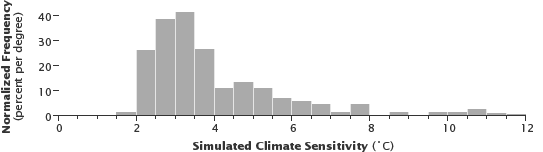
Doubled CO2 produces an increase in downward radiative forcing at the top of the atmosphere of roughly 3.7 watts per square metre (often rounded to about 4 W/m²). That forcing by itself does not determine the final temperature change — the climate system's feedbacks amplify or reduce the initial effect. A widely cited central estimate for ECS is near 3 °C per CO2 doubling, though studies and assessment reports give a range of plausible values. Many older and widely used assessments report credible ranges that span roughly 1.5–4.5 °C; more recent work has refined estimates but uncertainty remains. For summaries of these assessments and data sources, consult technical summaries and review articles.
Feedbacks that control sensitivity
- Water vapor and lapse rate: Warmer air holds more moisture, and water vapor is a strong greenhouse gas; interactions with vertical temperature structure alter warming.
- Surface albedo: Melting snow and ice reduce reflectivity, letting the surface absorb more solar energy.
- Clouds: Changes in cloud amount, altitude and type can either amplify or damp warming and are a major source of uncertainty.
- Carbon cycle interactions: Warming can release or store greenhouse gases from soils and oceans, modifying long‑term concentrations.
These feedbacks operate on different time scales. Some, like water vapor adjustments, act quickly; others, such as ice sheet responses or slow carbon cycle feedbacks, play out over decades to millennia.
Variants and how they are used
ECS and TCR are the two standard formal definitions used in scientific and policy contexts. ECS represents the equilibrium (long‑term) response, while TCR measures warming at the time CO2 reaches doubling under a scenario of gradually increasing CO2 (often used to characterize near‑term climate commitment). Observational analyses, paleoclimate records, and climate models each constrain these quantities in complementary ways; see observational constraints, paleoclimate evidence, and modeling studies for methods and examples.
Importance for policy and projections
Climate sensitivity is a central parameter for estimating future warming under different emissions pathways and for calculating remaining carbon budgets consistent with temperature targets. Higher sensitivity means smaller allowable cumulative CO2 emissions to avoid a given amount of warming. Because the exact value is uncertain, sensitivity contributes materially to the range of projected outcomes used by planners and negotiators. For accessible summaries and policy‑oriented explanations, see further reading.
Notable facts: sensitivity is not a fixed universal constant — it can depend on the background climate state and on the pattern of forcing — and research continues to refine estimates and reduce uncertainty through improved observations, process understanding and model development.
Questions and answers
Q: What is causing the Earth to get warmer?
A: People are putting greenhouse gases into the atmosphere, which is called the greenhouse effect.
Q: What is the biggest source of carbon dioxide in the atmosphere?
A: Burning coal is the biggest thing that puts carbon dioxide (CO2) into the atmosphere.
Q: What does climate sensitivity mean?
A: Climate sensitivity means how much the Earth will warm when a certain amount of CO2 is released into the atmosphere. It usually refers to how much warmer it would be if there was twice as much CO2 in the atmosphere than what was present in 1750 before people started burning lots of coal.
Q: How much extra heat gets trapped when CO2 doubles in the atmosphere?
A: When CO2 doubles in the atmosphere, an extra 4 joules of heat gets trapped every second on every square metre on Earth.
Q: How hot will Earth become after a long time if CO2 doubles?
A: After a long time, scientists think that if CO2 doubles, then Earth will be about 3°C hotter.
Q: What stops some heat from escaping from Earth?
A: Greenhouse gases stop some heat from escaping from Earth, which is why it's called "the greenhouse effect".
Related articles
Author
AlegsaOnline.com Climate sensitivity: how Earth's temperature responds to greenhouse forcing Leandro Alegsa
URL: https://en.alegsaonline.com/art/20995
Sources
- metoffice.gov.uk : "What is 'climate sensitivity'?"
- youtube.com : "Energy basics"
- environment.gov.au : "Climate sensitivity: fact sheet"
- carbonbrief.org : "Explainer: How scientists estimate climate sensitivity"
- doi.org : 10.1038/s41558-018-0097-x
- worldcat.org : 1758-6798
- agupubs.onlinelibrary.wiley.com : "Causes of Higher Climate Sensitivity in CMIP6 Models"
- doi.org : 10.1029/2019GL085782
- worldcat.org : 1944-8007
- gfdl.noaa.gov : Transient and Equilibrium Climate Sensitivity