
Clay animation: technique, history, and uses
Clay animation (claymation) is a stop-motion method using malleable materials to create frame-by-frame motion. This article covers materials, workflow, history, notable examples, and how it differs from other animation forms.
Clay animation is a form of stop-motion animation in which figures and sets are modeled from soft, re-shapable materials and photographed one frame at a time. Because the same physical object is altered slightly between frames, when the sequence is played back it appears to move. Artists commonly use non-drying modeling compounds such as Plasticine or oil-based clays so characters can be reshaped repeatedly without cracking.
Image gallery
4 Images


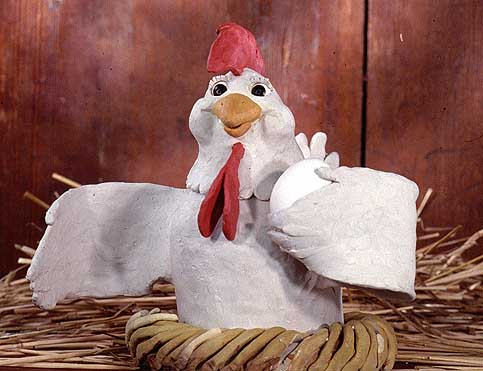
Materials and basic process
The core idea is simple: create a poseable armature or support, cover it with clay, position it, take a photograph, adjust the model, and repeat. Typical components include:
- Internal armature (wire, ball-and-socket joints) to hold poses.
- Modeling clay that remains pliable during shooting.
- Tools for sculpting small details and textures.
- Consistent lighting and a fixed camera mount to avoid flicker.
- Software or hardware that lets the animator review frames and check motion timing.
Most moving-image work follows the same frame-by-frame principle—whether traditional cel work or stop motion—so clay animation shares foundational techniques with other forms of animation. Frames are recorded on film or digital media, and the illusion of continuous motion depends on the chosen frame rate and how the brain integrates successive images; the animator exploits this aspect of human perception to sell smooth movement.
History and notable practitioners
Clay-based stop motion became widely recognized in the mid-20th century. Early television and short-film experiments used clay for its flexibility and sculptural possibilities. The technique was developed further by independent animators and studios; it later gained mainstream attention through distinctive characters and short films created by pioneers and companies in both the United States and United Kingdom. Over time, variations of clay techniques have been adapted to suit advertising, television, and cinematic storytelling.
Applications and examples
Clay animation is used for short films, television series, commercials, and feature films. Its tactile look—visible fingerprints, soft edges, and the ability to transform a model from one form to another—gives it a unique expressive quality that is hard to replicate in computer animation. While modern projects sometimes combine clay stop motion with digital compositing and effects, the hands-on nature of the craft contrasts with fully computer-generated imagery such as CGI.
Characteristics and distinctions
Compared with other stop-motion materials (puppets, cut-outs) clay allows seamless metamorphosis and fine surface manipulation, but it is also labor-intensive and sensitive to temperature and handling. Animators take precautions—careful storage, controlled lighting, and incremental changes—to maintain continuity. The medium rewards patience: small gestures and subtle deformations can convey personality and comedic timing in ways that feel immediate and organic.
For anyone interested in learning, small tabletop exercises—creating a simple walking loop or a short transformation—are excellent introductions. Resources on materials, armature construction, and frame-by-frame workflow are widely available for beginners and professionals alike, and the clay technique remains a vibrant and expressive branch of stop-motion practice.
Plasticine and modeling clays, animation basics, digital capture, frame rate, perception of motion, and CGI contrasts are useful starting points for further reading.
Questions and answers
Q: What is clay animation?
A: Clay animation is one of the many ways to create a stop motion animation where each character or background is made out of soft materials like Plasticine clay.
Q: What is the process of making animation?
A: Most animation, whether it is cel animation or stop motion, is made the same way. Each frame or still picture is recorded on film or digital media and then played back quickly at a frame rate of more than 10-12 frames per second.
Q: How does the human mind perceive movement in animation?
A: When the series of slightly changing, rapidly playing images are played back at a frame rate of more than 10-12 frames per second, the human mind sees it as movement, and it appears as if the object is moving by itself.
Q: What is the connection between zoetrope, movies, and video games?
A: All moving images, from zoetrope to movies to video games, use the same method of tricking the human mind into seeing "movement."
Q: How is CGI animation different from traditional animation?
A: CGI animation is different from traditional animation as it's made using a different method and process, rather than frame by frame.
Q: What is cel animation?
A: Cel animation is a traditional animation process where each frame is drawn by hand on a transparent piece of celluloid.
Q: What material is commonly used in creating clay animation?
A: Plasticine clay is commonly used in creating clay animation.
Related articles
Author
AlegsaOnline.com Clay animation: technique, history, and uses Leandro Alegsa
URL: https://en.alegsaonline.com/art/20834