
Classical elements (Greek theory and comparative traditions)
Overview of the classical elements: origins in ancient Greek thought, their qualities and medical links, later use in alchemy and astrology, and comparisons with Chinese and Indian elemental systems.
The term classical elements generally denotes a small set of basic principles or constituents that ancient thinkers proposed to explain the variety and change of natural phenomena. In the best-known Western lineage these are fire, air, water and earth. This fourfold scheme is a persistent feature of early Greek philosophy, and it appears across scientific, medical and literary writings grouped under the label classical elements. Philosophers and physicians used the elements as both explanatory materials and symbolic categories.
Image gallery
10 Images

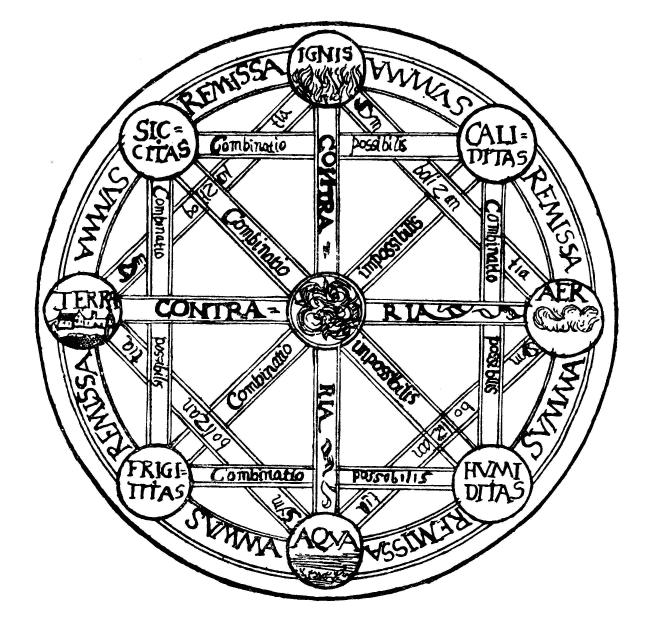


Origins and development in Greek thought
The idea of elemental roots appears in pre-Socratic thought: for example, philosophers debated whether a single principle or multiple principles underlay change. Empedocles (5th century BCE) is commonly credited with articulating the four roots that became standard in later accounts. Plato and Aristotle developed more systematic accounts, and Aristotle in particular analysed the elements in terms of qualitative pairs and natural places in his physical writings. Medieval and early modern commentators read these Greek sources closely, so the classical element theory endured in European learned culture for many centuries.
Qualities, transformations and pairings
Each of the four elements was associated with two opposite qualities drawn from the pairs hot vs cold and dry vs wet. The standard assignments were:
- Fire: hot and dry
- Air: hot and wet
- Water: cold and wet
- Earth: cold and dry
These qualities provided a way to model transformation: for instance, a change of heat or moisture could be described as one element altering into another. Such qualitative thinking functioned as a proto-scientific explanatory scheme before the development of modern chemical and physical theory.
Medicine and the humours
In ancient medical systems the elements were linked with bodily fluids and temperaments. The Hippocratic corpus uses elemental language, and later Galenic medicine made the correspondence explicit: Galen attributed to earlier practitioners such as Hippocrates a practice of describing bodily conditions in elemental terms and himself developed a detailed humoral physiology. In the humoral model each element corresponds to one of the four humours—phlegm, blood, yellow bile and black bile—which were thought to affect health and temperament through their balance of hot/cold and dry/wet qualities. This framework guided diagnosis and treatment in European and Mediterranean medicine well into the early modern era, and it shaped dietary, environmental and therapeutic recommendations recorded in medical texts (medicine).
Alchemy, astrology and symbolic reception
Beyond medicine, the classical elements were adopted and reinterpreted by alchemists, astrologers and artists. Alchemists used elemental names and symbols to describe processes of transformation, sometimes in literal chemical practice and sometimes in symbolic or spiritual registers. Astrology linked elements to groups of zodiac signs and to temperamental types, influencing cultural notions of personality and fate. While modern chemistry and physics no longer treat the four elements as physical constituents, their symbolic resonance persists in literature, ritual, visual arts and popular culture.
Comparative traditions
Many other cultural systems propose small sets of principles that play roles comparable to the Greek elements, but they often differ in number, emphasis and underlying philosophy. In South Asia the fivefold grouping called the pañcabhūta adds space or ether (ākāśa) to water, earth, fire and air, and these categories are integrated into classical Indian cosmology, medicine and yoga practices. In East Asia the Chinese five-phase system, commonly known as wuxing, lists metal, wood, water, fire and earth; this model is central to many strands of Taoist thought and to practical arts such as traditional medicine and feng shui, often discussed under the rubric of Chinese healing and cosmology. A key difference is that wuxing emphasizes cycles of generation and control among phases, whereas the Greek scheme more often functions as a taxonomy of elemental roots or qualities.
Interpretation and legacy
Scholars treat the classical elements as both historical scientific ideas and as enduring cultural symbols. Historically, they represented a coherent explanatory technique for natural philosophers and physicians prior to the chemical revolution. Culturally, elemental categories have been repurposed in religious thought, literature, visual arts and modern popular media. When reading historical texts or encountering elemental motifs in art and ritual, it is useful to distinguish literal theoretical claims (about matter and health) from metaphorical or symbolic uses.
For concise introductions consult general surveys of Greek philosophy, histories of science and treatments of pre-modern Galenic medicine. Comparative studies of elemental thought and overviews of non-Western frameworks provide context for the Chinese wuxing and the Indian pañcabhūta, and they illuminate how elemental models organized empirical observation and symbolic meaning across cultures.
Suggested starting points for further study include works on the four elements in antiquity, histories of humoral medicine, introductions to alchemy and astrology, and comparative treatments that place the Greek scheme alongside Chinese and South Asian traditions of elemental ordering.
Questions and answers
Q: What are the Greek classical elements?
A: The Greek classical elements are fire, air, water, and earth.
Q: In what fields of knowledge are the Greek classical elements used?
A: The Greek classical elements are used in Greek philosophy, science and medicine.
Q: What are the properties of fire according to Greek philosophy?
A: Fire is both hot and dry according to Greek philosophy.
Q: What are the properties of air according to Greek philosophy?
A: Air is both hot and wet according to Greek philosophy.
Q: What are the properties of water according to Greek philosophy?
A: Water is both cold and wet according to Greek philosophy.
Q: What are the properties of earth according to Greek philosophy?
A: Earth is both cold and dry according to Greek philosophy.
Q: What are the four humours and how are they linked to the Greek classical elements?
A: The four humours are phlegm (water), yellow bile (fire), black bile (earth), and blood (air). They are linked to the Greek classical elements in the following way: phlegm to water, yellow bile to fire, black bile to earth, and blood to air.
Related articles
Author
AlegsaOnline.com Classical elements (Greek theory and comparative traditions) Leandro Alegsa
URL: https://en.alegsaonline.com/art/20774