
Class struggle: social conflict between economic groups
Conflict between social classes over resources, power and status. Central to Marxist thought and widely used in sociology to explain political change, labour relations and inequality.
Class conflict, commonly called class struggle, describes sustained tension or opposition between social groups whose interests differ because of their economic positions and access to resources. Observers use the term to draw attention to how wealth, property and power shape disputes over wages, political influence and social recognition. The idea is a tool in analysis rather than a single, narrowly defined event: it can mean strikes and revolutions, or ongoing structural competition that affects everyday life and institutions in society.
Image gallery
10 Images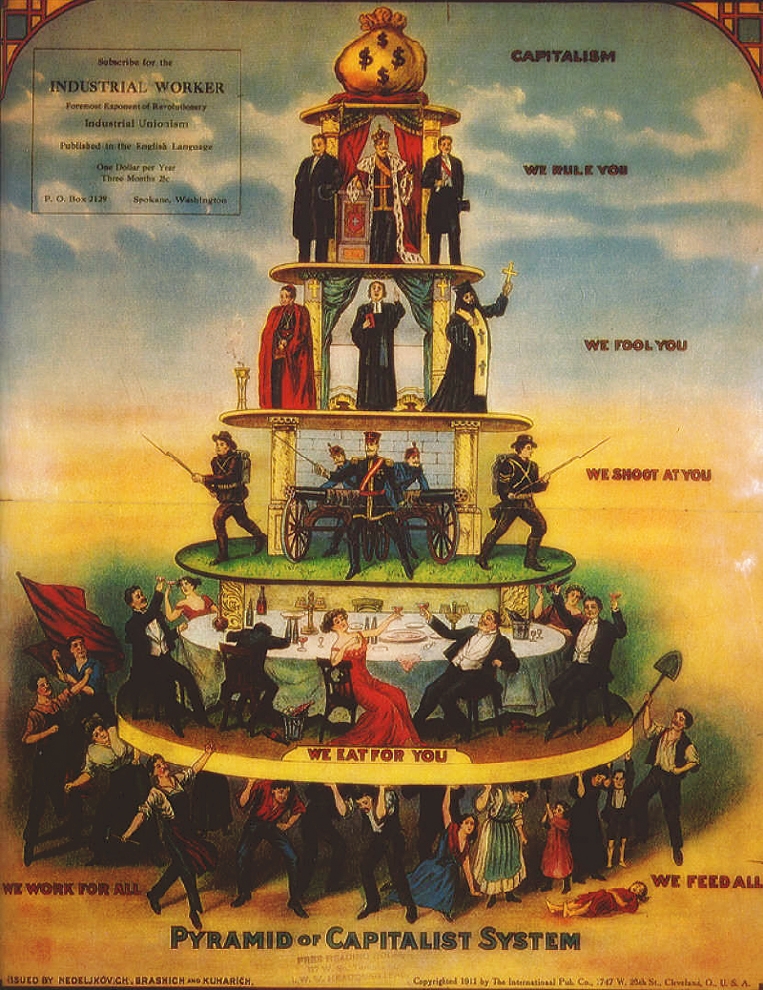


Theoretical origins
Class struggle is most closely associated with Marxism, where it appears as a driving force of historical change. Marxist theory argues that societies are organized by class relations rooted in economic production, and that conflict between classes generates social transformation. Related currents of socialism and other left traditions also emphasize antagonisms produced by unequal control over productive resources. Foundational thinkers such as Karl Marx and Friedrich Engels articulated these ideas in influential works including The Communist Manifesto and Das Kapital, where class relations, exploitation and historical dynamics are examined in detail.
Characteristics and forms
Social scientists group people into classes by patterns of income, property, occupation and cultural markers; these efforts are part of broader work in social sciences. In classical Marxist terms the main antagonists are the bourgeoisie, owners of capital and the means of production, and the proletariat, who sell their labour. But class conflict appears in varied forms: collective bargaining and strikes, political mobilization, legal battles over taxation and welfare, cultural struggles over status, and structural conflict built into market institutions.
History and examples
Throughout modern history, class-based conflict has taken multiple shapes. In some periods it produced large-scale political upheaval and social reform; in others it led to incremental policy changes such as labour protections, union recognition and welfare-state measures. Industrialization, urbanization and the rise of wage labour expanded the visibility of class tensions by concentrating workers and owners in factories, while later developments in finance and globalization reshaped how capital and labour interact across borders.
Contemporary relevance
Today, class issues remain central to debates about inequality, taxation, labour rights and public services. Class conflict intersects with other social divisions—race, gender, ethnicity and education—so contemporary movements often combine economic claims with demands for recognition and legal equality. Political parties, social movements and policy debates continue to reflect competing class interests in arenas from electoral politics to corporate governance and international trade.
Criticism and distinctions
Not all scholars treat class struggle as the sole or primary explanation for social change. Pluralist and institutionalist perspectives emphasize negotiation among many groups and interests rather than a binary class fight. Some critics argue that focusing only on class overlooks cultural factors and the role of middle classes and professional strata. Nevertheless, the concept remains a powerful analytic lens for interpreting persistent inequalities and the conflicts that arise from them.
Further reading and contextual resources: class struggle overview, society and conflict, Marxist theory, socialist approaches, social sciences methods, bourgeoisie, capital, means of production, proletariat, labour, Karl Marx, Friedrich Engels, The Communist Manifesto, Das Kapital.
Questions and answers
Q: What is class struggle?
A: Class struggle is the tension or antagonism in a society caused by different groups of people with different economic interests.
Q: What is the main idea behind the concept of class struggle?
A: The main idea is that there is a struggle between two main classes of people - the bourgeoisie who control capital and means of production and the proletariat who provide labor.
Q: What are the social sciences groups people into?
A: They group people into classes based on similar social features, mostly economic ones.
Q: How many main classes of people are there, according to Marxism?
A: According to Marxism, there are two main classes of people - the bourgeoisie and the proletariat.
Q: Who controls the capital and means of production?
A: The bourgeoisie controls the capital and means of production.
Q: What is the struggle between the bourgeoisie and the proletariat known as?
A: The struggle between the bourgeoisie and the proletariat is known as class struggle.
Q: What made the concept of class struggle well known?
A: The Communist Manifesto and Das Kapital made the concept of class struggle well known.
Related articles
Author
AlegsaOnline.com Class struggle: social conflict between economic groups Leandro Alegsa
URL: https://en.alegsaonline.com/art/20759