
City of the Living Dead
City of the Living Dead is a 1980 Italian supernatural horror film by Lucio Fulci, known for its dreamlike atmosphere, graphic practical effects, and status as part of Fulci's unofficial 'Gates of Hell' trilogy.
City of the Living Dead is a 1980 Italian supernatural horror film directed by Lucio Fulci. Released internationally under alternate English titles such as The Gates of Hell, the movie is widely remembered for its bleak mood, surreal imagery and conspicuous practical gore effects. The original Italian title appears as Paura nella città dei morti viventi and translates roughly to "Fear in the City of the Living Dead." The cast includes Christopher George and Catriona MacColl, among others, and Fulci's filmmaking style—lurid, elliptical and atmospheric—is prominent throughout.
Image gallery
2 Images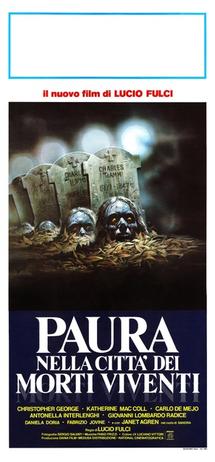

Overview and plot elements
The plot follows supernatural events triggered when a clergyman's suicide opens a supernatural gateway; as a result the living and dead begin to overlap, producing hauntings, possessions and reanimated corpses. The film intercuts scenes of investigation and flight with vivid sequences that prioritize mood and shock over conventional narrative logic. Rather than a tightly plotted thriller, the film operates as a sequence of nightmarish tableaux that emphasize decay, isolation and the breakdown of ordinary reality.
Production and style
Shot in the late 1970s and released in 1980, the film bears many hallmarks of Italian genre cinema of the period: economical sets, dubbed soundtracks for different markets, and a focus on striking visual and practical effects. The score, notable for its eerie and memorable motifs, complements the film's hallucinatory tone. Fulci's direction favors long, ambiguous sequences and abrupt transitions, producing a dreamlike rhythm that has divided viewers and critics.
Reception and legacy
On release the picture met mixed reviews—some critics condemned its gore and loose plotting while other viewers praised its atmosphere and visual audacity. Over time it gathered a devoted cult audience and is often discussed alongside two other Fulci films as an informal "Gates of Hell" trilogy, a grouping that highlights the director's recurring interest in portals, the supernatural and graphic decay. Contemporary assessments typically note its influence on splatter and supernatural horror filmmakers.
Notable features and differences
- Emphasis on practical effects and makeup rather than modern digital techniques.
- Multiple international versions and edits, which produced variations in running order and explicit content between releases.
- Atmosphere and imagery prioritized over strict narrative coherence, making the film as much an experience of mood as a conventional story.
Today the film is studied by fans and scholars of horror for its contribution to late 20th-century genre cinema and for the distinctive, uncompromising voice of its director. While not universally admired, it remains an important example of Italian horror's willingness to combine surrealism, visceral effects and stark emotion.
Questions and answers
Q: What is City of the Living Dead?
A: City of the Living Dead is a 1980 Italian horror movie directed by Lucio Fulci that starred Christopher George, Catriona MacColl, Carlo de Mejo, Luciano Rossi, and Lucio Fulci himself.
Q: Who directed City of the Living Dead?
A: City of the Living Dead was directed by Lucio Fulci.
Q: When was City of the Living Dead produced?
A: City of the Living Dead was produced in 1980.
Q: Who were the main actors in City of the Living Dead?
A: The main actors in City of the Living Dead were Christopher George, Catriona MacColl, Carlo de Mejo, Luciano Rossi, and Lucio Fulci.
Q: What type of movie is City of the Living Dead?
A: City of the Living Dead is an Italian horror movie.
Q: What is the English translation of the Italian title "Paura nella città dei morti viventi"?
A: The English translation of "Paura nella città dei morti viventi" is "Fear in the city of the living dead".
Q: Is Lucio Fulci one of the actors in City of the Living Dead?
A: Yes, Lucio Fulci is one of the actors in City of the Living Dead.
Tags
Related articles
Author
AlegsaOnline.com City of the Living Dead Leandro Alegsa
URL: https://en.alegsaonline.com/art/20560