
Citizens band radio (CB radio): overview, operation, and uses
Short-range two-way radio service on 27 MHz used for personal, business and emergency communications; typically 40 shared channels, simple equipment, varied national rules and common channel etiquette.
Overview
Citizens band radio (CB) is a short-range, two-way radio service used by members of the public for both personal and business communications. In many countries the service occupies part of the 27 MHz (11 m) amateur-adjacent spectrum and is organized into a set of standardized channels. CB is intended for local contacts rather than the long-distance experimentation associated with amateur ("ham") radio. Frequency allocations and channel plans differ between jurisdictions.
Image gallery
7 Images



Technical characteristics
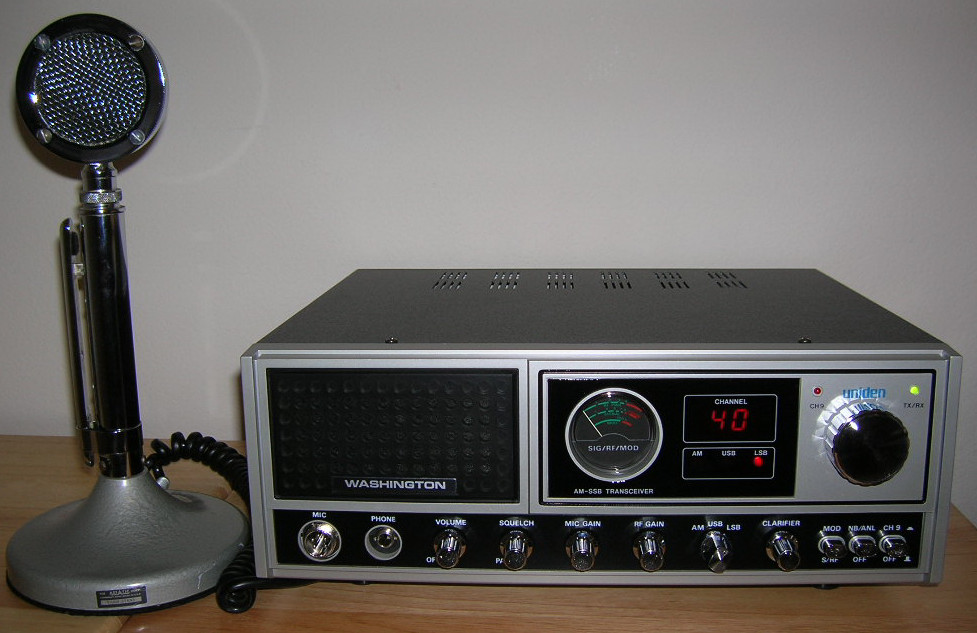
Equipment ranges from compact handheld transceivers to mobile units for vehicles and fixed base stations. Most consumer CB radios provide amplitude modulation (AM); many modern units also offer single-sideband (SSB) and, in some places, frequency modulation (FM). National rules set limits on transmitter power, antenna types, and permissible modifications to reduce interference and preserve shared use. For summaries of technical limits see technical guidance.
- Channels: A commonly recognized 40-channel plan is used in many countries, though numbering and allocations can vary; consult the local band plan.
- Range: Typical communications are local—normally a few kilometers—dependent on antenna height, terrain, and power; occasional ionospheric effects can extend reach significantly. See propagation notes.
- Equipment: Handhelds, mobile units, and fixed stations differ mainly by antenna and power; illegal amplifiers or unapproved modifications are often prohibited.
- Operation: Channels are shared on a half-duplex basis, so only one station transmits at a time; standard practices help manage access.
History and regulation
CB-style services developed during the 20th century when regulators set aside low-power voice channels for public use. Rules have evolved: some administrations permit license-free use within technical limits, while others require simple registration or a license. National authorities publish the detailed regulations and enforcement policies—check local regulatory information before operating.
Uses, etiquette and examples
CB has been widely used for road transport coordination, local business communications, neighborhood and recreational use, and as an auxiliary means of contacting help in emergencies. Informal conventions—such as announcing "break" to request access to a busy channel and keeping certain channels clear for assistance—help users coexist. In some regions particular channels are traditionally used by truckers or for traveler information; consult local guidance on operating etiquette and the designated emergency channel.
Distinctions and notable facts
CB remains valued where simple, resilient short-range voice links are useful or where cellular service is limited. It is inexpensive, requires little training in many places, and supports spontaneous community networks. While modern telecommunications have reduced some practical dependence on CB, hobbyists, rural users, and certain professional communities continue to use it for immediate, local coordination and as a backup communications method.
Questions and answers
Q: What is Citizens band radio?
A: Citizens band radio is a system of short-distance radio communications between individuals on 40 channels within the 27 MHz (11 m) band in many countries.
Q: How does Citizens band radio differ from Amateur Radio Service ("ham" radio)?
A: Citizens band radio is not the same as the Amateur Radio Service ("ham" radio) as it has a much shorter range.
Q: Is a license required to operate a citizens band radio in many countries?
A: In many countries, CB operation does not require a license to operate.
Q: What can citizens band radio be used for?
A: Citizens band radio may be used for business or personal communications.
Q: How are citizens band channels shared by users?
A: Like many other two-way radio services, citizens band channels are shared by many users. Only one station may transmit at a time. All other stations must listen and wait for the shared channel to be available.
Q: What is the customary way for stations waiting to use a shared channel to communicate?
A: It is customary for stations waiting to use a shared channel to broadcast the single word "break" (or "breaker") during a lull in the conversation. This lets other people using the channel know that others are waiting.
Q: What are the reserved channels for emergencies and which channel is most often used by truckers in the US?
A: In the US, channel 19 is most often used by truckers. Channel 9 is reserved for emergencies.
Related articles
Author
AlegsaOnline.com Citizens band radio (CB radio): overview, operation, and uses Leandro Alegsa
URL: https://en.alegsaonline.com/art/20504
Sources
- retrocom.com : retrocom.com/wtcollect/27_megacycle_history_in_the_u.htm
- newsmax.com : "What is a CB Radio?"
- wearecb.com : "CB Radio Frequencies & Channels"
- fourwheeler.com : "An Off-Road Driver's Guide to Cb Radios"