
Circuit breaker (electrical)
A circuit breaker is a resettable electrical safety device that interrupts current flow on overloads or faults. This article explains its parts, operation, history, uses, and how it differs from a fuse.
Overview
A circuit breaker is a mechanical or electronic switch designed to automatically stop the flow of electric current when that current exceeds a safe level. Circuit breakers protect wiring and equipment from damage and reduce the risk of fire or electric shock by interrupting abnormal currents such as overloads and short circuits. They are commonly mounted in electrical panels in homes, commercial buildings and industrial installations.
Image gallery
10 Images

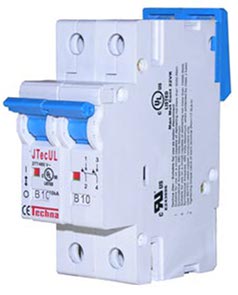


Design and main components
Although designs vary, most circuit breakers share several fundamental parts: fixed and movable electrical contacts, an arc-quenching mechanism, a trip device, and an operating handle. Trip devices can be mechanical (thermal and magnetic) or electronic. Common internal elements include an electromagnetic coil that responds to sudden high currents and a bimetal strip that bends with sustained heating to trip the mechanism. Specialized features such as ground-fault or arc-fault protection are also available.
How it works
There are two principal ways a breaker senses a problem. A magnetic element reacts almost instantaneously to very large surges produced by a short circuit, using a coil to pull the mechanism open. A thermal element reacts to prolonged overcurrent by heating a bimetal strip until it bends and trips. Many modern breakers use electronic trip units that monitor current with sensors and open the circuit based on programmed thresholds and time delays. Some units combine protection types and include residual-current detection for personal safety.
History and development
Circuit breakers evolved as electrical distribution systems expanded in the late 19th and early 20th centuries. Early protection relied on fuses, but breakers became widespread because they can be reset after a fault without replacing parts. Over time the technology advanced from simple thermal or magnetic designs to sophisticated digital trip units that offer adjustable settings, diagnostics and communication for large installations.
Uses, ratings and practical points
Breakers are specified by current and voltage ratings and by their interrupting capacity — the maximum fault current they can safely interrupt. They are used in residential panels, motor control centers, distribution boards and switchgear. Routine maintenance includes checking for worn handles, corroded connections and correct sizing. In many cases a breaker can be reset after tripping, but extreme events such as a very high-current fault or a lightning strike can damage internal parts and require replacement; for example, a surge caused by lightning may degrade its ability to interrupt future faults.
Comparison and notable distinctions
- Resettable vs replaceable: Unlike a fuse, a typical breaker can be reset after it trips, making it convenient for routine overloads.
- Response types: Thermal elements handle long-duration overloads; magnetic elements respond to instantaneous faults; electronic trip units offer precise control.
- Special protections: Ground-fault and arc-fault breakers add person-safety and fire-prevention functions beyond basic overcurrent protection.
- Installation: Breakers are installed in panels and must match the electrical circuit's voltage and current requirements and the enclosure's standards.
Further reading and standards
For technical specifications, installation guidance and safety standards consult product literature and national electrical codes. Manufacturers and standards bodies publish detailed information on selection, testing and ratings; for general background on electrical distribution and protection see resources on electrical circuits, trip device design like the switch and descriptions of modern electronic sensor implementations.
Questions and answers
Q: What is a circuit breaker?
A: A circuit breaker is a device designed to shut off an electrical circuit when too much current is flowing.
Q: What usually causes a circuit breaker to shut off?
A: Too many devices being plugged in or a short circuit usually causes a circuit breaker to shut off.
Q: Where are circuit breakers usually installed?
A: Circuit breakers are usually installed in the electrical panel.
Q: What is inside a circuit breaker?
A: There is usually an electromagnetic coil and a bimetal strip inside a circuit breaker.
Q: What happens to the switch inside a circuit breaker when too much current flows through the electromagnetic coil?
A: It pulls on the switch, shutting the power off.
Q: How does the bimetal strip in a circuit breaker work?
A: It will bend and pull on the switch if it gets too hot, reacting to extended periods of too much current.
Q: What is the difference between a circuit breaker and a fuse?
A: A circuit breaker does the same job as a fuse, but a circuit breaker does not need to be replaced to be reset, except in severe cases such as very high-current short circuits and lightning strikes that may damage the circuit breaker.
Related articles
Author
AlegsaOnline.com Circuit breaker (electrical) Leandro Alegsa
URL: https://en.alegsaonline.com/art/20447