
Circle of fifths
A concise encyclopedia entry explaining the circle of fifths: its structure, musical meaning, uses in harmony and key relationships, historical background, and practical notes for performers and composers.
The circle of fifths is a graphic representation used in music theory to show how musical keys and key signatures relate. Arranged as a circle, each step clockwise moves to the key a perfect fifth above (for example, C to G), while each step counterclockwise moves to the key a perfect fifth below (or a fourth above). The diagram provides an immediate way to see closely related keys, common chords, and patterns of sharps and flats.
Image gallery
6 Images
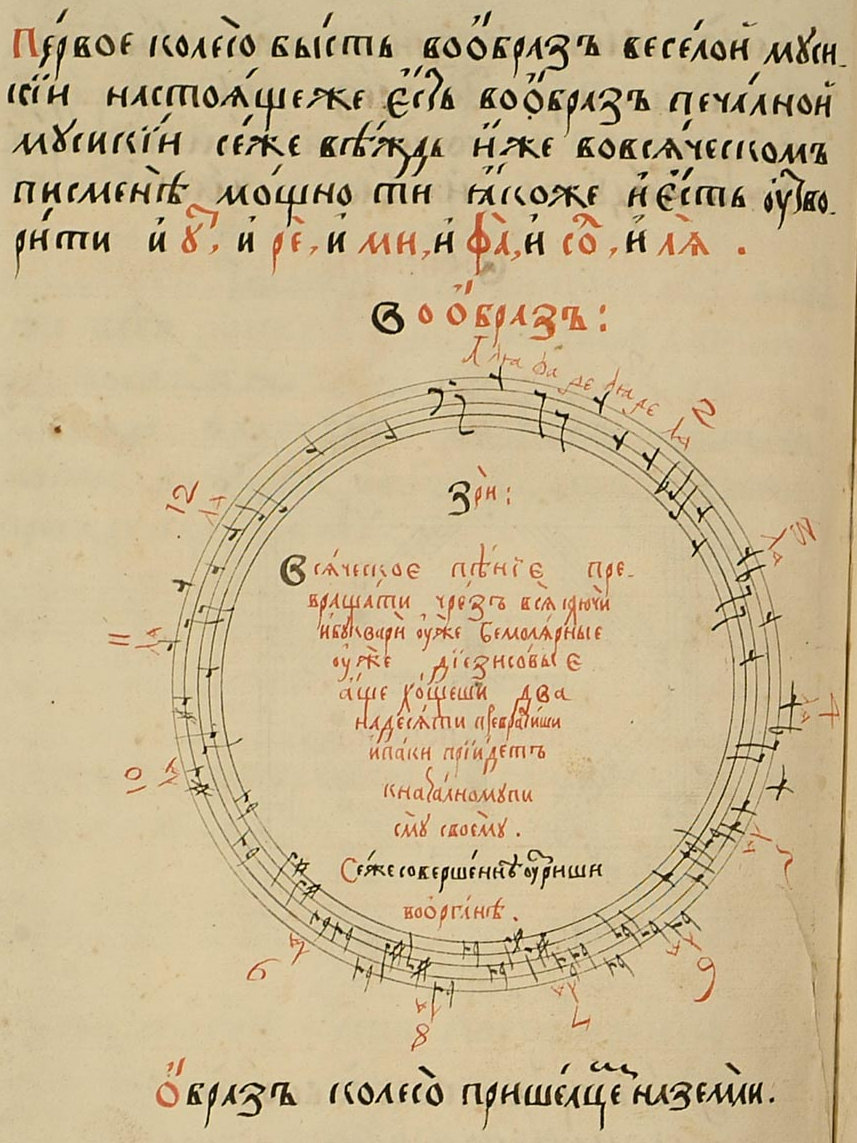


Structure and basic principles
At its simplest, the circle lists the twelve pitch classes around a wheel. Moving clockwise adds one sharp to the key signature per step; moving counterclockwise adds one flat per step. A perfect fifth spans seven semitones in equal temperament, so the progression around the circle follows that interval repeatedly. Many versions of the diagram show major keys on an outer ring and their relative minors on an inner ring, because each major key shares the same key signature with its relative minor.
How it is read and used
Practical reading of the circle helps musicians with transposition, key signature recall, and modulation planning. For example, starting at C major (no accidentals) the key immediately to the right is G major (one sharp) and to the left is F major (one flat). On a piano keyboard, these relationships correspond to familiar shifts in finger patterns and harmony. The diagram also highlights enharmonic equivalents — keys that sound the same in equal temperament but are written differently, such as F# and Gb.
Common applications
- Choosing likely modulations: composers often modulate to keys near the starting key on the circle because they share many tones.
- Harmonic progressions: progressions like ii–V–I move through adjacent sectors of the circle, reflecting closely related harmony.
- Learning and teaching: it is a memorization aid for key signatures and a quick reference for transposition and chord relationships.
History, theory and limitations
The idea behind the circle goes back to early studies of interval relationships and tuning systems; thinkers from Pythagorean tuning through later theorists explored fifth-based cycles. The visual circle became standard as tonal harmony developed in the common-practice period and was discussed by theorists such as Rameau. However, the circle is most exact in the context of equal temperament: in other tuning systems the enharmonic equivalences and the spacing of pitches differ, so the cycle does not close in the same way.
For performers and composers the circle remains a compact tool: it clarifies which keys are closely related, suggests efficient modulation routes, and makes key signature patterns transparent. While it simplifies many practical decisions, users should combine it with ear training and an awareness of tuning and stylistic context when applying it in performance or analysis.
Questions and answers
Q: What is the Circle of fifths in music theory?
A: The Circle of fifths is a tool in music theory that shows how the different keys are related to one another.
Q: How is the Circle of fifths usually represented?
A: The Circle of fifths is usually represented as a circle with the names of keys around it.
Q: What is the relationship between the keys in the Circle of fifths?
A: The keys in the Circle of fifths are related to one another by their distance of a fifth.
Q: What is a fifth in music theory?
A: In music theory, a fifth refers to the distance between two musical notes that are five notes apart from one another.
Q: What is the relationship between any key in the Circle of fifths and the key to its right?
A: The fifth of any key in the Circle of fifths is the key to its right.
Q: How can the Circle of fifths be easily understood together with a piano keyboard?
A: The Circle of fifths can be easily understood together with a piano keyboard by following the sequence of keys that are a fifth apart.
Q: What is the significance of the Circle of fifths in music theory?
A: The Circle of fifths is significant in music theory because it helps musicians understand the relationships between different keys and enables them to use this knowledge in composing music.
Tags
Related articles
Author
AlegsaOnline.com Circle of fifths Leandro Alegsa
URL: https://en.alegsaonline.com/art/20442