
Cinchona pubescens (quinine tree): description, range, uses and invasiveness
Cinchona pubescens, the quinine tree, is a South American species prized for bark alkaloids. This article covers its characteristics, native range, medicinal use, and invasive impact with control challenges.
Cinchona pubescens, commonly called the quinine tree, is a small to medium-sized tree valued historically for the quinine-rich bark used to make antimalarial treatments such as quinine. Extracts derived from species in the genus Cinchona have been used against malaria and related fevers. C. pubescens is one of several Cinchona species harvested for these alkaloids and is notable for its broad natural distribution and capacity to establish rapidly where introduced.
Image gallery
2 Images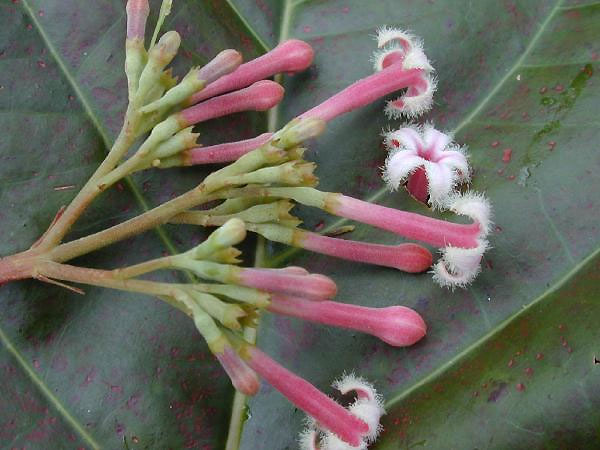

Characteristics
This species typically reaches around 10 metres in height in favorable conditions. It has a rough, fibrous bark that contains bitter alkaloids, opposite leaves, and clusters of small flowers that give way to numerous tiny seeds. C. pubescens reproduces both by seed and vegetatively through root suckers and resprouting from stumps, which contributes to its capacity to spread after disturbance.
- Growth habit: fast-growing tree with an open to dense canopy.
- Bark and chemistry: bark contains quinoline alkaloids used medicinally.
- Reproduction: produces many wind-dispersed seeds and spreads clonally.
Native range and habitat
C. pubescens is native to montane and foothill forests of tropical South America. Recorded native countries include Costa Rica, Venezuela, Ecuador, Peru and Bolivia. In parts of its range, such as Ecuador, it occurs across a wide elevational span—commonly reported from about 300 to 3,900 metres above sea level—reflecting its adaptability to different montane climates. Among Cinchona species it has one of the broadest distributions in its native region [distribution note].
Uses and historical importance
The best-known use of Cinchona species is the extraction of quinine-type alkaloids from the bark for use as antimalarial drugs. While synthetic and semi-synthetic medicines have largely supplanted crude bark extracts in modern clinical practice, cinchona bark played a pivotal role in the history of tropical medicine and colonial-era pharmacology. C. pubescens was planted in several regions outside its native range as a crop to supply bark for these substances.
Introductions, invasive behavior and ecological impact
When introduced to islands and some other tropical landscapes for cultivation, C. pubescens has become an aggressive invader in multiple locations. Reports indicate it has naturalized and spread on various islands after planting [introduced elsewhere]. In the Galápagos, trees were planted as a quinine crop and later became widespread on islands such as Santa Cruz where they can form dense stands. It has also been recorded as invasive in parts of Hawaii, including on Maui and the Big Island.
Management and control challenges
Controlling established populations is difficult because C. pubescens resprouts from stumps and root fragments and tolerates many control attempts. Mechanical removal must be thorough to remove root systems; chemical methods sometimes fail to prevent resprouting. Management programs in sensitive conservation areas emphasize early detection, follow-up treatments and integrated strategies combining manual removal, herbicide application where appropriate, and ongoing monitoring. Organizations that work in invaded regions have estimated that comprehensive control across large invaded islands would require sustained investment and effort.
Distinguishing C. pubescens from other Cinchona species—such as C. officinalis used for similar medicinal purposes—relies on morphological characters and, increasingly, on genetic methods when precise identification is needed for conservation, trade regulation, or pharmacological sourcing.
Further reading and regional reports can provide locality-specific guidance on identification and control approaches; readers may consult linked resources for more detail on chemistry, native range and management methods.
Questions and answers
Q: What is Cinchona pubescens?
A: Cinchona pubescens is a type of tree known for having a high content of quinine in its bark. It is used for making quinine, which is used in the treatment of malaria.
Q: Where is Cinchona pubescens native to?
A: Cinchona pubescens is native to several countries in South America, including Costa Rica, Venezuela, Ecuador, Peru, and Bolivia.
Q: What is the height of Cinchona pubescens?
A: Cinchona pubescens can grow up to around 10 meters in height.
Q: What is the main reason for the invasive spread of Cinchona pubescens?
A: The main reason for the invasive spread of Cinchona pubescens is its ability to grow quickly and spread by both seeds and root suckers. The shade it creates also prevents other plants from growing.
Q: Where has Cinchona pubescens become an invasive species?
A: Cinchona pubescens has become an invasive species in several places, including tropical islands where it has been planted as a crop for quinine, such as the Galapagos Islands and Hawaii.
Q: How is Cinchona pubescens controlled in the Galapagos National Park?
A: Attempts have been made to control Cinchona pubescens in the Galapagos National Park using a variety of methods. However, it is not affected by many poisons and can regrow from a stump or piece of root left in the ground.
Q: How much would it cost to control Cinchona pubescens over all of Santa Cruz Island?
A: According to research by the Charles Darwin Foundation, controlling Cinchona pubescens over all of Santa Cruz Island would cost several million US dollars.
Related articles
Author
AlegsaOnline.com Cinchona pubescens (quinine tree): description, range, uses and invasiveness Leandro Alegsa
URL: https://en.alegsaonline.com/art/20386
Sources
- mobot.org : "Medicinal Plants at the Missouri Botanical Garden"
- issg.org : "issg Database: Ecology of Cinchona pubescens"
- hear.org : "Cinchona pubescens (PIER species info)"
- species.wikimedia.org : Cinchona pubescens