
Cimabue: Florentine painter bridging Byzantine tradition and early naturalism
Cimabue (c.1240–c.1302), born Cenni di Pepo, was a Florentine painter whose work moved Italian art from Byzantine conventions toward greater naturalism and influenced later Renaissance masters.
Cimabue is one of the most important figures in late 13th-century Italian painting. Born around 1240 and usually identified as Cenni di Pepo (sometimes spelled Cenni di Pepi), he worked in and around Florence and elsewhere in Italy during the Late Medieval period. Traditionally described as the first great Florentine painter, Cimabue is credited with producing large-scale devotional images in the Byzantine manner while introducing more lifelike proportions and expressions that anticipate the innovations of the following century.
Image gallery
10 Images


Life and historical context
Documentary evidence for Cimabue’s life is scarce, and many attributions remain debated. He is known to have worked on commissions for major churches and cathedrals, often creating icons, altarpieces and monumental crucifixes. Contemporary chronicles are limited, and much of what became common knowledge about him derives from later accounts such as those by the biographer Giorgio Vasari. Vasari’s stories — including an anecdote about Cimabue discovering a talented shepherd boy, Giotto — are vivid but must be treated cautiously as they were written roughly two and a half centuries after Cimabue’s lifetime.
Style, materials and techniques
Cimabue worked primarily in traditional media for his time: egg tempera on wooden panels, gilded backgrounds, large-scale fresco and mosaic. His stylistic roots are in the Eastern Christian or Byzantine idiom of gold grounds, frontal figures and iconographic types, yet he introduced greater volume, softer modeling of faces and a tentative use of perspective cues. These adjustments made figures appear more corporeal and emotionally present when compared with the flatter, more stylized icons of earlier decades.
Major works and attributions
Only a small number of works are widely accepted as autograph, and many paintings historically linked to his name are now assigned to workshop members or followers. Notable works associated with Cimabue include:
- The mosaic of Christ in Majesty in Pisa Cathedral, one of the few works commonly accepted as his.
- Large fresco cycles in the Basilica of San Francesco in Assisi attributed to him or to his workshop; today several are fragmentary and heavily restored (fresco fragments).
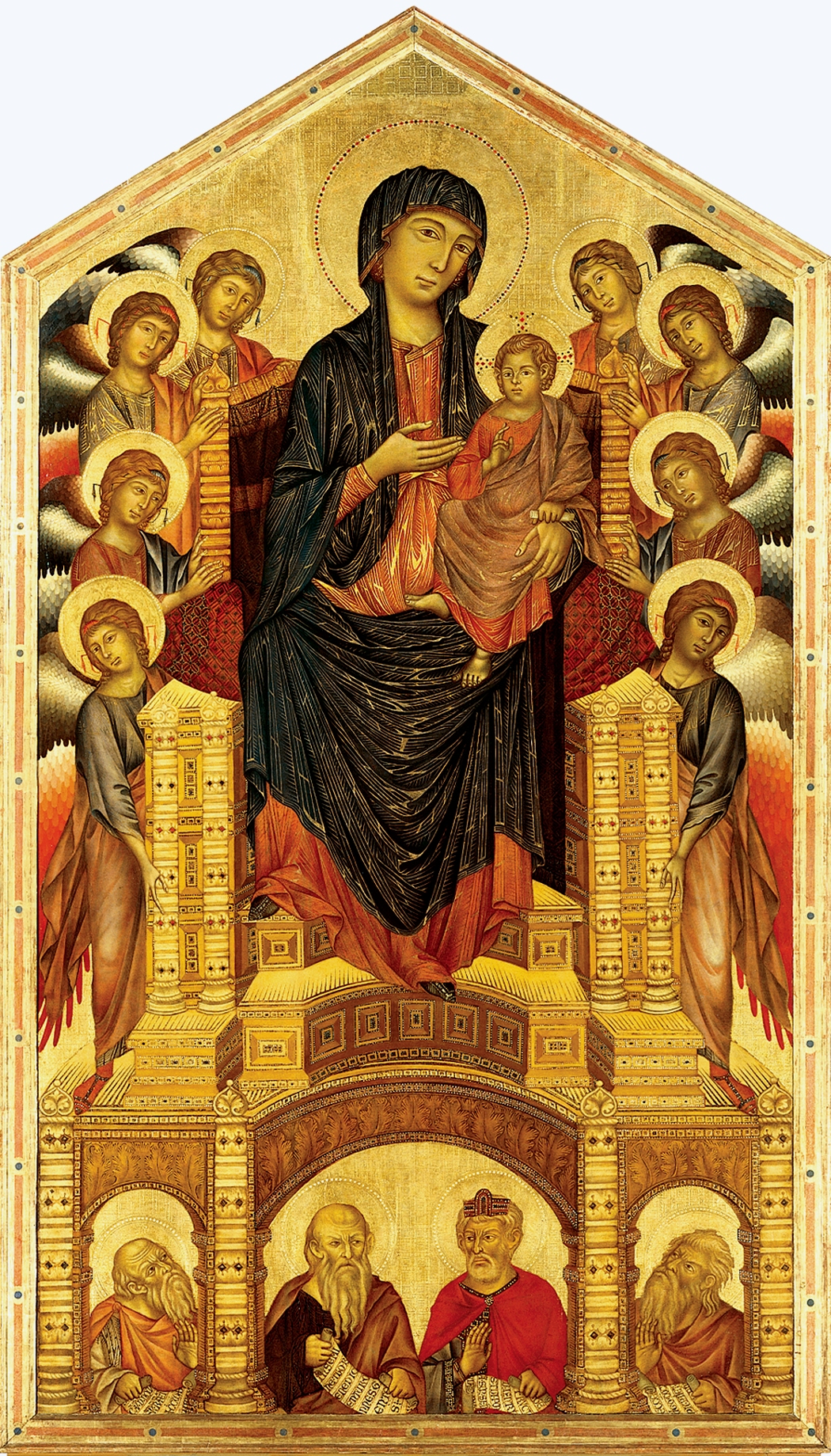
- The Madonna of Santa Trinita, an altarpiece long attributed to him and now in the Uffizi Gallery in Florence; considered an important example of his move toward greater naturalism.
- Two celebrated crucifixes once displayed in the church of San Domenico in Arezzo and in Santa Croce in Florence; the latter was severely damaged in the 1966 flood and is preserved in the church museum.
Legacy and significance
Cimabue occupies a transitional place in the history of Italian art. Working within the long-established Byzantine tradition of sacred imagery, he introduced subtler modeling and a stronger sense of human presence that helped to open a path toward the naturalism later associated with Renaissance painting. Whether or not the story of his mentorship of Giotto is literally true, the narrative captures the idea that Cimabue’s generation prepared the ground for the dramatic changes of the 14th century. Modern scholarship continues to reassess attributions and the chronology of works, using technical analysis and archival research to refine our understanding of Cimabue’s workshop and influence.
Further reading and research
For readers interested in learning more about Cimabue’s life and works, museum catalogues and specialised monographs remain the best sources. General histories of medieval and early Renaissance art place his career in the broader story of Italian painting’s evolution from the medieval to the pre-modern era. Selected resources and exhibition catalogues can be found through major institutions and academic publications (icons and panels, scholarly reviews at repositories noted by museums at conservation reports and archival studies in regional archives like those of Florence and Italy).
The historical image of Cimabue — both a master of Byzantine iconography and a forerunner of more observational painting — remains central to discussions about the origins of Italian naturalism and the emergence of the Renaissance.
Questions and answers
Q: Who was Cimabue?
A: Cimabue (c.1240 - c.1302) was a painter from Florence in Italy who worked in the Late Medieval period. His real name was Cenni di Peppi.
Q: What works of art are known to be definitely by Cimabue?
A: The only works of art that are known to be definitely by Cimabue are the mosaic of Christ in Majesty in Pisa Cathedral and two very large ruined frescos in the Church of St Francis in Assisi.
Q: What is the most famous painting believed to be by Cimabue?
A: The most famous painting that is believed to be by Cimabue is the "Madonna of Santa Trinita" which is an altarpiece that was done for the Church of the Holy Trinity. It is now in the Uffizi Gallery in Florence.
Q: Where were two large crucifixes painted by him hung?
A: Two large crucifixes painted by him hung in the Church of St Domenic in Arezzo and the Church of the Holy Cross (Santa Croce, Florence). The crucifix of Santa Croce was ruined in a flood and is now in the church's museum.
Q: Who wrote about Cimabue's life 250 years after his death?
A: Giorgio Vasari wrote about Cimabue's life, 250 years after his death.
Q: How did he discover Giotto as an apprentice?
A: According to Giorgio Vasari, one day while walking through countryside, he saw a little shepherd boy scratching a picture of a sheep onto a rock and it impressed him so much that he went to boy’s father and asked if he could take him as his apprentice and teach him how to paint . This boy turned out to be Giotto who became very famous painter later on and considered as first Italian Renaissance painter .
Related articles
Author
AlegsaOnline.com Cimabue: Florentine painter bridging Byzantine tradition and early naturalism Leandro Alegsa
URL: https://en.alegsaonline.com/art/20376