
Chord progression (music): structure, common patterns, and uses
A chord progression is an ordered sequence of chords that defines harmony and movement in music. This article outlines its structure, common patterns, history, and practical uses in songwriting and arrangement.
Overview
A chord progression is a sequence of two or more chords played in succession that shapes the harmonic framework of a piece of music. Progressions create a sense of movement, contrast and resolution by combining chords that relate to a key or mode. They are a fundamental element for composers, songwriters and performers because they establish the tonal center and emotional direction of a passage. For general context about music, see music.
Image gallery
3 Images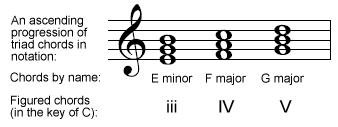

Components and characteristics
Each chord in a progression serves a function: for example, chords commonly act as tonic (rest), dominant (tension), or subdominant (preparation). Progressions can be described with chord names, scale degrees, or Roman numerals, and they often rely on voice-leading rules that make transitions smooth. Instruments that commonly realize chord progressions include piano and guitars; for practical playing on fretted instruments see guitar resources. Chords as individual building blocks are discussed in more detail at chords.
Common patterns and examples
Certain sequences recur throughout many styles because of how they balance tension and release. Examples include:
- I–IV–V: foundational in early popular, folk and blues-based songs.
- I–vi–IV–V: very common in 20th-century pop and doo-wop styles.
- ii–V–I: the core turnaround in jazz harmony, especially for modulation and cadence.
Each example can be transposed to any key and can be varied by adding sevenths, suspensions, or substitutions to change color and sophistication.
History and development
Western chord progressions evolved alongside tonal harmony from the Baroque into the Classical and Romantic eras, with later popular and jazz traditions adapting and extending those patterns. The notion of functional harmony—chords serving tonic, dominant and subdominant roles—became a principal organizing idea in the 18th and 19th centuries and remains influential in many modern genres.
Uses and importance
Songwriters and arrangers use progressions to support melodies, create contrast between sections (verse/chorus/bridge), and drive emotional arcs. Musicians who play chordal instruments, or who need to lead a group, often rely on progressions to outline form and guide improvisation; see resources for performers and educators at musical instruments and songwriting.
Notable distinctions
Not all music is built on Western functional progressions: modal music, some folk traditions, and modern ambient or electronic styles may emphasize static chords, drones or non-functional movement instead. In addition, modern composers and producers frequently borrow, invert or substitute chords to blur traditional functions and create novel harmonic textures.
Understanding chord progressions gives performers and creators tools to shape harmony, support melody, and communicate musical ideas across many genres.
Questions and answers
Q: What is a chord progression?
A: A chord progression is a sequence of chords played one after another in a piece of music.
Q: Why are chord progressions important?
A: Chord progressions are important for people who write songs or play musical instruments that can play chords, such as the guitar. They help provide structure and harmony to a piece of music.
Q: What types of music use chord progressions?
A: Chord progressions are used in many types of music, including pop, rock, blues, jazz, and classical.
Q: What role does a chord progression play in how a piece of music sounds?
A: The chord progression can affect how a piece of music sounds, including the mood, tone, and overall feeling conveyed by the music.
Q: Can a chord progression be a part of a single chord?
A: No, a chord progression is comprised of multiple chords played in a sequence, not a single chord.
Q: Are chord progressions limited to just guitar music?
A: No, chord progressions are used in many different types of music, played on a variety of instruments that can play chords, not just the guitar.
Q: How can someone learn about chord progressions?
A: Someone can learn about chord progressions through music theory courses, instructional videos, or getting guidance from a music teacher. They can also study chord charts and analyze existing songs to see how chord progressions are used in music.
Related articles
Author
AlegsaOnline.com Chord progression (music): structure, common patterns, and uses Leandro Alegsa
URL: https://en.alegsaonline.com/art/19975