
Choanoflagellates: collar-bearing unicellular and colonial eukaryotes
Choanoflagellates are microscopic, collar-bearing flagellates—single cells or colonies—that feed on bacteria and occupy a key evolutionary position as the closest relatives of animals.
Choanoflagellates are tiny, free-living organisms characterised by a single beating flagellum surrounded by a collar of microvilli. They are microscopic eukaryotes that capture bacteria and particulate food with the collar and then ingest it by phagocytosis. Some species exist as solitary cells while others form simple multicellular colonies; none possess chloroplasts and all are heterotrophic, obtaining energy and carbon by consuming other organisms rather than by photosynthesis.
Image gallery
10 Images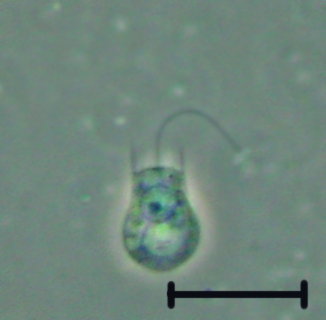





Morphology and feeding
The defining structure of a choanoflagellate is the collar of actin-supported microvilli that surrounds the flagellum. The flagellum generates a current that draws water and suspended bacteria toward the collar; particles are trapped and phagocytosed. This combination of a beating flagellum and a protein-lined collar distinguishes choanoflagellates from many other protists and gives them their common name as a flagellate group. Their cell body typically contains a nucleus, mitochondria and other organelles typical of opisthokont cells.
Classification and relationship to animals
Taxonomists have treated choanoflagellates variably as a class or as a distinct phylum, and they are often discussed under different higher-level schemes of classification. Molecular phylogenetic studies place choanoflagellates as the closest living relatives of multicellular animals, which makes them central to studies of the origin of animal multicellularity. Historically they have also been grouped with other single-celled organisms called protists, reflecting debates about whether they should be considered the simplest animals or remain in a protist assemblage.
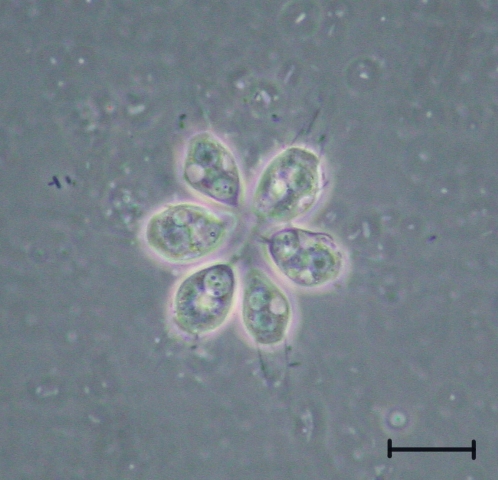
Choanoflagellates inhabit marine and freshwater environments worldwide. In these habitats they act as important grazers on bacteria and small particulate matter, influencing microbial food webs and nutrient cycling. Some form simple rosette-like colonies that may aid feeding efficiency or provide other ecological advantages. Because of their ecological role, they are frequently sampled in plankton surveys and studied in laboratory cultures.
Researchers study choanoflagellates to understand early steps in animal evolution. Genome and transcriptome sequencing have revealed genes shared with animals that relate to cell adhesion, signaling and extracellular matrix—components key to multicellularity. Laboratory species can be cultured and manipulated, making them useful model organisms for testing hypotheses about how single cells evolved coordinated multicellular life.
Key features and notable facts
- Distinctive collar of microvilli plus a single apical flagellum for feeding and locomotion.
- No photosynthetic organelles: absence of chloroplasts makes them obligate consumers, i.e. heterotrophic.
- Phylogenetic position as the sister group to animals highlights their evolutionary importance.
- Debated rank in biological classification—treated as a class or a phylum in different systems.
- Often cited in comparisons with animal choanocytes (sponge feeding cells) because of structural similarity.
For overviews and taxonomic resources see general references and databases via links to classification pages and specialist reviews (flagellate studies, eukaryote resources). Choanoflagellates continue to be a focal group for work at the intersection of cell biology, ecology and evolutionary biology.
Questions and answers
Q: What is a choanoflagellate?
A: A choanoflagellate is a type of microscopic flagellate eukaryote that can be either single-celled or multicellular.
Q: Do choanoflagellates have chloroplasts?
A: No, choanoflagellates do not have chloroplasts.
Q: What is the diet of choanoflagellates?
A: Choanoflagellates are heterotrophic, meaning they obtain their nutrients by consuming other organisms.
Q: Are choanoflagellates considered animals?
A: Some scientists consider choanoflagellates to be the simplest phylum of animals, while others classify them as protists.
Q: How do choanoflagellates move?
A: Choanoflagellates move using a flagellum, a long whip-like appendage.
Q: Are all choanoflagellates multicellular?
A: No, some choanoflagellates are single-celled while others are multicellular.
Q: What is a unique feature of choanoflagellates?
A: A unique feature of choanoflagellates is the presence of a collar-like ring, which helps them capture food particles.
Related articles
Author
AlegsaOnline.com Choanoflagellates: collar-bearing unicellular and colonial eukaryotes Leandro Alegsa
URL: https://en.alegsaonline.com/art/19908
Sources
- pnas.org : "Estimating the timing of early eukaryotic diversification with multigene molecular clocks"
- doi.org : 10.1073/pnas.1110633108
- ncbi.nlm.nih.gov : 3158185
- pubmed.ncbi.nlm.nih.gov : 21810989
- cambridge.org : The choanoflagellates : evolution, biology, and ecology · archive.org
- doi.org : 10.1111/j.1550-7408.2011.00572.x