
Chipping Campden — Cotswold market town in Gloucestershire
Historic Cotswold market town noted for its long honey‑coloured High Street, early 17th‑century Market Hall, medieval market origins, Arts and Crafts legacy and well‑preserved stone architecture.
Overview
Chipping Campden is a small historic market town set in the rolling limestone landscape of the Cotswolds. Situated in the county of Gloucestershire, in England, the town is best known for a long, gently sloping High Street lined with continuous rows of warm, honey‑coloured Cotswold stone houses, inns and civic buildings. Over many centuries the town served as a local centre for farming, trade and craft industries and it continues to attract visitors for its atmosphere, shops and walking routes nearby.
Image gallery
9 Images



Origins and history
The prefix "Chipping" comes from an Old English word for market, reflecting the settlement's medieval origins as a market place. Market activity was a central part of the town's economy through the medieval and early modern periods, with the wool trade especially important when English wool underpinned much local prosperity. In the early 17th century a timber‑framed and stone Market Hall was erected in the centre of the High Street to shelter traders and their goods; the building remains one of Chipping Campden's most recognisable landmarks.
Architecture and townscape
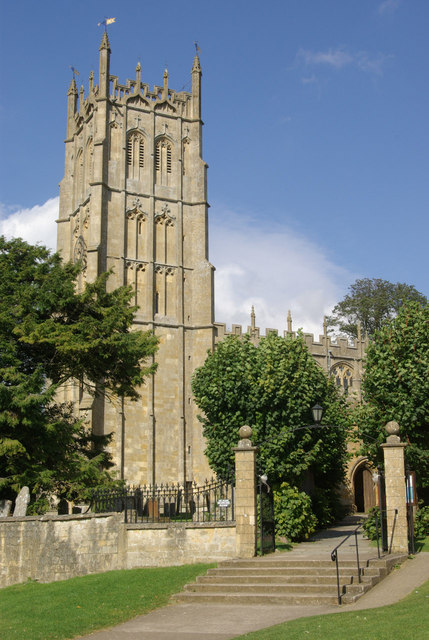
Chipping Campden's visual cohesion comes from the widespread use of locally quarried limestone, traditional proportions and long building frontages that follow the High Street. Surviving medieval and later structures include the Market Hall, a substantial parish church with medieval roots and a mix of domestic buildings, some with timber frames or mullioned windows. The town is largely a designated conservation area and careful repair and reuse of historic fabric help preserve its character.
Arts, crafts and community
In the early 20th century the town acquired new cultural significance as a focus for the Arts and Crafts movement when a small community of designers and craftsmen moved to the area to revive handcraft traditions. Workshops and studios produced metalwork, furniture and textiles inspired by local materials and forms. Today Chipping Campden supports artisans, galleries and specialist shops, and its calendar often includes craft fairs, exhibitions and local events that reflect this continuing tradition. Historically the prosperity of the town was closely linked to the regional wool industry and sheep farming on surrounding pastures.
Visiting and significance
Visitors come for the High Street, independent shops, traditional inns and nearby walking routes, including routes that run close to the town and link to broader Cotswold footpaths. Local conservation policies, community stewardship and a steady interest in heritage tourism have helped retain the town's historic appearance while supporting small businesses and residential life. Nearby are parks, formal gardens and country estates that add to the area's appeal for day visitors and longer stays.
Notable points
- "Chipping" denotes the town's long role as a market centre.
- The Market Hall is an early 17th‑century shelter and town focal point.
- Chipping Campden was associated with the Arts and Crafts movement in the early 20th century.
- The town exemplifies the traditional use of Cotswold limestone and strong conservation practice.
For practical information and local resources, consult town guides, conservation listings and regional histories of the Cotswolds or Gloucestershire. General visitor information and community pages can be found through local tourism services and historical societies focused on Chipping Campden and the surrounding region in England.
Questions and answers
Q: Where is Chipping Campden located?
A: Chipping Campden is located in the Cotswolds area in Gloucestershire, England.
Q: What is Chipping Campden famous for?
A: Chipping Campden is famous for its High Street, which has many very old buildings, including one that was built almost 400 years ago.
Q: What is the name of the building that is almost 400 years old in Chipping Campden?
A: The name of the building that is almost 400 years old in Chipping Campden is called the Market Hall.
Q: What did people sell in the Market Hall in Chipping Campden?
A: People used to sell things in the Market Hall in Chipping Campden, including wool from sheep which were, and still are, raised on farms in the area.
Q: What type of farming is common in Chipping Campden?
A: Sheep farming is common in Chipping Campden.
Q: How old are some of the buildings in the High Street of Chipping Campden?
A: Some of the buildings in the High Street of Chipping Campden are very old, built almost 400 years ago.
Q: What is the significance of wool in relation to Chipping Campden?
A: Wool from sheep raised on farms in Chipping Campden used to be sold in the Market Hall and was an important part of the town's history and economy.
Related articles
Author
AlegsaOnline.com Chipping Campden — Cotswold market town in Gloucestershire Leandro Alegsa
URL: https://en.alegsaonline.com/art/19819