
Chinchillidae: chinchillas, viscachas and their relatives
Chinchillidae is a family of South American rodents including chinchillas and viscachas. This article summarizes their anatomy, behaviour, distribution, taxonomy, fossil record, human uses and conservation status.
The family Chinchillidae comprises a distinctive group of medium‑to‑large hystricomorph rodents that includes the familiar chinchillas and several kinds of viscachas, together with a number of extinct relatives known from the fossil record (fossil relatives). Chinchillids are native to southern and western South America and are often associated with open, rocky or high‑elevation habitats such as the Andes. They are members of the larger order of rodents and are notable for their dense pelage, compact bodies and strong hind limbs.
Image gallery
3 Images
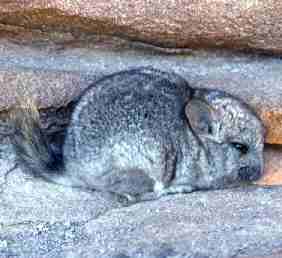

Key characteristics
- Size and build: body mass ranges broadly, from roughly 800 grams in smaller species to several kilograms in the largest; they possess robust hind legs adapted for hopping and short bursts of running.
- Fur and integument: all species have thick, soft fur that insulates against cold and wind; this fur has been a major factor in human exploitation and captive breeding.
- Senses and dentition: chinchillids have relatively large ears and well‑developed incisors and cheek teeth typical of herbivorous rodents, adapted to processing coarse plant material.
- Tails and locomotion: tail length and form vary between taxa and relate to balance and social signalling; some viscachas have long bushy tails while true chinchillas tend to have shorter tails.
Distribution and habitat
Chinchillids occupy a range of habitats in South America, from high Andean slopes to arid plateaus and temperate grasslands. Mountain species use rocky crevices and cliffs for refuge, while some plains‑dwelling viscachas construct extensive burrow systems. Elevation, climate and local vegetation influence their distribution and local abundance.
Ecology and behaviour
Diet is primarily herbivorous, consisting of grasses, seeds, bark and other plant material. Activity patterns and social organisation vary by species: some form large, colonial aggregations with complex burrow networks, while others are more solitary or live in small family groups. Reproduction typically results in small litters of well‑developed young that receive extensive maternal care. Predators include birds of prey, canids and mustelids, and chinchillids rely on agility, crypsis and refuges to avoid predation.
Taxonomy and fossil record
The family includes several extant genera (for example the true chinchillas and the various viscachas) and a wider diversity of extinct forms known from Neogene deposits. Fossils show that chinchillid relatives were once more widespread and ecologically varied across South America; paleontological work continues to refine the group's evolutionary history (see fossil summaries).
Human use and conservation
Dense fur made some species highly valued in the past, motivating extensive hunting and contributing to steep population declines. Today, regulated farming and captive breeding supply pelts and maintain an international pet trade, but wild populations remain threatened by habitat loss, overexploitation and competition with introduced species. Conservation measures include habitat protection, anti‑poaching enforcement, and monitoring of populations; regional conservation summaries and management plans are available for many localities (regional overviews, Andean conservation).
Research into behavior, genetics and disease ecology continues to inform conservation priorities. For further general information about chinchillids and their place among South American mammals, consult specialist texts and faunal surveys (rodent references, fur industry history).
Questions and answers
Q: What animals belong to the Chinchillidae family?
A: The Chinchillidae family includes chinchillas, viscachas, and their fossil relatives.
Q: Where are Chinchillidae animals found?
A: Chinchillidae animals are restricted to southern and western South America, with many found in the Andes.
Q: What are some physical characteristics of Chinchillidae animals?
A: Chinchillidae animals have strong hind legs and large ears, and all species have thick, soft fur.
Q: How much do Chinchillidae animals typically weigh?
A: Chinchillidae animals can range in weight from 800 grams to 8 kilograms.
Q: Why is the fur of Chinchillidae animals considered valuable?
A: The fur of some Chinchillidae species is considered valuable.
Q: Are there any living Chinchillidae species?
A: Yes, chinchillas and viscachas are living Chinchillidae species.
Q: Where are Chinchillidae's fossil relatives found?
A: Chinchillidae's fossil relatives are found in southern and western South America.
Related articles
Author
AlegsaOnline.com Chinchillidae: chinchillas, viscachas and their relatives Leandro Alegsa
URL: https://en.alegsaonline.com/art/19744